

The Iranian war battlefield has acquired a second front—not in the Saudi desert or in the Red Sea, but across the negotiating table. The United States, having escalated operationally, is now escalating diplomatically. President Donald Trump, in a manner consistent with his transactional instincts to pursue maximum leverage, has introduced a hard deadline—March 28th—for Iran to agree to a framework that would:
Reopen the Strait of Hormuz to unrestricted energy flows
Cease missile and drone launches
Relinquish nuclear materials and dismantle enrichment capability
Failure to comply will trigger an expanded target set to include Iran’s critical energy infrastructure, including major power-generation facilities—assets that have thus far been largely avoided to prevent more pain to the general populace and preserve the necessary infrastructure for a new Iran. In effect, Trump has manufactured leverage the way he often does in markets: by compressing time and backing it up with unfettered power.
Markets Rally—Then Remember Reality
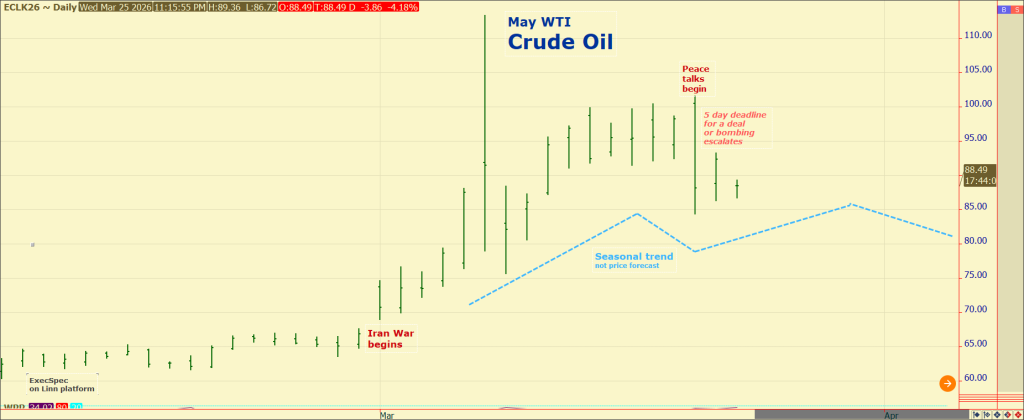
The market’s reaction to the news of potential peace talks with a decimated – yet radical – Iranian leadership was telling. For an hour or two, optimism prevailed. Oil collapsed. Equities surged. The possibility of a swift resolution of a war ending in agreement—briefly took hold. Then reality reasserted itself. Iran is not known for verifiable compromise. It is a regime that has historically mastered delay as strategy—stretching negotiations and conceding little. But who are the new leaders can be a hopeful question, given thorough allied targeting of the entire upper hierarchy. Yet, the US and its limited interceptor stockpile and fading patience of the voters, compel Trump to maintain a short leash. The US, Israel and Iran will continue exchanging blows while talks proceed until this weekend.
Markets have adopted skeptical suspension. Not panic. Not relief.
But watchfulness.
The Constraint Beneath the Negotiation
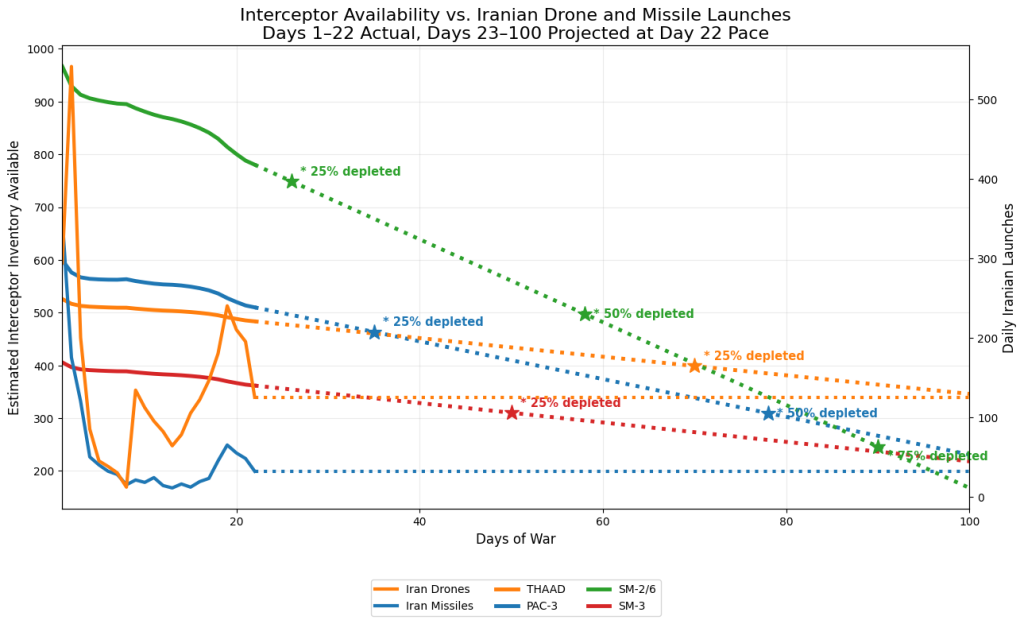
The urgency behind the March 28th deadline is not merely political. It is logistical. As outlined in our prior analysis—and now visualized in the accompanying chart—the United States and its allies are engaged in a quiet but consequential contest: the depletion of interceptor inventories.
Through Day 22, modeled consumption suggests:
~152 PAC-3 interceptors expended
~57 THAAD interceptors
~228 SM-2/6 systems
~57 SM-3 interceptors
Even with an assumed 15% increase in March production, the conclusion remains unchanged: The rate of consumption exceeds the rate of replenishment. This is not yet a crisis. But it is a trajectory with a finite level. There is evidence that more missiles and drones are penetrating certain zones that have low supplies of interceptors. The US will not run dry, but to maintain a stockpile distributed around the globe, there may only be a month or two of salvos exchanged at the current pace before the drones and missiles more effectively penetrate increasingly depleted allied resources. Our chart uses prewar ammunition levels and usage rates published in the first few days of the war and projected forward in proportion to the reported daily drone and missile launches by Iran. US global stockpiles were already 75% below ideal levels before the war began. A further depletion of this inventory by 50% in various interceptor systems – by late April to late May we estimate – would leave US global stockpiles at rouhgly 12% of targeted safety levels needed to fight a two front war. In other words, the war can continue apace with Iran, but the ability to defend will diminish rapidly over the next two months and should there be a new front to the war – such as with Yemen in the red Sea or anywhere else in the world or if Iran can somehow increase its rate of fire – the US would have an unusually limited capacity to engage and defend.
*Interceptor levels on Left edge of chart when war began represents a 25% readiness level of defensive weapons needed
Why Time Is No Longer Iran’s Ally
Iran’s strategic advantage has traditionally been patience. It delays while its adversaries fatigue. But this war has inverted that equation.
The United States, facing:
Rising interceptor drawdowns
Escalating energy-market risk
Mounting pressure to reopen global shipping lanes
…cannot afford an open-ended negotiation.
The President’s ultimatum reflects this reality. It is not merely a negotiating tactic—it is a recognition that our US industrial base has limits in the short term. Iran may prefer to delay, as long as it can find drones to launch. The United States increasingly must push for resolution, while touting its unending military might.
Escalation as Negotiation
Thus, the paradox: escalation is not the alternative to negotiation—it is its instrument.
The expansion of targeting to include:
Power-generation infrastructure
Launch zones secured via special operations forces
Potential seizure of enriched uranium stockpiles
…is designed not simply to degrade capability, but to accelerate decision-making in Tehran. The message is unmistakable: What remains untouched can be touched. And time is now finite.
The Market’s Three Scenarios
The introduction of a deadline sharpens the market’s branching paths:
1. A Deal (or credible framework) by March 28
Oil retraces from $90–$100 into the $80s and evntually the $70s.
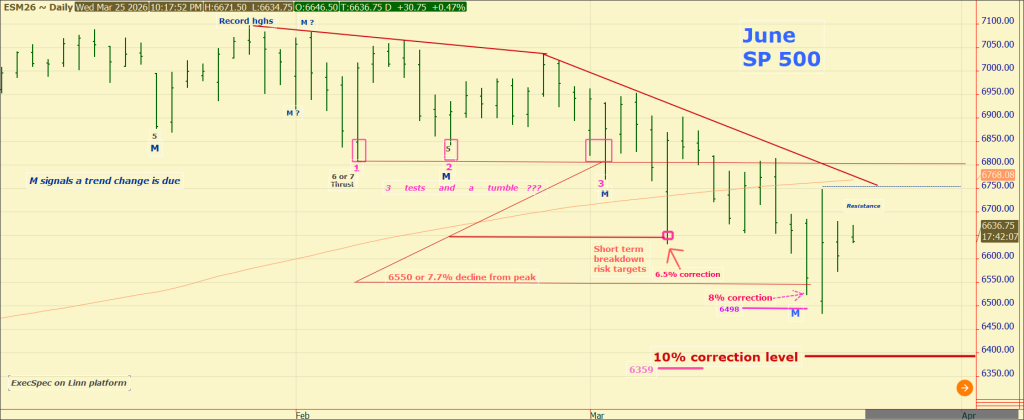
Equities stage a sharp relief rally.
Risk premiums compress.
2. A Partial Delay (talks continue, launches persist)
Markets drift in a holding pattern.
Oil trends higher toward low $100s
Equities grind lower as uncertainty lingers.
3. No Deal—Escalation Expands
U.S. targets Iranian energy infrastructure.
Red Sea risks rise if Houthi forces engage.
Pipeline vulnerability (Saudi/UAE 8.8 million b/d capacity) becomes central.
In this third scenario:
Oil likely exceeds $120
A pipeline disruption or new war front ould push prices toward $150+
The S&P 500 risks breaking below 6,000, with 5,700s plausible
Not because earnings collapse—but because multiples do. Yet, we expect a positive resolution when commerce through the Strait resumes its normal flow at some point in Q2.
The Illusion of Time in Markets
Markets often assume that time will smooth outcomes—that negotiations will extend, that escalation will plateau, that rationality will prevail. But wars are not earnings cycles. They are governed instead by capacity, constraint, and the sudden narrowing of options. The introduction of a deadline— backed by credible escalation—removes the market’s assumption that there is always more time, which supports the market’s reluctance to panic, assuming the outcome – good or bad – will be known soon.
Relief Rallies and the Storm Beyond
Oversold conditions are emerging. Momentum is deteriorating toward extremes, sentiment is close behind. These are the raw materials of a rebound when the fundamental narrative in Iran turns positive. But until one condition is met, such rallies will remain fleeting:
A sustained decline – or peace deal cessation – in daily Iranian missile and drone launches.
Absent that, any relief is tactical, not structural. With the benchmark indices stalled for almost 8 months, this correction can reach extreme oversold levels quickly from here.
Positioning: Liquidity as Discipline
The recommendation remains unchanged:
~50% cash allocation (>SP 6750=75% equity/25%cash: >6850=85% equity/15% cash)
Defensive hedges maintained
The bull market has not ended. But it has encountered a force it cannot model with precision. The President has set a deadline and given another of his famous investment edicts: Buy stocks, Sell oil -as he did after the Liberation Day tariff panic almost a year ago. The market has taken note—but not yet taken a position. Between now and March 28th lies a narrowing corridor of possibility: negotiation on one side, escalation on the other. And beneath both, the quiet, inexorable calculation of inventories—of missiles remaining, of barrels flowing, and time.


Comments
Log in or sign up to join the conversation.