


Angela and I love to travel.
It’s one of the things we promised ourselves we’d make more time for in this chapter of our lives. So, this week, that’s exactly what we’re doing.
But here’s what struck me as I looked around.
Plenty of people are still spending freely on trips like ours. And plenty of others have gone quiet.
The American consumer is splitting in two.
And that split happens to be one of the clearest investment signals on the board right now.
Let me show you what I mean.
The Two-Speed Economy
On one side, you’ve got affluent consumers. They’re winning.
The stock market keeps setting records, and every new high pads their portfolios. That’s the wealth effect at work. When people feel richer, they spend like it.
These households have both the money and the confidence to book the trip, upgrade the room, and splurge on the experience.
On the other side, you’ve got middle and lower-income families. They’re struggling.
Years of inflation have worn them down. And here’s the part most people get wrong.
Sometimes you’ll hear that inflation is improving. That’s true.
But improving inflation does NOT mean prices are coming down.
It just means prices are climbing more slowly than before.
The high prices are here to stay. They’re simply (hopefully) not getting worse as fast.
So, if your budget was already stretched by two or three years of rising costs, nothing about “improving inflation” puts money back in your pocket.
You’re still stretched.
That’s the two-speed economy. And it points to one clear bull idea and one clear bear idea.
The Bull Idea: Travel
Affluent consumers spend on experiences. And nothing says “experience” like travel.
Here are three quick ways to play it.
Delta Air Lines (DAL): Delta has been on my watch list for a while, and I hold a personal position that generates up-front income from the stock.
Premium travel demand has stayed remarkably resilient, and Delta’s high-end cabins cater to exactly the kind of affluent flyer who’s still spending.
There’s a bonus catalyst, too. As hopes for peace between the U.S. and Iran help push oil prices lower, Delta’s single biggest variable cost (jet fuel) gets cheaper.
Lower fuel, fatter margins.
Royal Caribbean (RCL): Cruising skews affluent, and Royal Caribbean has already reported strong bookings for the upcoming season.
This is the “spend some of my market gains on a week at sea” trade. When portfolios are sitting at records, a balcony stateroom suddenly feels very affordable.
And just like Delta, RCL benefits directly if oil keeps sliding.
Airbnb (ABNB): This one is the coiled spring.
ABNB has been stuck in a range for a while now. But two things are starting to line up.
First, analysts have begun boosting their profit expectations for the company. That kind of upward revision is often exactly what releases a coiled spring and drives a stock sharply higher.
Second, as affluent travelers start booking their fall and winter getaways, those reservations flow straight to Airbnb. An easing of tensions with Iran would be a natural trigger for that wave of planning to kick off.
A rangebound stock, rising expectations, and a clear catalyst on the horizon. That’s a setup worth watching closely.
The Bear Idea: Discount Retail
Now flip the table… If affluent consumers are the winners, who’s on the other side?
The retailers who serve the families getting squeezed. And the key name here is Walmart (WMT).
Walmart caters to the value shopper, the consumer feeling every bit of that inflation pinch. That puts the company in an ugly spot. Call it a vise.
On one side, Walmart can keep prices low to protect its struggling customers. But that means accepting thinner profit margins.
On the other side, it can raise prices to cover its own rising costs. But strained shoppers may simply not be able to afford the higher tags, and sales suffer.
Neither door leads anywhere good.
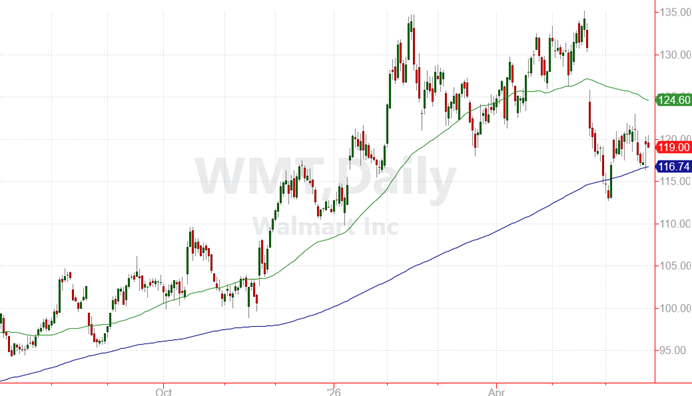
That’s why WMT sits on my bearish watch list. And right now, the chart is looking ominous.
Keep your eye on the 200-day moving average (the blue line in the chart below). That’s the line in the sand.
If Walmart breaks below it, things could get dicey in a hurry.
Two ideas. One bullish, one bearish.
That’s exactly how I want you positioned in a two-speed economy: ready to profit no matter which way a stock breaks.
It’s also exactly what my Watch List is built for.
Every month I update 20 bullish names, 20 bearish names, and 20 income plays, so you always know which stocks I’m tracking on both sides of the market.
The entire list is just $27 a month. You can take a look right here.
Tomorrow, I’m going to give you a deep dive on another of the stocks on our watch list.
We’ll take a closer look at the fundamentals of the company, the way the stock is trading, and where I expect this name to go from here.
I think you’ll want to see this one.



Comments
Log in or sign up to join the conversation.