

Due to general market weakness particularly affecting tech stocks lately, Alphabet's (GOOG) (GOOGL) stock is down by nearly 20% from its highs of the last year. However, Alphabet is a high-quality business, financial performance remains clearly strong, and valuation levels look quite attractive at current price levels.
Even if the stock could remain under pressure in the short-term, chances are that current weakness in Alphabet's stock will turn out being a buying opportunity for long-term investors in the company.
1. A High-Quality Business
Alphabet is a combination of two different segments: Google and "other bets", and the whole is worth more than the sum of the parts in this particular case.
The Google division is still growing revenue at over 20% year-over-year, and it produces big sums of cash that the company can invest in different areas with enormous potential for disruption in the years ahead. This means that Alphabet doesn't need to worry about external financing or short-term profitability for its growth projects, and it can have a true, long-term approach to developing the most promising futuristic technologies.
When you are trying to disrupt multiple key areas in business and technology at the same time, having access to permanent capital and a practically unlimited time horizon can make all the difference in the world.
When analyzing a company's fundamental quality, competitive advantage is arguably the most important factor to consider. Competitive advantage is the attribute that allows a company to outperform the competition over time, generating superior profitability and returns for investors in such a company in the long term.
Brand differentiation is a key source of competitive advantage for Alphabet. The Google brand is so powerful that many consumers use the term "googling" as a synonym for online search.
Such as important, the company now has 8 different platforms with over 1 billion monthly users each: Search, Android, Gmail, Maps, YouTube, Play, Chrome, and Drive. This provides Google with access to massive amounts of data, and the company uses such data to improve the quality of its services and provide better-targeted and more effective advertising.
Google is also a major beneficiary from the network effect, meaning that the value of the platform increases as the company gains size over time. The more people visit Google's platforms, the more advertisers want to advertise on Google. The more advertisers Google has, the more effective and targeted the advertisements become, which in turn drives more users.
The same dynamic is at play in YouTube. Content creators want to go to the video platforms where they have access to more content, and consumers obviously want to have more content. This means that content producers and consumers attract each other to a leading online video platform such as YouTube.
Speaking of which, YouTube already has 1.9 billion monthly users, and people are now watching 150 million hours of YouTube every day. Google is still in the first stages of monetizing YouTube, and the platform offers tremendous opportunities for growth in the years ahead.
Alphabet is also making big bets on Artificial Intelligence. CEO Sundar Pichai has said that AI could be more important for humanity than electricity or fire from a historical perspective, and he is putting his money where his mouth is.
Google has made lots of acquisitions in the AI space in the past several years, beating other tech giants in the AI acquisition race.
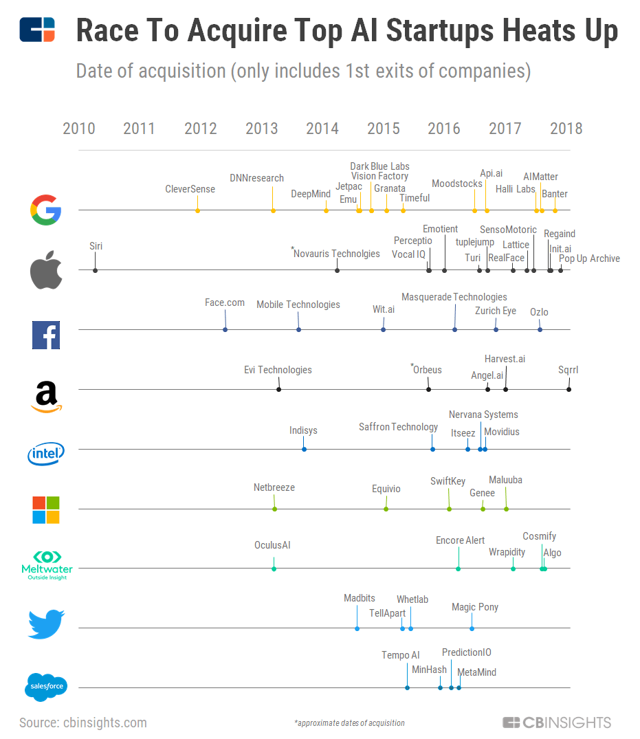
Source: cbinsights.com
2. Rock-Solid Financial Performance
The company has produced outstanding financial performance over the long term. The chart below shows how key financial metrics such as revenue, cash flow from operations, and operating income have evolved in the past decade.
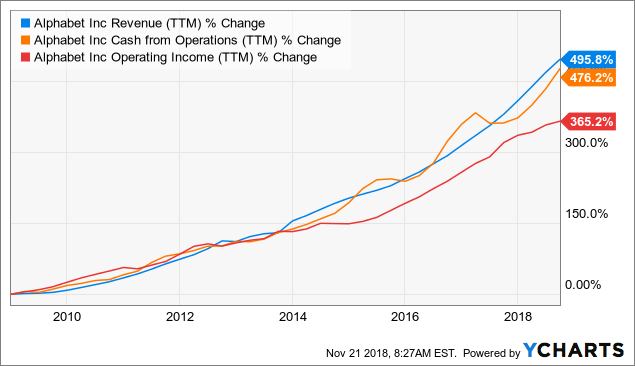
GOOGL Revenue (TTM) data by YCharts
The numbers for the third quarter of 2018 confirm that the business keeps firing on all cylinders. Alphabet reported $33.74 billion in sales during the period, an increase of 22% year-over-year on a constant-currency basis.
Advertising revenue grew 20.3% versus the same quarter in the prior year to $28.95 billion. Revenue from Google properties amounted to $24.05 billion, increasing by 22%. Network members' sites produced $3.9 billion in revenue, growing by 12.9%.
The company is aggressively investing in all kinds of growth projects, and profit margins in the mobile advertising segment are under pressure. However, the business remains remarkably profitable from a broad perspective, and Alphabet retained 25% of revenue as operating profit last quarter.
3. Attractive Valuation
Wall Street analysts are on average expecting Alphabet to make $46.96 in earnings per share during 2018. Under this assumption, the stock is trading at a forward price to earnings ratio below 22 times expected earnings.
This is a fairly reasonable valuation for a high-quality business generating revenue growth levels above 20% and with profit margins around 25% at the operating level.
In the words of Warren Buffett, "price is what you pay and value is what you get". Investors in Alphabet are currently buying an exceptional business for a modest valuation.
The PowerFactors system is a quantitative investing system available to members in my research service, "The Data Driven Investor." This system basically ranks companies in a particular universe according to quantitative indicators such as financial quality, valuation, fundamental momentum, and relative strength.
The chart below divides the investable universe in 5 buckets based on their PowerFactors ranking, and it compares their historical performance versus the S&P 500. There is a clear and direct relationship between PowerFactors rankings and historical performance; this is to be expected when the quantitative system is robust and consistent. Also, companies with elevated quantitative rankings have substantially outperformed the market over the long term.
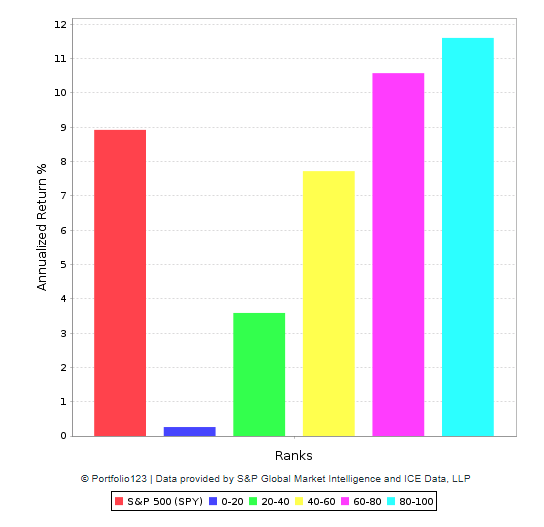
Data from S&P Global via Portfolio123
Alphabet's stock has a PowerFactors ranking of 87.7, which puts the company in the top bucket based on the quantitative algorithm.
The Bottom Line
Past performance does not guarantee future returns, of course. A quantitative system is always based on past data and current expectations about future performance. If Alphabet fails to deliver in accordance with those expectations, then the stock will most likely deliver disappointing returns going forward.
A quantitative system can tell you that a specific group of companies with certain quantitative attributes has a good chance of delivering market-beating returns over long periods of time, but it does not tell you much about a particular stock in a single year.
Google owns massive amounts of personal information about its users, and the company has a dominant market position in different segments. This means that regulatory risk is always an important factor to keep in mind when investing in Alphabet.
In addition, companies such as Facebook (FB) and Amazon (AMZN) have gained a lot of ground in online advertising in recent years. The industry is fertile ground for disruptive innovation, so competitive risk should not be overlooked.
Global stock markets in general, and tech stocks in particular, have been under heavy selling pressure lately. The current market environment is remarkably challenging, and it makes sense to expect more downside pressure over the middle term.
This means that Alphabet stock could remain volatile due to general market conditions in the coming months. None of that changes the fact that the company is a remarkably solid investment from a multiyear perspective, though.
Those risks being acknowledged, the main point is that fundamental quality, solid financial performance, and attractive valuation levels are three powerful reasons to consider a long position in Alphabet's stock with a long-term horizon.



Comments
Log in or sign up to join the conversation.