


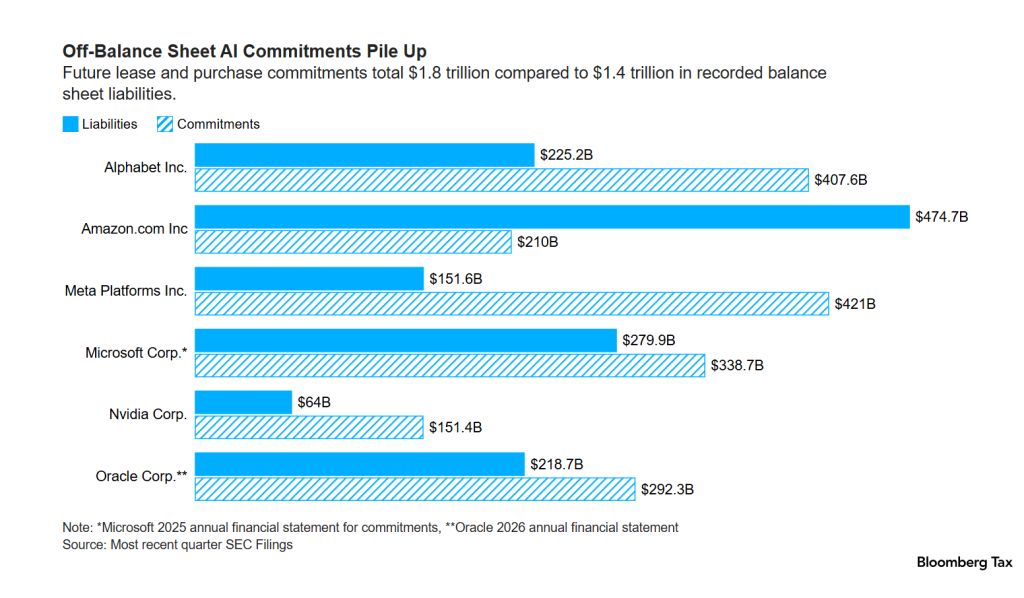
There’s $1.8 trillion in AI-related debt off the balance sheets vs $1.4 trillion on.
Big Tech AI Spree Revives Accounting Devices That Toppled Enron
Bloomberg comments Big Tech AI Spree Revives Accounting Devices That Toppled Enron
Enron Corp. exploited US accounting rules to hide from investors and lenders hundreds of millions in debt it had bundled into off-balance sheet entities — obligations that contributed to one of the biggest corporate collapses in US history.
Twenty-five years later, new risks have emerged as some of the world’s most valuable companies create similar financing vehicles that can mask how much debt they’re taking on, as the technology industry looks to spend more than $3 trillion to power artificial intelligence systems.
Alphabet Inc. (GOOGL) and Meta Platforms Inc. each have turned to vehicles known as variable interest entities (VIEs) as part of the financing mix needed to construct data centers and related energy infrastructure.
Meta, the parent of Facebook, last year formed a joint venture, a VIE, to build a Louisiana data center through a partnership with Blue Owl Capital (OWL). The social media titan’s maximum exposure for the venture is $46 billion, according to its filings with the Securities and Exchange Commission. The company announced last week that it would expand its planned campus and is expected to spend as much as $250 billion on the project, Bloomberg News has reported.
Alphabet, Google’s parent company, keeps VIE arrangements for leases and credit backstops for data centers along with other guarantees related to power infrastructure off its balance sheet.
Microsoft (MSFT) provides few details about its VIEs, only stating that it doesn’t consolidate those entities.
Oracle Corp. (ORCL), for example, has agreed to backstop another entity’s lease for up to $3.3 billion. The database management company has $260 billion of future lease commitments mostly for data centers that will eventually roll onto its balance sheet, according to its SEC filings. Ratings agency S&P Global (SPGI) downgraded Oracle’s credit earlier this month due in part to its “stretched leverage.”
Trillions Pressure Accounting
Meta’s auditors at Ernst & Young said it was “challenging” to evaluate whether the social media giant has the power to direct the activities of its Blue Owl joint venture.
To Ben Butler, an investment analyst for Veritas Investment Research Corp., Meta should bring its Hyperion data center project onto its balance sheet.
Meta — as the sole tenant of the project, an equity investor and property manager — appears to have the power to direct its activities, Butler said. The social media giant also has disclosed billions in obligations related to the project, he said.
Managing Optics
Not showing interest payments on credit funding AI infrastructure projects boosts profit metrics like EBITDA, said Jennifer Law, chief financial and operating officer at K2 Integrity, a risk consulting firm.
“It can speak levels about what stage we’re at if companies are having to rely on SPVs to make their return on capital look good, to make their free cash flow look good, to make leverage look more attractive,” Butler said.
Ratings agency Moody’s (MCO) assesses future lease commitments as it weighs the debt load of companies. Those future payments will drain cash, hitting metrics like free cash flow, Gonzales said.
Investors have to dig through disclosures attached to corporate financial statements to find details on the off-balance sheet structures and how each firm accounts for those arrangements and any related obligations.
The information is there, but finding it requires more work than if Meta, for example, borrowed directly to finance the build out, said Gil Luria, head of technology research for D.A. Davidson & Co.
“Enron’s crime wasn’t having special purpose vehicles. Enron’s crime was hiding them,” Luria said.
On and Off Balance Sheet
Alphabet $225B On, $408B Off
Meta $152B On, $421B Off
Microsoft $280B On, $339B Off
Nvdia (NVDA) $64B On, $151B Off
Oracle $219 On, $292B Off
Amazon (AMZN) $475B On, $210B Off
Circular Financing
Nvidia is facing scrutiny over allegations of employing “circular financing” (or “round-tripping”), where the company allegedly invests in or lends money to AI startups and cloud providers (e.g., OpenAI, CoreWeave), which then use those funds to purchase Nvidia’s GPUs. Analysts worry this creates artificial revenue growth and inflates AI demand.
AI Overview of the Controversy
The Mechanism: Nvidia invests heavily in companies like OpenAI and CoreWeave, which are simultaneously the largest customers for their H100/B200 chips.
Concerns: Critics argue this, similar to historical telecom bubbles, creates a high-risk ecosystem where the “growth” is just money circulating between firms. If the cash flow stops or AI monetization fails, the entire chain could collapse.
Nvidia’s Stance: Nvidia has denied these claims, providing a seven-page memo to analysts arguing they do not rely on such arrangements to grow revenue.
Evidence Cited by Critics: High Days Sales Outstanding (DSO) (a measure of how long it takes to collect payment) suggesting “phantom revenue” and extreme customer concentration, with a massive percentage of revenue coming from a few heavily-invested partners.
Nvidia Denial
On November 29, 2025. Yahoo!Finance reported Nvidia says it isn’t using ‘circular financing’ schemes. 2 famous short sellers disagree.
Nvidia (NVDA) sent a memo to Wall Street analysts over the weekend arguing that it is not engaged in vendor financing, a controversial practice in which suppliers invest in or extend loans to their own customers.
Famed short sellers Jim Chanos and Michael Burry aren’t so sure.
A Guide to the Circular Deals Underpinning the AI Boom
Bloomberg has a January 22, 2026 article, A Guide to the Circular Deals Underpinning the AI Boom
What makes a deal circular?
The term typically refers to an arrangement in which one company invests in another firm that buys its products and services: By doing so, the businesses effectively bind their fortunes more tightly to one another. (A circular deal is different from a fraudulent “round-trip” transaction, a term regulators have used for sham trades with no economic substance that are designed to inflate reported results.)
So what’s the problem?
If revenue from AI products does not grow as much or as fast as expected, company B might find itself staring at untenable bills for data center capacity and hardware. Company A loses twice — company B stops buying its products and its stake in company B tumbles in value.
Circular deals don’t just increase the potential damage to the companies in a market downturn. They can also skew the balance of incentives to encourage bad decision making. A company that has one of its suppliers as a major shareholder may be more likely to keep buying its stuff whether or not it makes commercial sense. That increases the risk of money being spent to secure business that fails to materialize. The circularity can be most risky when a handful of buyers are responsible for a large share of the market — as is the case with AI.
Here we go again?
During the internet boom of the late 1990s, fiber optic networks were built on the promise of relentless growth. Equipment makers helped to fuel the expansion with vendor financing — loans and other support that allowed telecommunication service providers to sustain the heavy investments.
When demand forecasts fell short and prices for transporting internet data sank, the model broke: Heavily leveraged carriers slashed spending and some filed for bankruptcy. Much of the capacity sat underused for years as the industry consolidated.
Paul Kedrosky, a venture capitalist who covered networking and communications companies as a technology analyst during the telecom boom, said AI capital spending is climbing toward levels last seen at the peak of the late-1990s fiber-optic buildout. In some cases, he said, the risk is that facilities using today’s semiconductor chips will become obsolete before they’ve made a return on investment.
This Isn’t Fraud
Nvidia isn’t Enron, Global Crossing, or WorldCom.
It will remain profitable even if it the some businesses supporting it default on payments.
But how long can this growth go on with AI-Related companies that have zero earnings?
Here We Go Again Heartaches
The hardware makers and cloud providers post massive revenues.
However, the pure-play AI developers like OpenAI and Anthropic are operating at a significant loss as they burn billions on infrastructure to build and run their models.
That money is fueling profits at the chipmakers. But most of the risk is hidden off the balance sheet, inflating earnings.
One never knows how long this can go on until hindsight.
But unless profit matches current lofty valuations, and the pure play AI companies start making huge profits, this is going to end the same way it always does. Heartaches.



Comments
Log in or sign up to join the conversation.