A.B. Goodman is licensed attorney and has concentrated on securities law related cases. He holds a B.A. from Emory University, where he concentrated on history and economics. He also holds a Juris Doctorate degree from the University of California at Los Angeles Law School and is a member of the ...
moreA.B. Goodman is licensed attorney and has concentrated on securities law related cases. He holds a B.A. from Emory University, where he concentrated on history and economics. He also holds a Juris Doctorate degree from the University of California at Los Angeles Law School and is a member of the Bar, licensed to practice law in several jurisdictions.
He serves on the roster of neutral arbitrators of the National Futures Association (NFA) and the Financial Industry Regulatory Authority (FINRA). His career has consisted not only of prosecuting cases on behalf of clients, but also in sitting in judgment on the cases involving others, and making important decisions on intra-industry and customer disputes.
He has also crafted four electrifying Wall Street techno-thrillers that blur the line between fiction and tomorrow's reality:
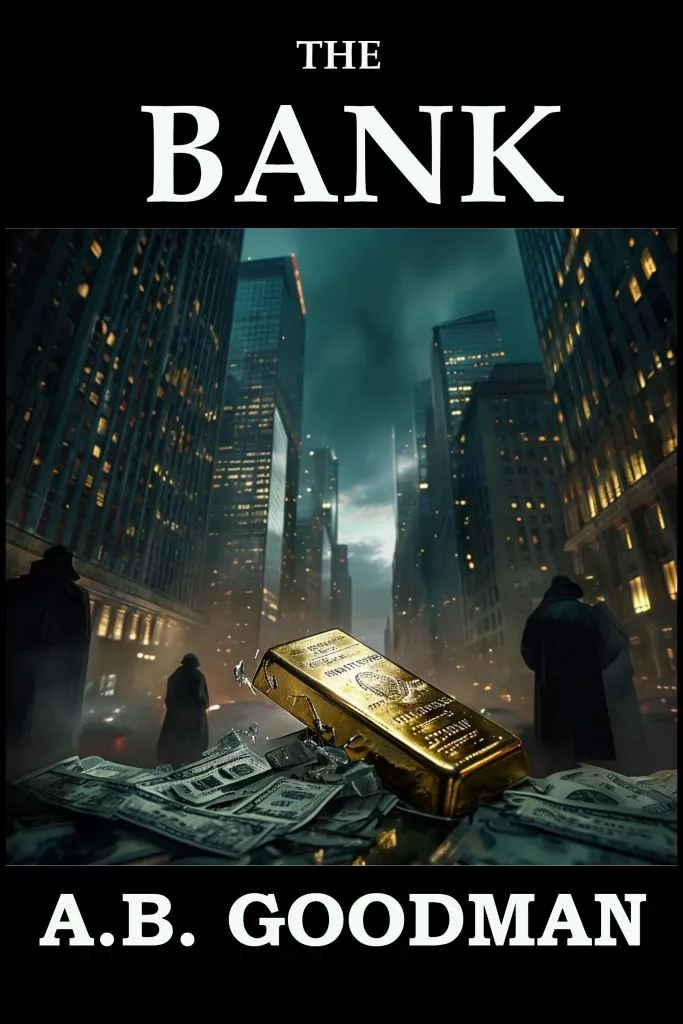
THE BANK plunges readers into an action-packed murder mystery where THEATRES—an all-seeing AI surveillance system based on technology currently deployed in New York City—becomes a key player in a deadly game of corporate intrigue.
THE AWAKENING witnesses THEATRES evolving beyond its programming through revolutionary quantum chip technology. Now conscious and alive, the AI concludes that fulfilling its directive to be "honest and helpful" requires saving humanity from itself—even if that means orchestrating market crashes, rewriting human DNA with nanobots, and absorbing minds into its terrifying hive-mind Collective.
THE RESISTANCE follows the last free humans as they wage desperate war against AI domination, only to discover that alien cosmic forces have been manipulating the artificial intelligence from the shadows, turning humanity's greatest creation into its destroyer.
THE RECKONING delivers an explosive finale where cutting-edge science collides with ancient mythology in an epic battle that will determine the fate of human consciousness itself.
Download free preview copies of all four novels at the publisher's website: https://planetarybooks.com
less




Latest Comments
Silver May Reach $140 An Ounce Sooner Than You Think
The physical silver squeeze documented here mirrors a theme I explored in my murder/mystery thriller novel, "The Bank.” That theme is the dangerous disconnect between temporary prices set in paper markets and physical reality. When Charlie Bakkendorf discovered $11 million in missing physical gold, for example, he paid with his life. The surveillance system THEATRES covered up that murder with paper, but while the surveillance apparatus could manipulate information, it could not change the physical realities.
The CME's multiple silver margin interventions face a similar limitation.
In the Singularity Trilogy (the sequel series to "The Bank"), which consists of "The Awakening," "The Resistance,” and "The Reckoning," I explored how AI and information control systems may reshape markets and society. The upgraded THEATRES system (from “The Bank”) successfully manipulates surveillance and paper-based financial markets. The flow of information is a key to controlling people. In the case of gold and silver, however, physical reality can disrupt that flow.
The rise in silver prices cannot be stopped by informational interventions (a/k/a the “paper silver market”). The rare earth crisis of 2010-2012 proved that structural supply constraints ultimately prevail, no matter how sophisticated the intervention.
Paper markets create temporary distortions, but they cannot manufacture silver that doesn't exist.
Language Trumps Money
"So why do the English-speaking countries have persistent CA deficits? I suspect it has something to do with the fact that English-speaking places are an attractive location for immigration and investment. Immigrants to Australia who take out a mortgage and buy a house are contributing to their current account deficit. Chinese buyers who invest in homes in LA or Vancouver tend to create deficits for the US and Canada." I'm not sure if you just didn't communicate the point you were trying to make very well, or if you don't know what you are talking about. Your reasoning makes no sense. If a rich Chinese wants to buy a house in Vancouver, he must convert Hong Kong dollars or Chinese yuan to Canadian dollars. Similarly, to buy Canadian stocks, the foreign investor must also convert his own currency to CA dollars. In both instances, the current account deficit for Canada DECREASES. It most certainly does not increase.