


Image Source: Unsplash
After one of its strongest annual performances on record, the metal has started the new year on a firm footing. With a data-packed second half of the week, we could see a bit more volatility in gold and other buck-denominated assets should the data calendar deliver any major surprises. While much of the gold-buying in recent years have been powered by heavy central-bank buying, its more recent gains reflect a global turn towards lower interest rates. So, data will matter for gold, especially as signs emerge of slowing central bank buying.
Gold’s long-term bullish case intact
The longer-term case for holding gold is still intact, but the environment looks less forgiving than it perhaps did throughout last year. For one, much of the monetary easing that supported the gold price is already behind us, and expectations for further rate cuts have cooled. Several central banks now appear closer to a pause, while others are openly discussing the need to normalise policy. In that sort of world, gold could potentially lose one of its most powerful supports: falling interest rates. Meanwhile, physical central bank gold buying stayed robust through 2025, though the pace slowed as prices pushed to record highs. China, which has played a pivotal role in recent years, has eased back its purchases, raising some concern that elevated prices may discourage further accumulation. At the same time, a handful of countries have already begun trimming their gold reserves, suggesting that profit-taking is no longer unthinkable at these levels.
Geopolitics continues to matter, though the picture is becoming more nuanced. While conflicts and strategic tensions helped drive safe-haven flows last year, early signs of de-escalation in parts of Eastern Europe and the Middle East have slightly dulled gold’s defensive appeal. That said, global stability remains fragile. Political risks have not disappeared, and sudden flare-ups — particularly involving energy markets or emerging economies — could quickly revive demand for protection.
The US dollar is another key variable. A softer dollar index helped underpin gold in 2025, but it is far from clear that this trend will extend indefinitely. Any renewed inflation pressures or supply-side shocks could strengthen the dollar and complicate the outlook for precious metals.
So, gold looks less like a one-way bet and more like a test of conviction. The metal may stay elevated and remain strategically attractive, but the powerful tailwinds of last year are fading. Without a fresh geopolitical shock or a renewed push towards looser policy, gold may struggle to replicate its previous surge — and investors should be prepared for a more measured, and potentially choppier, year ahead.
Gold technical analysis
From a technical point of view, the gold chart continues to make higher highs and higher lows, and as long as that remains the case, selling gold aggressively does not make much sense. It’s important for traders to wait for a proper bearish signal to emerge before attempting to short gold. While the metal does appear overbought, that alone is not a reason to sell.
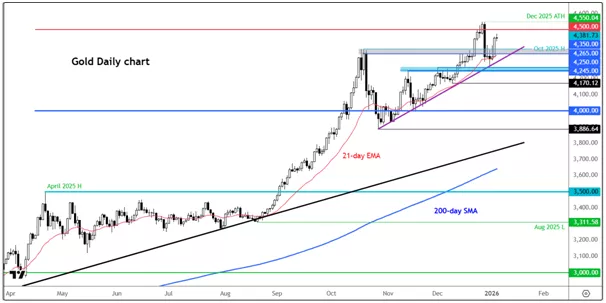
Key support levels to watch include the $4,350 to $4,380 zone. This area is marked in grey on my chart. It’s a region where gold found significant resistance back in October before finally breaking above it in December. After a brief dip below this area, prices pushed back above it at the start of this year. As a result, it’s essential that this zone holds on any retest from above. However, if prices fall back below it, that would put the bulls in a spot of bother. In that case, we could see a deeper breakdown in the precious metal, with the next support coming in around the $4,250 area. Below that, there’s nothing significant until the low $4,000s.
On the resistance side, $4,500 is the key level to watch. This is a psychologically important level, and the fact that gold sold off aggressively from there on the 29th of December suggests this level should not be taken lightly. So, it’s definitely an area to keep an eye on. Ahead of that, the low from the 26th of December comes in at $4,469. This level acted as the last support before the late-December sell-off, so it’s possible we could see resistance emerge around $4,469, potentially preventing gold from reaching the $4,500 level.
That said, if gold prices continue to push higher and break above $4,500, the next upside target is liquidity sitting above the December all-time high at $4,550. Beyond that, there are no major resistance levels, meaning round numbers such as $4,600 and $4,700 would come into focus next.
More By This Author:
S&P 500 Steady As Investors Weigh Conflicting Signals
Gold Makes Positive Start But Challenges Lie Ahead
EUR/USD In Focus Ahead Of FOMC


Comments
Log in or sign up to join the conversation.