


Photo by JustStartInvesting on Unsplash
Understandably, FX vol outside of the yen has been quiet ahead of the Fed meeting so far this week. But things should liven up from here on, with Bank of Canada and US Federal Reserve set to decide on their respective monetary policies today. Much of the focus will be on the FOMC presser, where Powell could set the tone for the rest of the year in the FX space. The EUR/USD trend remains modestly bullish, although in the near-term there is a risk of a drop on the back of a potentially hawkish Fed cut, thanks to US data turning a little positive in the last couple of weeks. Yesterday, for example, both JOLTS Job Openings and the ADP Weekly Employment Change came in surprisingly higher, which gave the US dollar a bit of support.
What’s been driving EUR/USD recently?
Until this week’s mild pullback, the euro has been on a decent run lately. However, with the greenback selling taking a pause ahead of the FOMC rate decision, the EUR/USD currency pair has stalled after climbing from sub-1.15 handle to around 1.1650.
Still, the downside has been limited for the single currency so far, thanks to at least a handful of macro reasons.
Among these is lower energy prices, thanks mostly to oversupply from OPEC+ keeping pressure on crude oil. Meanwhile gas prices have dropped to the lowest level in nearly 5 years across the US, standing around $2.90 per gallon on average. The US is an oil exporter, and falling energy prices is usually not a great sign for the dollar. Weaker energy prices have given currencies of energy importing regions like the eurozone’s single currency some breathing room, although not all oil importing currencies have benefited (e.g., the JPY and INR).
Also supporting the euro are ongoing peace talks in the Ukraine-Russia war, which is easing geopolitical pressure, and we have seen this in the form of a recovery in the EUR/CHF pair, which climbed to its highest point since the end of the summer.
What’s more, even though it’s small, we have been seeing some mild improvement in Eurozone economic data, which has effectively ended talks of any further near term rate cuts by the ECB.
Add in the German fiscal stimulus, which is expected to boost the eurozone’s economic powerhouse in 2026, and suddenly there are not much in the way of negative factors to influence the single currency.
Attention turns to the Fed
Things will start to get more interesting. We are now inside a massive two-week period for central bank meetings. This week, we have already heard from the Reserve Bank of Australia calling an end to the easing cycle with a widely expected rate hold. Next up is the Bank of Canada’s turn to hold policy steady today, where the central bank may hint at the next move being a hike in 2026, although it will surely push back against that idea at least a little. Next week, the European Central Bank, Bank of England and Bank of Japan are among the more important policy meetings to keep an eye on.
Of course, the big one is happening later on today: the US the Federal Reserve, which is widely expect to trim rates by an additional 25 basis points. But the cut is almost fully priced in. So, the real market mover won’t be the cut itself, but more so the Fed’s tone about rates outlook in 2026 and beyond.
US economic data lately has been mixed, providing mild support to the Dollar Index. Whether things will improve or get worse is something no one can predict of course, especially with recent government shutdown delaying the release of critical data.
Nonetheless, markets are looking for a softer, more dovish message from the Fed than we are likely to hear from other major central banks in the next couple of weeks.
But if Powell & Co. don’t validate the 70-80 basis points of easing priced in for 2026, the dollar could bounce back, at least temporarily.
I say that because the focus is then likely to shift to the governance of the Federal Reserve, with current the Chair Jerome Powell’s tenure set to end in early 2026.
Kevin Hassett is the frontrunner to become the next Fed Chair. He’s widely seen as a dove, meaning he may keep downward pressure on US interest rates and therefore on the dollar into 2026.
So even if we get some short-term dollar strength, the broader trend could still be tilted to the downside for the greenback, keeping the longer term EUR/USD trend positive.
EUR/USD technical analysis and trade ideas
For now at least, it looks like the EUR/USD has found a bottom around 1.1500, though momentum is clearly lacking as cautious prevails ahead of the central bank meetings, and with the dollar finding some mild support.
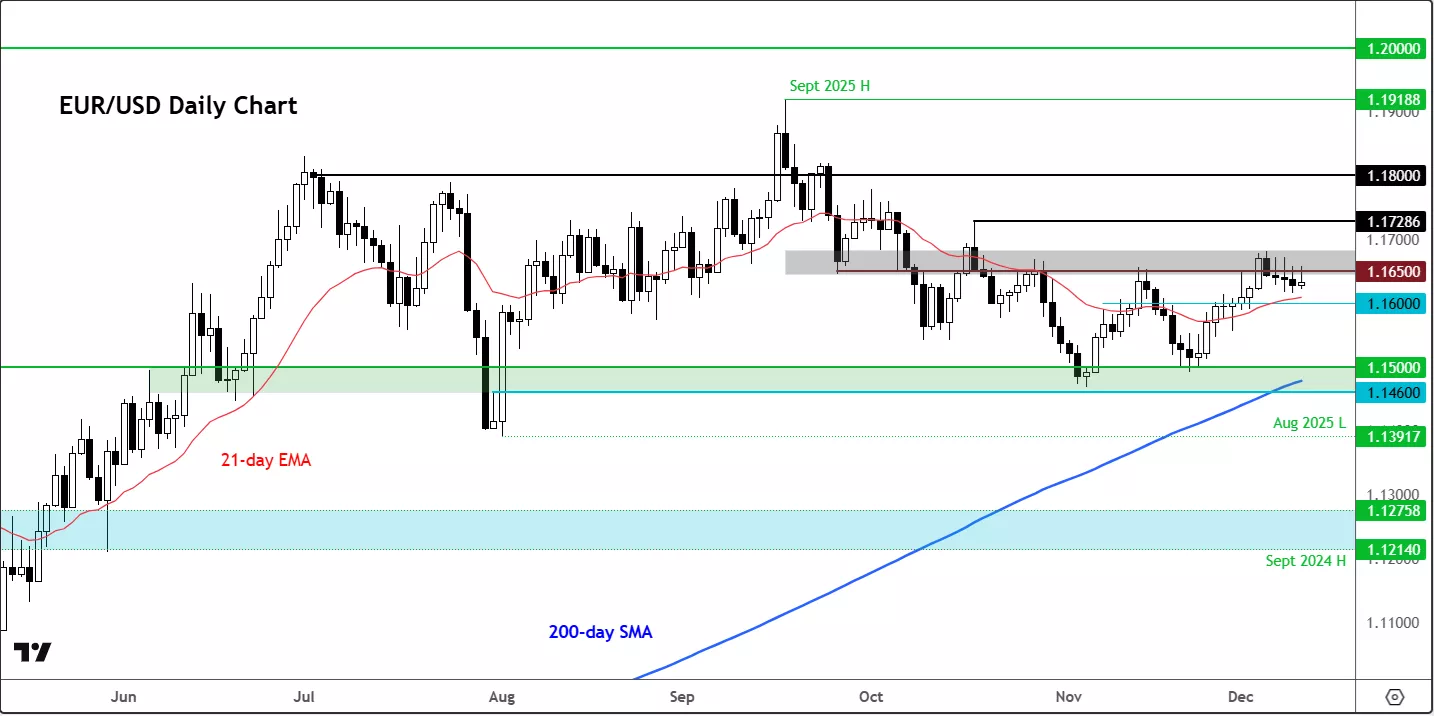
Support comes in 1.1600, followed by 1.1550 and then 1.1500. On the upside, the 1.1650–1.1680 range marks short term resistance where price has struggled in the last few trading sessions. Break above that brings 1.1700 into focus, with the bigger upside target being at 1.1800
Key takeaway point
Whether the EUR/USD rallies and we break above 1.18 really depends on the Fed. A dovish surprise could open the door to a fresh leg higher, indeed. But my gut feel is that the Fed Chair will be more hawkish at the presser and that could potentially lead to some dollar strength, though this may be short-lived as investors will quickly re-focus on hawkish central banks abroad and the appointment of a dovish Fed Chair in 2026.
More By This Author:
Gold AnalysisEUR/USD Extends Recovery
Gold Starts December On A Positive Note, But Things Could Unravel


Comments
Log in or sign up to join the conversation.