

I have been a “South Park” fan for as long as I can remember, and while the show isn’t a market guidebook, its brutal satire cuts through nonsense better than many Wall Street commentaries. Just like on the show, characters make absurd decisions and face absurd consequences, which is familiar to investors today. For example, one of my favorite scenes is when Stanley goes to the bank to deposit the money his Grandmother gave him into an account at the bank…“And It’s Gone.”
Notably, in South Park, Eric Cartman once declared, “Screw you guys, I’m going home.” That line has become shorthand for frustration and fatigue when chaos overwhelms you during market volatility. For example, during the “Liberation Day” market decline, many investors sold out just as the market reached its bottom. The increase in market volatility was something we wrote about this time last year in “Curb Your Enthusiasm.” Notably, the same market dynamics that existed then persist today. Such suggests that investing in 2026 may also experience similar increases in volatility. That means anyone looking for a simple road map will end up feeling like Cartman walking out on his friends.
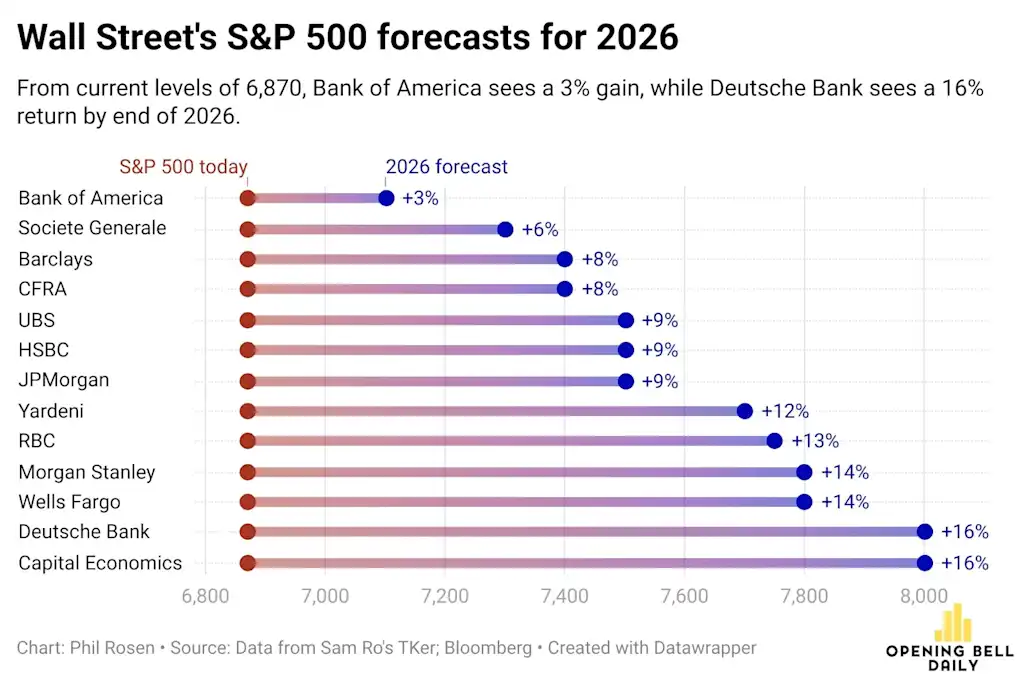
To avoid being Cartman, it is critical to understand that 2026 will not deliver certainty. Instead, investors should focus and make decisions based on probabilities backed by data, earnings trends, policy shifts, and macro signals. Wall Street analysts have already begun issuing universally bullish forecasts, some more cautious than others. However, while there are no guarantees of outcomes, a shifting environment of volatility and complexity is expected.
This article breaks the 2026 outlook into three cornerstone sections:
- Market Structure and Valuations
- Economic Forces and Policy Drivers
- Strategic Investment Implications
Across each section, you will see the same economic truth South Park illustrates: Chaos is not the opposite of order. Chaos is part of the system.
Market Structure and Valuations in 2026
Wall Street begins 2026 with conflicting signals. As noted above, while several Wall Street firms expect to see another year of “double-digit” gains in 2026, such follows three consecutive years of elevated gains. That is potentially a risk as discussed in the “Market Outlook For 2026,”
“The current 3-year return is 18% above its 3-year average. While that is not the highest level on record, when the index trades significantly above its moving average, volatility tends to rise. These periods often see sharp drawdowns, and corrections become more frequent, with increased variance in returns leading to larger losses in downturns, which compounds the problem. Secondly, there are declining risk-adjusted returns. When returns deviate significantly from the trend, future returns tend to revert toward the mean. This mean reversion is driven by stretched valuations resetting. Over time, high volatility and large price swings reduce compound returns. Even if average returns remain positive, the math of compounding is compromised by losses, weakening full-cycle gains.”

Secondly, the markets currently trade at record levels above their long-term exponential growth trend. As shown in the chart below, when valuations rise unchecked, the market grossly exceeds its long-term exponential growth trend, eventually leading to a reversion.
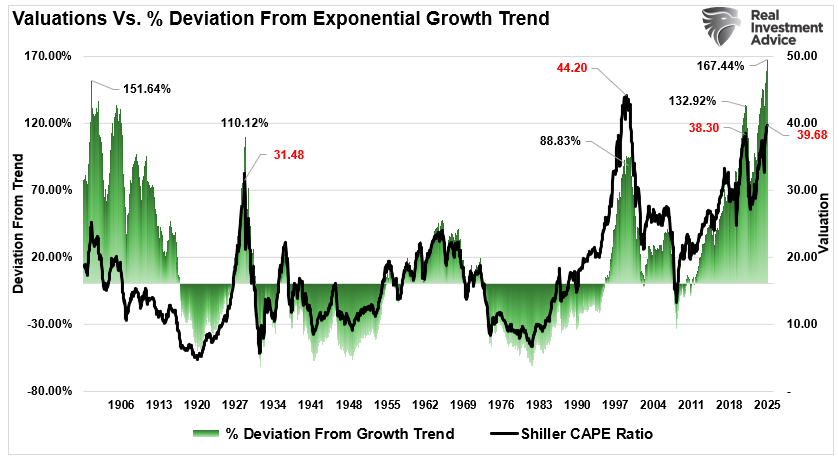
Lastly, valuations remain above long‑term historical norms. Crucially, as discussed in a recent BullBearReport:
“Market valuation measures are just that—a measure of current valuation. Moreover, market valuations are a much better measure of “investor psychology” and a manifestation of the “greater fool theory.” This is why a high correlation exists between one-year trailing valuations and consumer confidence in higher stock prices.”
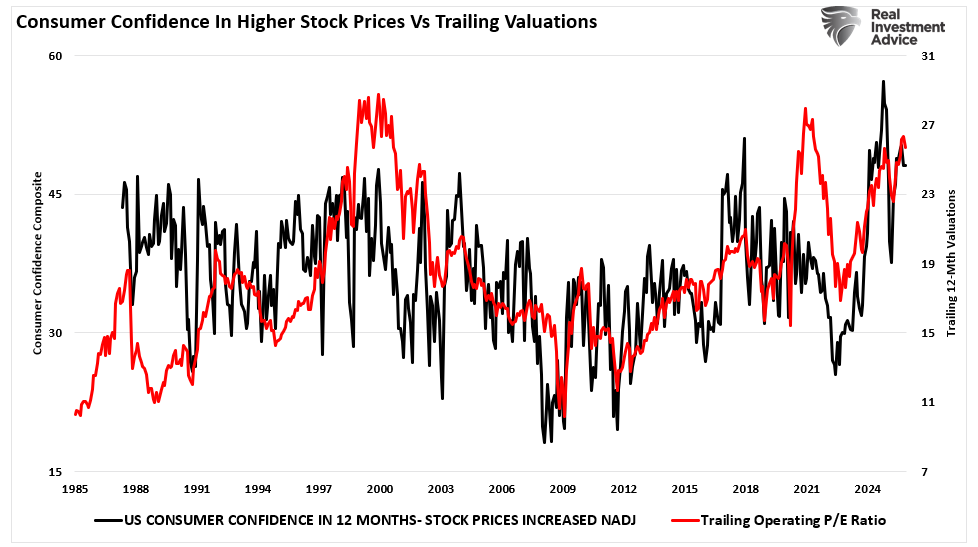
Simply, this means that current valuations are just a reflection of the “hope” that future earnings growth and profitability will justify overpaying for assets today. Wall Street’s 2026 forecast for the markets represents that “hope.”
However, what we do know today is that the most powerful force in finance is “mean reversion.” As all the charts above demonstrate, at some point over the next five years, market returns will likely be closer to 0% than 10%.

Of course, that doesn’t mean markets will “crash” in 2026. However, price deviations, excess valuations, and elevated sentiment do suggest that market volatility will likely be higher and returns lower than current expectations. Such is particularly the case if something happens that causes Wall Street to lower forward earnings expectations. It is worth noting that historically, valuations have not always caught up with earnings, but rather vice versa.

That scenario is when the Cartman line feels most appropriate: “Screw you guys, I’m going home.” Because investors will shift from an optimistic to a defensive position almost instantly.
Drivers Shaping 2026
Markets do not exist in a vacuum. Earnings “expectations” are what will matter the most, but earnings are influenced by macro forces such as inflation, interest rates, global growth, and monetary policy. Currently, many of those factors are not favorable to those more elevated forecasts.
For example, inflation remains a central concern with major investment banks and strategists cautioning that inflation may hover above the Federal Reserve’s 2% target as the labor market weakens. Jerome Powell even noted this in the December FOMC policy statement. During Powell’s press conference, he emphasized that job gains have slowed and downside risks to employment have increased. That statement aligns with our recent article on how alternative employment sources may affect its outlook. Powell went further, suggesting official payroll figures likely overstate job growth by around 60,000 jobs per month. That implies an actual labor market contraction. It further acknowledges that the potential negative payroll growth was a pivotal signal of the Fed’s priorities.
Such is crucial to forward expectations, because the markets are closely tied to both fiscal and monetary actions. While the Fed signaled possible rate cuts in 2026, if inflation does not subside as expected, rate cuts may be limited or postponed, which would negatively impact investor confidence. Famed investors often warn that policy surprises matter more than policy intentions, especially when markets are priced for optimism.
Secondly, internationally, growth forecasts are uneven. Credit rating agencies project moderate but uneven expansion across major economies, with emerging markets often outpacing developed markets in GDP growth. That imbalance creates divergence in asset returns and credit flows. However, given that the Euro area is expected to grow at roughly half the rate of the US, it would be unsurprising to see 2025’s outperformance by international markets, relative to the US, reverse.

In such environments, currency fluctuations and trade dynamics become even more crucial, meaning that a strong U.S. dollar rally or slowing global trade could pressure multinational earnings even if domestic sales hold up.
Lastly, leverage is a growing risk of market volatility disruption. As we discussed in “The DPI Link To Margin Debt,” household allocations to equities are at a record. Of course, such should be unsurprising given the strong market advances over the past few years.

However, this surge in allocations has also been accompanied by a massive expansion in leverage. Currently, margin debt as a percentage of real DPI has been reported at around 6.23 %, the highest on record. This ratio also suggests that for every $100 of real DPI, roughly $6 of margin debt is outstanding, a substantial amount. But that number doesn’t include the additional leverage taken on by investors through speculative option trading and 2x and 3x leveraged ETFs, which are also being bought on margin.
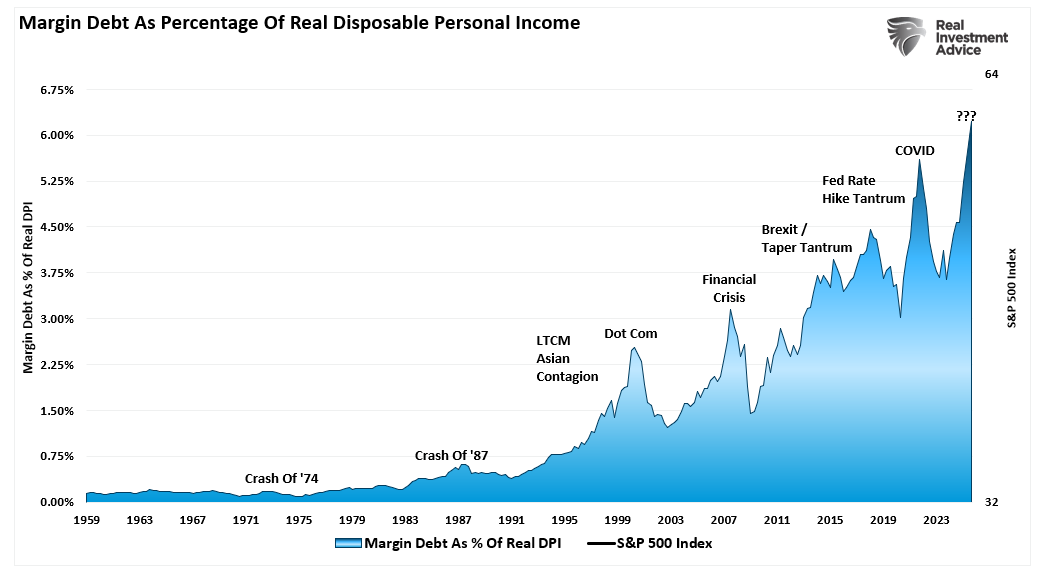
As we concluded:
“Naturally, when fresh savings are lacking and investors turn to margin to participate in markets, two risks emerge.“
- The quality of the investor base weakens because borrowed money replaces savings.
- The carrying cost of that borrowing becomes more salient when interest rates are elevated. If the margin debt carries higher interest and investors’ income growth is weak, servicing the debt becomes harder, reducing the buffer against loss.
“In summary, weak DPI growth, combined with elevated margin borrowing, creates a vulnerability. In such an environment, the investor base is much less resilient.”
Does any of this mean the markets are going to crash in 2026? No.
However, investors should be aware that all these forces interact in complex ways. Recognizing that macroeconomic data releases, policy shifts, and geopolitical events can lead to short-term volatility and long-term trend adjustments is crucial for navigating the “South Park” market in 2026.
South Park Wisdom for Investors
South Park often shows characters reacting emotionally to chaos. Yet mature investors must behave differently and recognize that emotion is not a strategy. However, understanding the data, identifying the probabilities versus possibilities, and maintaining risk controls are critical to success in 2026.
If you feel like shouting, “Screw you guys, I’m going home,” in the face of market moves, take a beat. Markets do not need your commitment; they reward discipline and patience.
In 2026, implement portfolio tactics to participate with the market if the bullish forecasts come to fruition, but protect your wealth in case they don’t.
- Diversify beyond tech leaders: Shift allocations gradually toward underappreciated sectors, such as healthcare, industrials, energy, and consumer staples, which demonstrate earnings strength and stable demand.
- Rebalance quarterly: Trim overextended positions, especially in momentum names. Reallocate into lagging but fundamentally sound assets.
- Build cash buffers: Hold 5% to 15% in short‑duration cash equivalents to deploy during volatility or price dislocations.
- Use tactical hedges: Add protective puts or inverse ETFs to limit downside on core equity holdings in concentrated portfolios.
- Add exposure to high‑quality bonds: Reallocate from speculative credit into high‑grade corporate or Treasury ladders as yields remain favorable.
- Favor earnings momentum over hype: Focus on stocks delivering real EPS growth over those driven by thematic speculation or valuation expansion alone.
- Reduce concentration in crowded trades: Limit exposure to AI and mega‑cap tech where positioning is crowded and narrative risk is high.
- Be cautious with international diversification: Developed market and emerging market ETFs are at risk of slower future growth and may be overvalued relative to their respective economies.
- Adjust risk models for higher volatility: Updating drawdown expectations and rebalancing portfolio risk targets accordingly.
- Track earnings revisions monthly: Stay nimble and reduce positions in companies issuing weaker forward guidance or showing margin compression.
- Treat narratives as signals, not strategies: Use themes like AI, reshoring, or inflation narratives to inform ideas, but confirm with real data and balance sheet strength.
These actions position your portfolio for resilience, rather than reliance on a single scenario, while preserving flexibility to capitalize on market shifts throughout 2026. Like any complex system, markets blend risk and opportunity. Recognizing where probability exceeds speculation is the difference between reacting like Cartman and investing with purpose.
Stay informed, stay disciplined, and treat “chaos” as part of the landscape, not a reason to abandon the field.
That is how you navigate the market in 2026.
More By This Author:
Silver Math: Gold Warns Of Silver CorrectionAkademiker Pension Serves The US A Warning
What Does Kevin Warsh Bring To The Fed?


Comments
Log in or sign up to join the conversation.