


Image Source: Pixabay
Last September, Nvidia (NVDA) sent shockwaves through the tech world when it announced alongside OpenAI a staggering $100 billion investment plan to fuel the AI pioneer's growth. The partnership promised to supercharge OpenAI's capabilities with Nvidia's cutting-edge hardware and expertise.
However, doubts crept in last month as reports surfaced that Nvidia was pulling back, effectively shelving the $100 billion figure. NVDA CEO Jensen Huang clarified that the investment was never pegged at that exact amount but would still rank as the company's largest ever. Now, fresh reports indicate Nvidia is close to finalizing a $20 billion stake in OpenAI's latest funding round, with the deal nearly complete though terms could shift. It's not $100 billion, but it's nothing to sneeze at either.
Mutual Dissatisfactions in the Partnership
Despite the ongoing commitment, tensions have simmered between the two giants. Reports suggest Huang has expressed dissatisfaction with OpenAI's operations or progress, contributing to the scaled-back investment. On the flip side, OpenAI has been vocal about its frustrations with Nvidia's latest AI chips, particularly their performance in inference tasks – like generating responses for ChatGPT users or handling code generation via Codex. The core issue lies in Nvidia's GPUs relying on external memory, which hampers speed for data-intensive inference compared to training models.
OpenAI has been scouting alternatives since last year, aiming to diversify about 10% of its future inference needs. They've explored deals with Advanced Micro Devices (AMD) for competing GPUs and startups like Cerebras and Groq, which offer chips with embedded SRAM for faster processing. However, Nvidia's influence looms large: It licensed Groq's tech in a $20 billion deal, derailing OpenAI's talks there, while Cerebras opted for a commercial partnership with OpenAI instead. Nvidia defends its tech, claiming superior overall performance and cost-efficiency for inference.
(Click on image to enlarge)
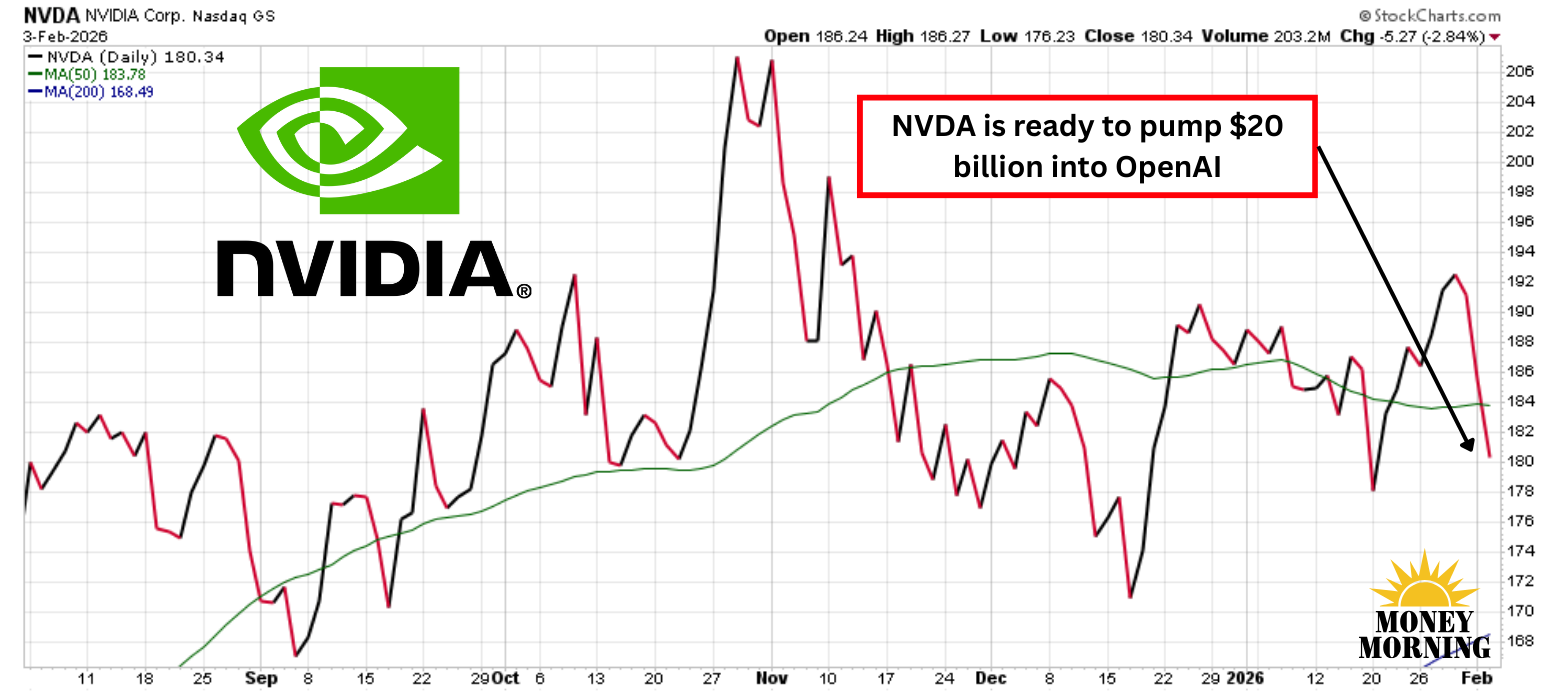
Both companies have pinpointed shortcomings in the other – Nvidia questioning OpenAI's execution, and OpenAI seeking hardware tweaks for better efficiency. Yet, this hasn't severed ties. OpenAI still depends on Nvidia for the bulk of its computing fleet, and the potential $20 billion infusion underscores a mutual recognition of interdependence in the AI race.
The Specter of Circular Financing
This interplay does little to quiet critics who decry much of Nvidia's investment strategy as circular financing. Detractors argue that Nvidia's hefty stakes in AI startups, including potentially OpenAI, create a self-reinforcing loop: Nvidia invests in companies that then buy its chips, inflating demand and revenues in a way that masks underlying market vulnerabilities. Such arrangements have drawn scrutiny from regulators and investors alike, questioning whether they artificially prop up Nvidia's dominance in AI hardware.
While the $20 billion figure is smaller than the original hyped figure, it aligns with Nvidia's pattern of strategic bets to embed its technology across the AI ecosystem. OpenAI's chip gripes highlight real technical challenges, but the investment signals that both sides see value in patching differences rather than parting ways.
Bottom Line
Despite mounting concerns over AI's long-term sustainability, the sector's expansion shows no signs of slowing. There are still hurdles to surmount, such as soaring energy demands that could strain global grids, while input costs skyrocket amid a massive copper shortage, critical for data centers and chips. Analysts warn of potential bottlenecks that might curb growth.
Yet, Nvidia remains undeterred, positioning itself as the linchpin for major players like OpenAI. With its fingerprints on key AI ventures, NVDA is betting big that innovation will outpace these challenges, ensuring its hardware powers the next wave of breakthroughs.
More By This Author:
AMD Tumbles 10% On AI Worries Despite Record Results
Cathie Wood Just Dropped $33.5 Million On Robinhood. Time To Buy?
PayPal Is Plunging 14% As Profits Come Up Short



Comments
Log in or sign up to join the conversation.