

Image Source: Pexels
Joby Aviation (JOBY) is at the forefront of the eVTOL industry, aiming to revolutionize urban transport with its air taxis. The company has made steady strides, completing three of five FAA certification phases and gearing up for passenger flights in 2026. It plans to debut services in Dubai this year. Partnerships with airlines, automakers, and even Nvidia (NVDA) for autonomous flight controls, plus manufacturing expansions in Ohio and California, support its goal to produce four aircraft monthly by 2027.
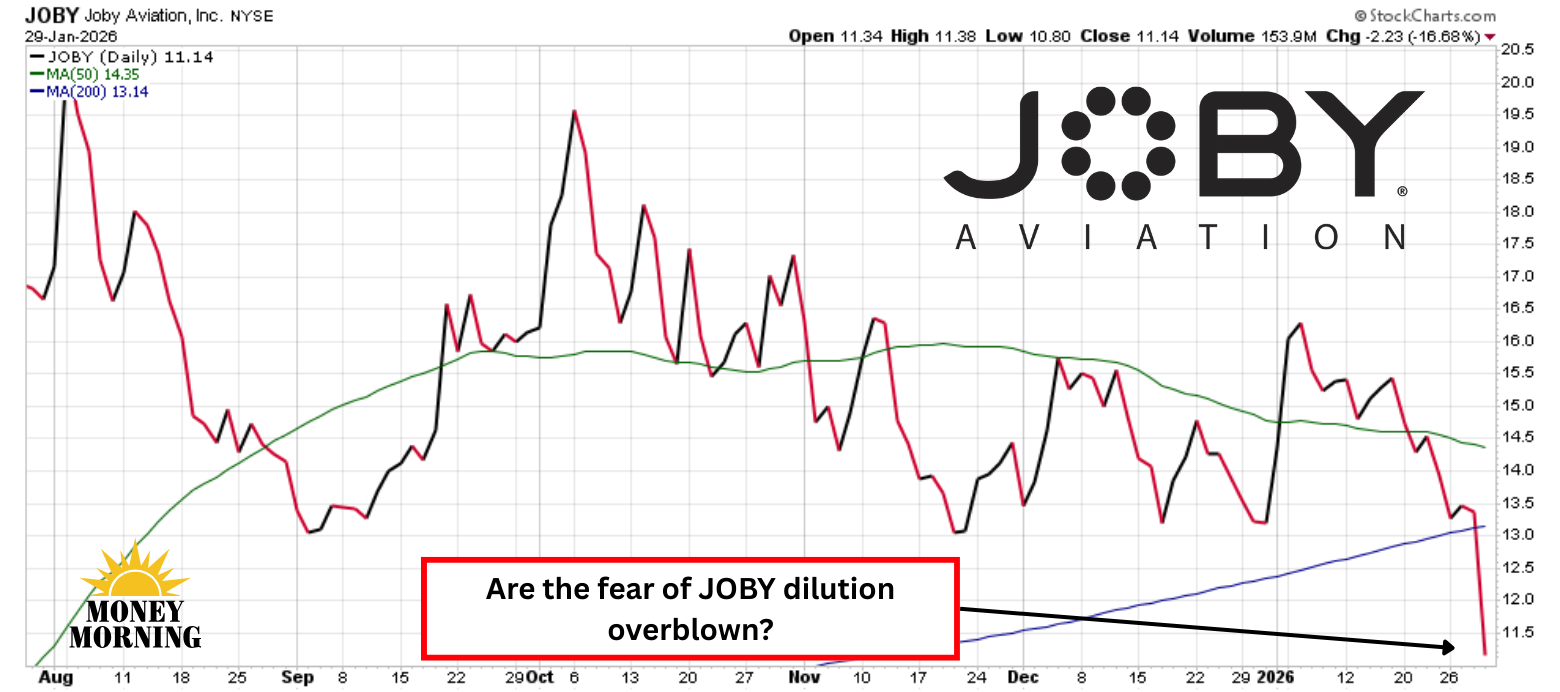
But Joby's stock has been volatile lately, trading in a narrow band for the past few months. Yesterday, though, its stock cratered 16.7% to close at $11.14, marking one of the day's biggest losers. So, what triggered this sharp drop?
The Billion-Dollar Cash Raise
To bridge the gap to commercialization, Joby needs substantial capital for certification, production scaling, and operational setup. Yesterday morning, it unveiled an upsized fundraising effort of a $600 million convertible senior notes issuance and the sale of about 52.9 million common shares at $11.35 each. This combined offering aims to generate roughly $1.2 billion before expenses, exceeding the initial $1 billion target. Net proceeds are estimated at $583 million from the notes and $576 million from the stock, with potential increases if underwriters exercise options. The proceeds will bolster Joby's $978 million cash reserves from the end of Q3, covering certification, manufacturing ramps, commercial preparations, and general needs.
The convertible senior notes mature in 2032 and bear a low 0.75% annual interest rate, paid semi-annually. These instruments act as debt but allow holders to convert into Joby shares at an initial price of $14.19 per share, a 25% premium over the $11.35 stock offering price. This structure offers Joby cheaper borrowing costs than traditional bonds, thanks to the equity conversion option, making it a cost-effective choice for a growth-stage company. Joby can settle conversions in cash, stock, or a mix, providing flexibility.
(Click on image to enlarge)
Protection Against Dilution
To counter potential share dilution from conversions, Joby also used $55 million of the notes' proceeds for capped call transactions. These derivatives essentially buy protection: They offset extra shares or cash payouts if the stock rises above $14.19, up to a cap of $22.70 per share – a 100% premium over $11.35. This mechanism raises the effective conversion threshold, safeguarding existing shareholders from excessive dilution while keeping financing affordable.
Yet the market balked at the immediate effects: The new shares dilute ownership by about 7%, and the discounted $11.35 pricing – 15% below the prior close of $13.37 – sparked the selloff. A separate 5.3 million share delta offering for hedging added to the pressure. Such reactions are typical for pre-revenue firms raising capital, as near-term dilution overshadows future gains.
Bottom Line
Joby stock now trades at the same price it did last July, presenting investors with a buying opportunity for those who believe in eVTOL's potential to overhaul mobility. But it's still only one for those with risk tolerance as electric urban air mobility is still an emerging industry with unproven demand, a need to overcome any public skepticism, and time for widespread adoption. It might take years for eVTOL's to become truly viable, but at this new, lower price valuation, Joby is a buy.
More By This Author:
Did META Just Prove It's Not Making The Same Metaverse Fiasco With AI?
Humana's Health Scare Sinks Stock To 9-Year Low. Time To Buy?
IREN Soars 15% On Amazon Deal Rumor. Could It Happen?



Comments
Log in or sign up to join the conversation.