


Image Source: Unsplash
Meta Platforms' (META) latest fourth-quarter earnings reignited investor enthusiasm for the social media stock as the results indicate the fiasco it created with unchecked spending on the metaverse is not being repeated with AI.
While Meta faced skepticism going into the earnings report due to heavy and ongoing losses by Reality Labs, workforce reductions, antitrust scrutiny, and concerns over its dependence on ad revenue, it was able to deliver a strong beat.
AI Supercharging Growth
The company reported Q4 revenue of $59.9 billion, up 24% year-over-year and surpassing Wall Street expectations of around $58.6 billion. Earnings per share came in at $8.88, also topping estimates of $8.22 and rising from $8.02 a year ago.
The core Family of Apps segment – Facebook, Instagram, WhatsApp, and Messenger – drove the momentum, generating $58.9 billion in revenue (up 25%) and $58.1 billion in advertising (up 24%). Ad impressions grew 18%, with average price per ad rising 6%. Operating income hit $24.7 billion, yielding a robust 41% margin. AI enhancements played a key role here, boosting engagement – such as a 7% lift in organic feed and video views – and improving ad performance through better ranking, personalization, and tools like generative media creation. Daily active users generating media with Meta AI tripled year-over-year.
This contrasts sharply with the metaverse era, when CEO Mark Zuckerberg's bold pivot to virtual reality led to massive, unprofitable spending without clear returns. Reality Labs continues to struggle, with Q4 revenue falling 12% to $955 million, while operating losses widened to $6.02 billion compared to $4.97 billion a year earlier. Cumulative losses since late 2020 now approach $80 billion, with full-year 2025 losses at $19.2 billion.
(Click on image to enlarge)
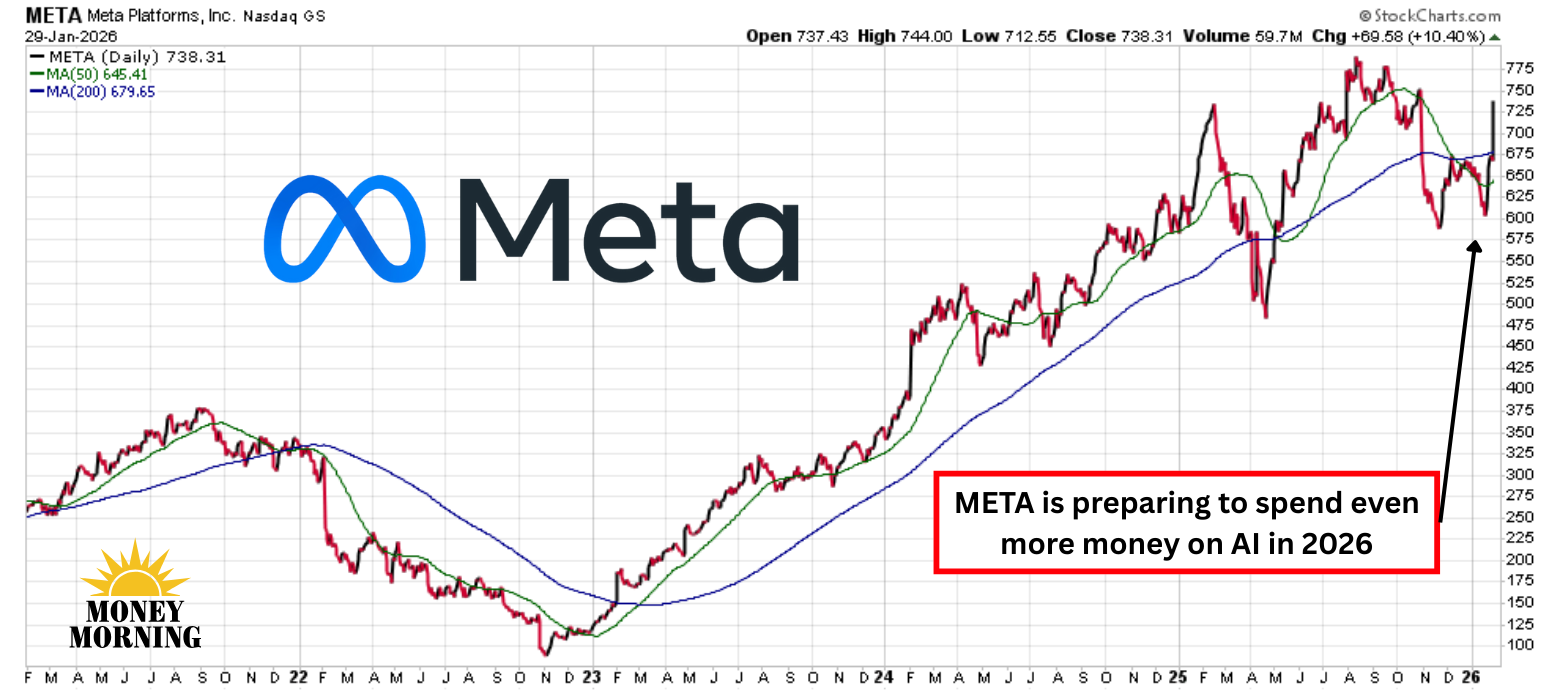
Yet Meta promises a shift is coming. Zuckerberg indicated Reality Labs losses should peak in 2026 and then gradually decline, with itys focus pivoting toward promising areas like smart glasses – sales more than tripled in 2025 – and wearables, rather than pure virtual reality headsets. Recent layoffs in the division (over 1,000) underscore the reallocation toward AI priorities.
An Even Bigger Bet on AI
Meanwhile, Meta is doubling down on AI with unprecedented investment. Capital expenditures surged in 2025 to about $72 billion, but the company guided for $115 billion to $135 billion in 2026 to build infrastructure for "personal superintelligence," advanced models, and AI agents. Total 2026 expenses could reach $162 billion to $169 billion, a 43% increase.
Despite short-term margin pressure and projected free cash flow impacts, Meta's core ad engine funds this aggressively: 12-month revenue growth of 21% outpaces peers like Alphabet (GOOG, GOOGL) (13%) and Amazon (AMZN) (11%), while its stock trades at cheaper valuations than its hyperscaler peers.
Bottom Line
The market's response was immediate, with shares jumping 10%, reflecting confidence that AI is delivering measurable ROI in ads and efficiency, unlike the metaverse's resource-draining. Zuckerberg's vision emphasizes a rapid AI trajectory over instant perfection, positioning Meta to lead in AI-driven experiences.
While risks remain, such as regulatory probes, competition, and execution on the massive spending Meta's proven cash generation, strong balance sheet – it ended the quarter with $81.6 billion in cash and equivalents – and accelerating core growth suggest AI is not repeating the mistakes of the metaverse. Instead, it's building on a profitable foundation.
For long-term investors tolerant of tech volatility, the potential upside as AI monetization scales in 2026 and beyond makes META stock a buy.
More By This Author:
Humana's Health Scare Sinks Stock To 9-Year Low. Time To Buy?
IREN Soars 15% On Amazon Deal Rumor. Could It Happen?
Pinterest Stock Keeps Falling. Is It Too Cheap To Ignore?



Comments
Log in or sign up to join the conversation.