

Quantum computing burst onto the scene like a supernova, captivating investors who envisioned it mirroring AI's explosive growth and transforming industries from drug discovery to finance. Hype surged as companies promised breakthroughs in solving complex problems beyond classical computers' reach.
However, nagging uncertainties about timelines such as when would viable, scalable quantum systems arrive, began eroding enthusiasm. Stocks like D-Wave Quantum (QBTS) lost their luster amid these doubts. In today's risk-off market, with economic headwinds and delayed quantum milestones, the sector is plummeting.
QBTS tumbled nearly 15% yesterday, sits 34% below where it started 2026, and trades 63% below its all-time high, reflecting a broad investor retreat.
Understanding D-Wave's Unique Approach
D-Wave stands out in the quantum computing landscape by focusing on quantum annealing, a specialized technique optimized for solving complex optimization problems. Unlike gate-based quantum computers pursued by competitors such as IBM (IBM), IonQ (IONQ), or Rigetti Computing (RGTI), which aim for universal computing capable of running any algorithm, D-Wave's systems excel in practical applications like logistics, scheduling, and machine learning enhancements.
This annealing approach uses quantum bits (qubits) to explore vast solution spaces efficiently, making it more immediately applicable for real-world business challenges rather than theoretical universality.
(Click on image to enlarge)
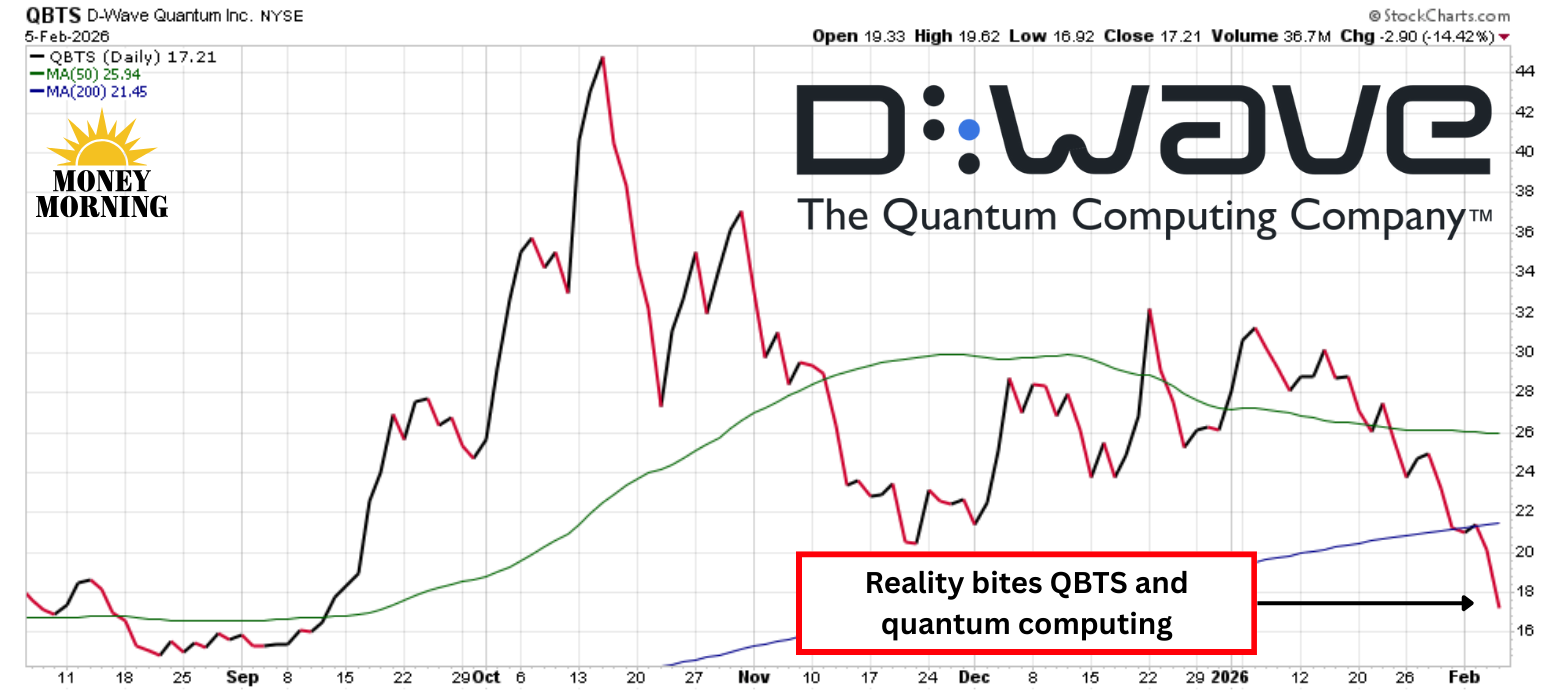
What differentiates QBTS from other quantum stocks is its commercial maturity. While many peers remain in early research stages, D-Wave has deployed operational systems via its Leap cloud platform, allowing businesses to access quantum capabilities without owning hardware. This positions QBTS as a pioneer in quantum-as-a-service, contrasting with the hardware-centric focus of others. However, this niche comes with trade-offs: annealing isn't suited for all quantum tasks, like Shor's algorithm for cryptography, limiting its scope compared to gate-model rivals.
Strategic Moves Fueling Future Growth
Despite market turbulence, D-Wave is aggressively expanding its technological footprint. A key milestone was its acquisition of Quantum Circuits, a move that transformed D-Wave into a dual-platform quantum computing company. By integrating Quantum Circuits' gate-based architecture with its own annealing systems, D-Wave now offers a hybrid ecosystem that combines the strengths of both paradigms.
This strategic expansion enhances its capabilities, broadening market appeal and positioning it to tackle a wider array of problems, from optimization to simulation. The acquisition also bolsters D-Wave's intellectual property and talent pool, strengthening its competitive stance in a fragmented industry.
D-Wave has secured significant contracts totaling $30 million, underscoring growing enterprise interest. These include quantum-computing-as-a-service (QCaaS) agreements that promise recurring revenue streams, shifting from one-off sales to subscription models. Such deals with sectors like manufacturing and finance validate D-Wave's practical utility and could stabilize cash flows amid volatility.
Technological advancements further signal potential. D-Wave's hybrid solver recently demonstrated a 10x faster solution time for defense applications, such as radar optimization and resource allocation. This breakthrough enhances its edge in critical sectors like aerospace and national security, where speed and efficiency are paramount. By blending quantum and classical computing, these hybrids make quantum more accessible today, bridging the gap until full-scale systems mature.
Bottom Line
Quantum computing faces formidable structural hurdles, including qubit stability, error correction, and scalability – issues that could delay widespread adoption for years, if not decades. While D-Wave's advances are promising, the field remains nascent, riddled with technical and economic uncertainties.
Investors should treat stocks like QBTS as speculative bets, not core holdings. There may be a bright future if quantum lives up to its potential, but wagering large sums now risks significant losses in this high-stakes gamble.
More By This Author:
It Ain't $100 Billion, But Nvidia's $20 Billion OpenAI Investment Isn't Nothing Either
AMD Tumbles 10% On AI Worries Despite Record Results
Cathie Wood Just Dropped $33.5 Million On Robinhood. Time To Buy?



Comments
Log in or sign up to join the conversation.