

Image Source: Pexels
- Target date funds (TDFs) need modernization, as their set-it-and-forget-it approach limits participant engagement and most TDFs expose investors to excessive risk near retirement.
- Integrating academic lifetime investing theory with personalized risk tolerance offers a superior framework, enabling investors to adjust as they age and as preferences change.
- Investors should actively assess their risk tolerance, compare the associated model in this article with TDF allocations, and consider shifting to more personalized allocations if misaligned.
Yaqub Ahmed is Global Head of Retirement, Workplace & Wealth with the FIRST Organization (Franklin Innovation Research Strategies Technology). In 5 Trends Shaping the Future of Retirement he explains:
The industry created somewhat of a monster with target-date funds, with its “set it and forget it” mindset, thereby limiting participant engagement.
“Some may argue that it’s a better approach,, but we believe participants are far from disengaged,” Ahmed responded. “They want to be involved—they just don’t know where to start. The real issue is that we’re not effectively activating those engagement levers.
Target date funds (TDFs) are crying for improvements that are just beginning. This article is about contemporary models that enable personalization. These improvements apply to both retirement savings plans and IRAs, in other words to all tax deferred savings. And most of all, this article is about substantive prudence – doing what is best and right.
Better models
Investment models are ubiquitous. Investors can get models from just about any money manager, using that manager’s funds of course.
I present a framework for investment models that integrates lifetime investment paths – like those used in target date funds -- with academic lifetime investing theory.
To keep things simple, I use just two assets – a well-diversified portfolio of risky assets and a safe asset like T-bills. Ibbotson Associates labeled this approach the “Separation Principle.” Identify the model that is best for you and implement it with your favorite risky and safe portfolios, potentially with the help of an investment advisor.
Framework
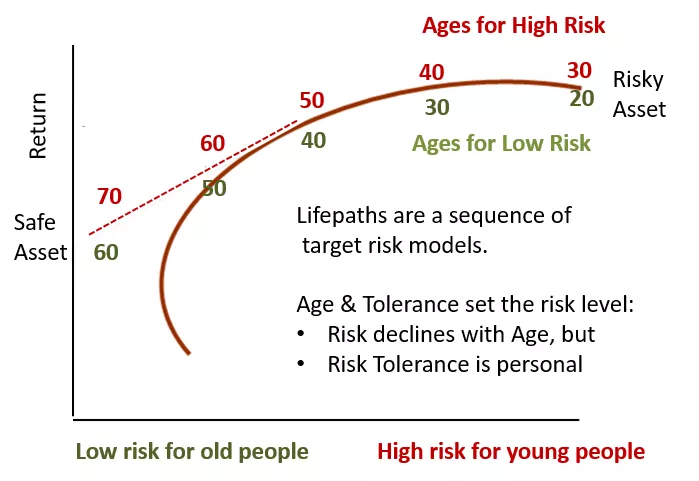
My models are a sequence of target risk models along the efficient investment frontier where your position on the frontier is a function of your age and your risk tolerance, as shown in the following:
Academic lifetime investment theory sets the risk level based on age. It integrates human capital with investment capital as follows:
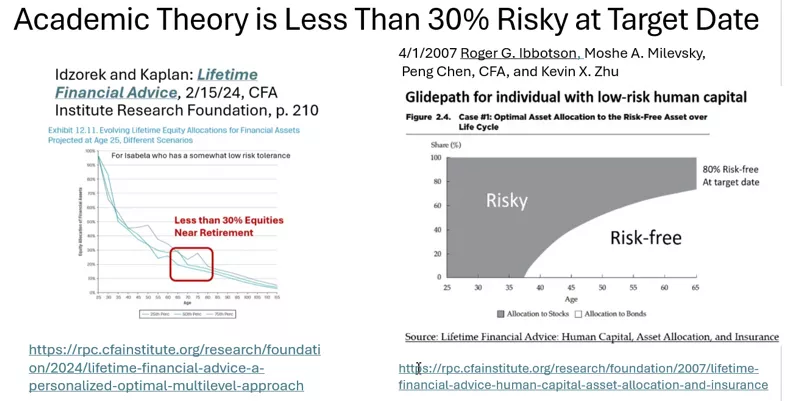
As our human capital depletes, we become increasingly dependent on our investments, so theory says that our investments can be risky when we’re young, but we should become less risky as we age. As we are near retirement, theory says very low risk, as shown in the following:
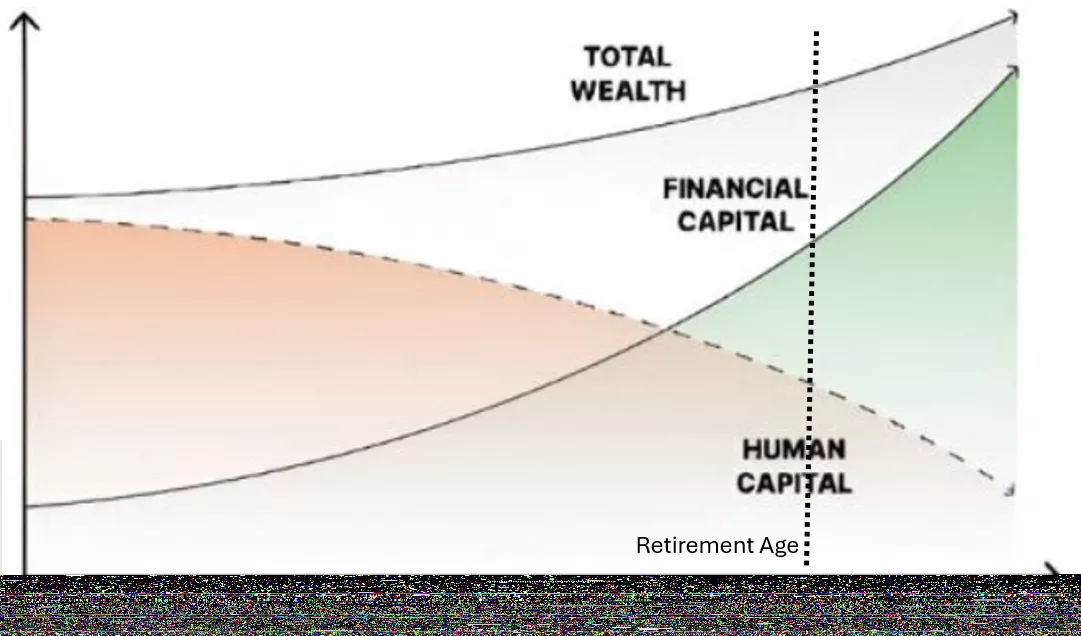
But we all have our personal feelings about risk that creates our risk preferences. Behavioral scientists tell us that we are risk averse -- we don’t like risk. But some people are risk takers, and they want their money to work really hard. Academic theory sets the standard for the risk averse majority, but an individual can override theory. Hence the red ages in the efficient frontier graph above.
This theory brings us up to retirement, at which time I point to a different theory
Investing in retirement
The academic theory for investing in retirement was introduced in Kitces and Pfau’s 2013 paper on Reducing Retirement Risk with a Rising Equity Glide-Path. Kitces & Pfau make a very persuasive case for entering retirement with low risk and then re-risking in retirement. We all pass through 3 stages of investing where the second stage of transitioning from working life to retirement should be very safely invested.
Connecting with pre-retirement theory, the pre-retirement glidepath needs to end safe to connect with a post-retirement path that starts safe, creating a U shape.
Implementation
Acknowledging different levels of risk tolerance requires several lifetime glidepaths as shown in the following:
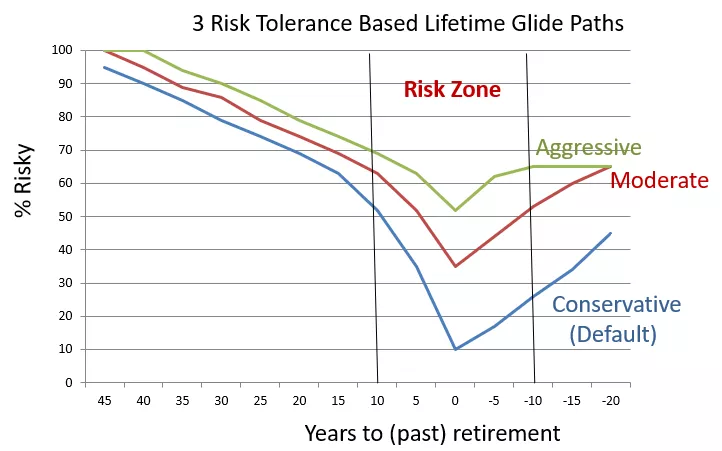
Investors can blend these glidepaths and they can change their risk tolerance at will. And there you have a framework for investment models. Voila!
How do one-size-fits-all TDFs fit in this model?
TDFs are all very similar to one another and fit into my model framework as shown in the following:
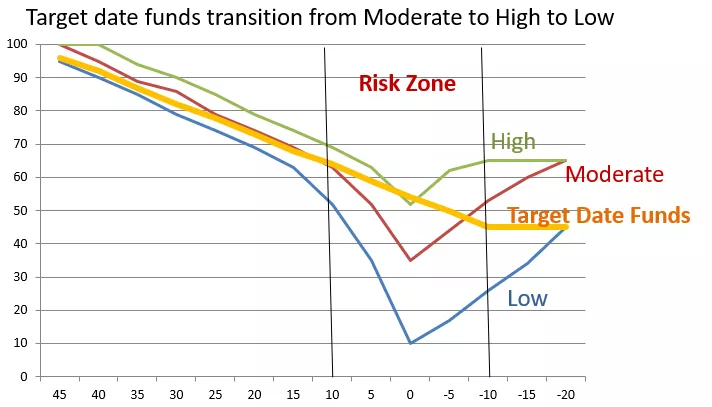
As shown in the exhibit, TDFs take moderate risk until they reach the Risk Zone when they become high risk, and then in retirement they become low risk. Note that participants in the Risk Zone are taking high risk. They don’t know it, but they will when the stock market crashes. A crash will be a “good” thing because it will expose this high risk, opening the door for improvements. Substantive prudence will morph into procedural prudence.
Conclusion
Albert Einstein said that everything should be as simple as possible, but no simpler. Here is a simple universal investment framework. Please use it.
Readers of this publication expect an action step. How should you use this article? Please feel free to contact me. I have tools you can use. But if you’d rather not contact me, here’s what you can do:
- Think about your risk tolerance. Most of us have low risk tolerance, but you might be different.
- Find your risk tolerance path (low, middle or high risk) in the last graph above and locate yourself on the horizontal axis by finding the number of years that you are away from retirement and then look diagonally to your left for an allocation to your diversified risky portfolio.
- Act.
- Is the answer near your current portfolio? This will either confirm or question what you’re currently doing.
- If you’re invested in a target date fund, how close is your answer to a TDF? If it’s not close, consider getting out of your TDF, especially if it’s riskier than your answer.
More By This Author:
High Earnings Growth Does Not Justify High Price/Earnings
The Santa Rally Could Fizzle This Year
Tipping Point: Baby Boomers Beware


Comments
Log in or sign up to join the conversation.