


Photo by Taylor Brandon on Unsplash
One of the hallmarks of the Israeli economy is its great resilience during the past two years as it dealt with wars on all its borders. The centrality of the high tech sector has placed the nation into one of the top three centres in the world in just about all facets of the digital world. Above all, the Israeli economy has bifurcated into two broad sectors marked by different levels of productivity and overall contribution to long term growth.
The tech sector’s dominance is felt throughout the economy.The nation’s current account balance has been in surplus for several years running , thanks ,in large part, to the high-tech services sold worldwide. The sector accounts for 57% of all Israeli exports, employing 15-20% of the labour force. Foreign direct investment continues at a healthy pace, approximately $15 billion was invested in 2025. As a result, the national budget has recorded record levels of tax revenues, providing considerable fiscal room to fund the relatively high rate of military and security expenditures.
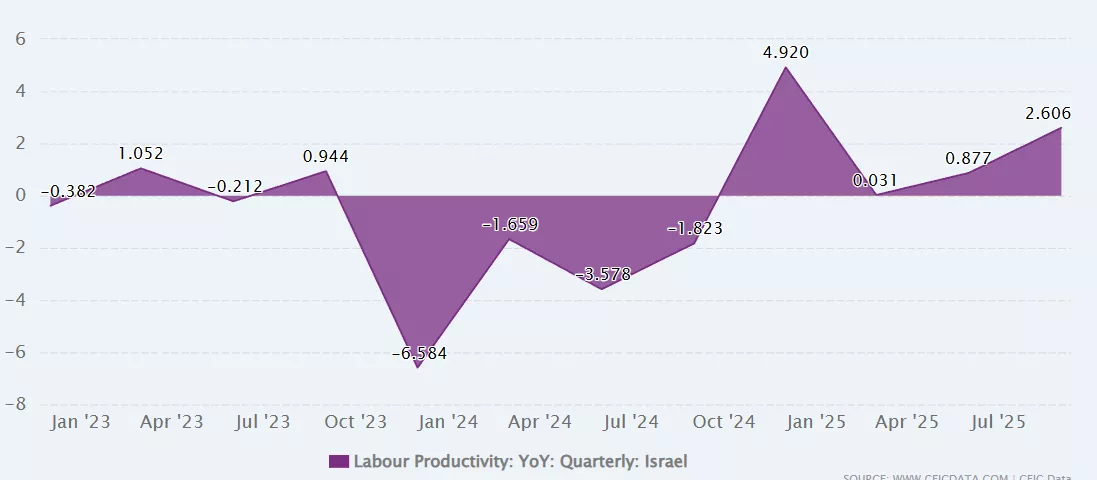
Economists prefer to look at total factor productivity which takes into account all the factors that go into a worker’s success. That includes workers’ education,capital investment available to each worker, along with estimates of growth not explained otherwise. Much of the unexplained factors relate to education and the introduction to new technologies over time. Using this more complete measure, Israel’s productivity performance shot up, once hostilities ended late in 2025.
Israel's economy is often described as a "dual economy," characterized by a significant productivity gap between a highly advanced high-tech sector and the rest of the economy. This gap is a central structural challenge for the country's long-term growth. Productivity among tech workers is roughly three times that of the non-tech sector employees,, creating an ever growing gap in wages.The high-tech sector's productivity is not just higher; it grows at a much faster pace than the national average. While the high-tech sector is at the global frontier, traditional industries suffer from low capital per worker and slower adoption of digital equipment.
Israel, Total Productivity Growth, 2023 to 2025
(Click on image to enlarge)
Looking under the hood, the disparities in wages reflect the productivity gap between tech and traditional workers.The former earns upwards of three times the latter. Moreover, the tech sector’s incomes are rising faster than those in the traditional industrial sectors, thus contributing to worsening income disparities. Israel has one of the highest degrees of income inequality amongst OECD members, largely because its tech contributes so much added value.
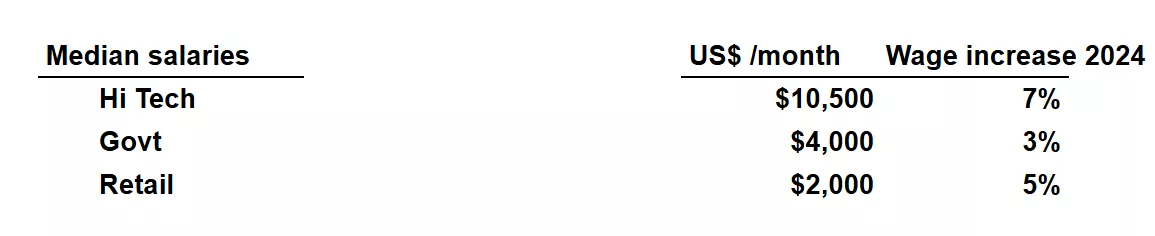
Source: author
The late-2023 conflict hit the traditional sectors ,especially construction and agriculture, the hardest due to labor shortages. Meanwhile,the high-tech sector was able to conduct business, as usual, and attracted funding from overseas investors to expand operations . Moreover, the Israeli tech sector has become multinational with offices throughout the Americas, Europe and even Asia which allowed the industry to continue operations uninterrupted during the Middle East war.
Israel's challenge remains that its high-tech success has created a "Two-Speed Economy” . The High wage levels contribute to driving up local living costs, especially in the major urban centres, employing the bulk of the tech workers. Nonetheless,the tax system is too dependent on returns from a relatively small segment of the workforce. With that dependency, the country has to fund a generous welfare system and maintain defense expenditures in the face of external threats. So far, the economy has rebounded strongly from the 2024-25 war years slowdown and is operating efficiently along its long term growth projections.
More By This Author:
Israel’s Economy Enters A Sweet Spot
The Failure Of U.S. Trade Policy: How Asia Successfully Overcame U.S. Tariffs
The Truth About U.S. Tariffs is Finally Emerging



Comments
Log in or sign up to join the conversation.