


Photo by Taylor Brandon on Unsplash
When the Bank of Israel lowered its policy rate by one-quarter point to 4% yesterday it caught the market by surprise, especially knowing how expansionary the economy has been since the cessation of hostilities in Gaza. In a wide ranging statement, the Bank of Israel offered very compelling reasons as to why it concluded that the economy needed a rate cut.
Inflation is well under control.Over the past 12 months consumer prices have increased by a very modest 2.4%, well within the Bank’s target range of 1%-3%. More importantly, the Bank forecasts that inflation will likely remain within the target range, possibly going below 2%.
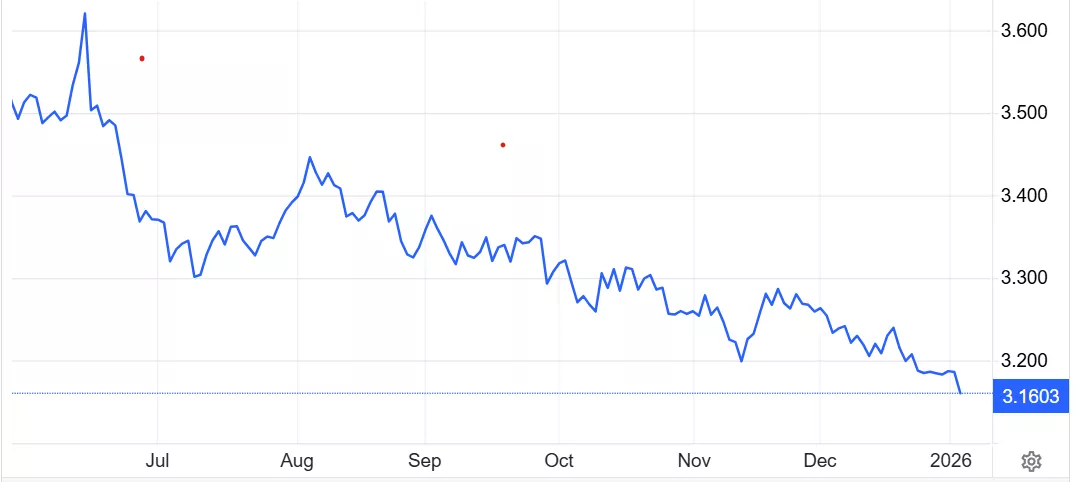
Currency is too strong. Although the Bank does not target the Israeli shekel explicitly, it does take particular note the shekel appreciated by 14% since April, 2025. Israel continues to run large current account balances, approximately $ 5 billion a quarter. An additional $ 5 billion a quarter enters the country through foreign direct investment, principally into its tech sector.
Israeli Shekel per USD
Credit markets are healthy. The Bank emphasizes that the nation’s financial situation is very healthy, as risk premia, as measured by CDS spreads ( a form of bond insurance) are back to pre-war levels. Also, the Tel Aviv stock market had an outstanding year, outpacing all other markets in the OECD. The tech sector continues to raise capital from domestic and overseas investors at previous high levels.
Consumer spending once again. Consumer credit is growing, and2026 forecasts for consumption are in excess of 7%, well above the inflation rate.Wage increases in the private sector averaged 5.5% over the last year, indicating workers' real wages continue to grow. The labour market remains relatively tight with job openings relativelyhigh in relation to the number of unemployed.
Labour market conditions have improved due to a dramatic decline in military reserve duty and participation rates and employment rates returning to pre-war levels. In other words, normal labour market conditions have returned.
Economic forecasts have been upgraded. The Bank conducted its forecast on the assumption the ceasefire in Gaza will be maintained and that the number of reservists called up willcontinue to decline. GDP for 2026 is forecasted to expand by 5.2% ;inflation will be under 2%; the budget deficit will be 3.9% of GDP; and, the debt to GDP ratio at 68.5% Finally, the Bank expects that its interest rate will decline further to 3.5% by year’s end.
What surprised many observers was that the Bank followedits Novemberrate cut so soon in January. Clearly, the surge in the shekel and its impact on future inflation provided the roomto cut the rate and provide even more stimulus to an economy that is performing better than its peer group.
More By This Author:
The Failure Of U.S. Trade Policy: How Asia Successfully Overcame U.S. TariffsThe Truth About U.S. Tariffs is Finally Emerging
A Year After Trump Launched His Trade War Canada Remains Largely Unscathed

Comments
Log in or sign up to join the conversation.