


Image Source: Pixabay
Gold (XAU/USD) regains ground on Friday, notching yet another record high after coming under brief pressure earlier in the day. At the time of writing, XAU/USD is trading around $4,980, rebounding from an intraday low near $4,899, and remains on track for a third consecutive weekly gain.
Meanwhile, a mixed batch of US economic data failed to offer meaningful support to the US Dollar (USD), allowing Gold to extend its advance.
Bullion is up more than 8% this week, supported by strong safe-haven demand after renewed trade rhetoric from US President Donald Trump over the Greenland dispute unsettled global markets, reviving “Sell America” sentiment.
However, some of these tensions eased on Wednesday after Trump backed away from earlier threats to impose tariffs on several European nations following the announcement of a future-framework agreement on Greenland.
The move did little to cool Gold’s bullish momentum, as investors remain unconvinced that tensions are fully resolved, with the framework agreement lacking concrete details. At the same time, broader geopolitical and economic uncertainties continue to underpin demand for safe-haven assets, keeping the precious metal well bid.
Market movers: US data, Fed leadership and policy credibility concerns
- Preliminary S&P Global Purchasing Managers Index (PMI) data showed Manufacturing PMI rising to 51.9 in January from 51.8, below expectations of 52.1, while Services PMI came in at 52.5, unchanged from December but below the 52.8 forecast.
- University of Michigan survey data for January showed the Consumer Expectations Index climbed to 57, above forecasts and the previous reading of 55. The Consumer Sentiment Index improved to 56.4, beating expectations and rising from 54. One-year Consumer Inflation Expectations eased to 4.0% from 4.2%, while five-year Inflation Expectations slipped to 3.3% from 3.4%.
- Economic data released on Thursday showed the US economy expanded at an annualized pace of 4.4% in the third quarter, beating market expectations of 4.3% and accelerating from 3.8% in Q2. Core Personal Consumption Expenditures (PCE) inflation held steady at 2.9% QoQ, while Initial Jobless Claims rose to 200,000 from 199,000 the prior week.
- The US Dollar Index (DXY), which tracks the greenback against a basket of six major currencies, is trading around 98.36, near two-week lows, and is on track for its first weekly decline in three weeks.
- US President Donald Trump’s disruptive trade agenda and repeated use of tariffs as a policy weapon are eroding investor confidence in US assets, fueling debasement concerns and driving demand for traditional safe-haven assets.
- President Donald Trump said on Thursday that he has completed interviews for the next Federal Reserve (Fed) Chair and confirmed he has made his selection, adding that a formal announcement is likely before the end of January. Media reports suggest the shortlist includes Kevin Hassett, Rick Rieder, Christopher Waller, and Kevin Warsh, although Trump indicated last week that he may keep National Economic Council Director Kevin Hassett in his current role.
- Markets remain wary that President Trump’s choice for the next Fed Chair could push the central bank toward a more dovish policy path, following his repeated criticism of current Fed Chair Jerome Powell for not cutting interest rates more aggressively.
- On the monetary policy front, recent US economic data have reinforced the view that the Fed is likely to stick to a gradual easing path rather than aggressive rate cuts. Markets are almost fully pricing in no change
at the upcoming January 27-28 meeting and broadly expect the central bank to remain on hold through the first quarter.
Technical analysis: Bulls pause below $5,000
(Click on image to enlarge)
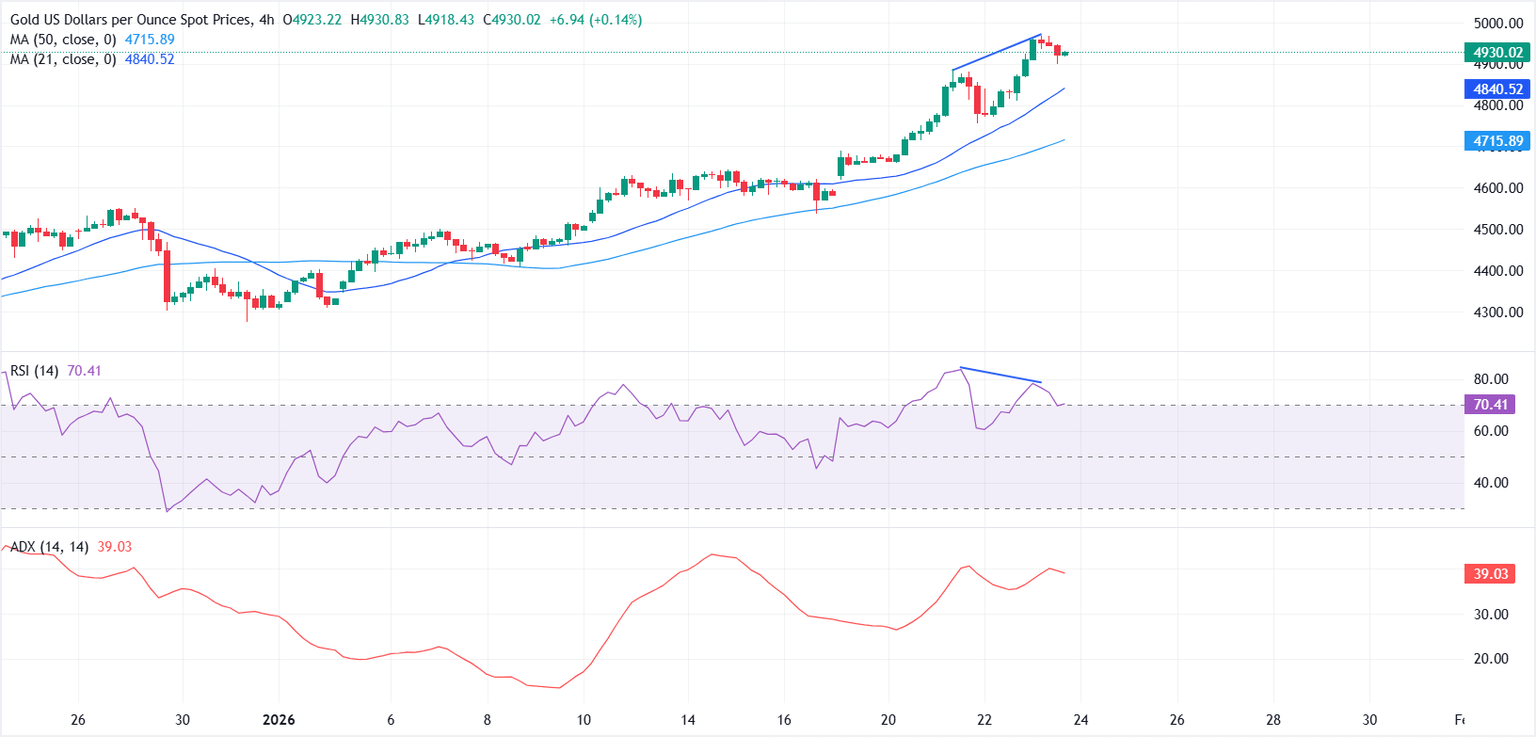
From a technical perspective, trend conditions remain firm, with XAU/USD holding well above the 21-period and 50-period Simple Moving Averages (SMAs). The Average Directional Index (ADX) is hovering around 39, signaling a strong trend environment despite emerging signs of near-term exhaustion.
The risk of a pullback is rising as overbought conditions persist across multiple timeframes. On the 4-hour chart, the Relative Strength Index (RSI) has eased back toward the 70 level and is printing a bearish divergence, signaling early signs of fading upside momentum.
On the downside, immediate support is seen at the $4,900 psychological level. A sustained break below this zone shifts focus to the 21-period SMA near $4,828, followed by the 50-period SMA around $4,709. On the upside, the $5,000 psychological mark remains the key resistance.
More By This Author:
Gold Pauses Near Record Highs As Bulls Struggle Below $5,000
Japanese Yen Languishes Near One-Week Low Vs. USD Ahead Of BoJ Presser
Gold Refreshes Daily Top As Fed Rate Cut Bets Offset Positive Risk Tone Ahead Of US PCE



Comments
Log in or sign up to join the conversation.