

My least favorite thing in the world is when people talk in absolutes. You know when people say things like "I always win at cards," or "I never eat chocolate." The average person knows that at least once in this world of absolutes, you can find an exception to the absolute terms of which some people live their lives.
The world of investing is no different. When someone says a stock is worthless, or a stock is an amazing value, savvy investors raise an internal flag of caution. No one knows for sure. The reality of investing is that the market exists in a state of asymmetrical risk and reward. Investors are told that risk and reward have perfect correlation. Higher risk equals higher reward. Lower risk equals lower reward. I would argue that this actually represents an investor's perception of risk and reward. As investors, our perceptions do not equal reality.
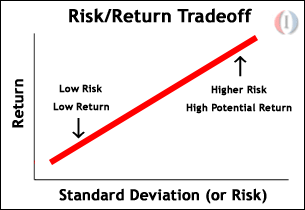
The key to beating the market, is to identify opportunities that are not recognized by the masses. Sometimes that means buying stocks that others call worthless. In fact, these are some of my favorite ideas.
I've told some of my fellow investor friends this over the years. I remember when I sold Amazon.com after the dotcom bubble burst because someone wrote a piece that said the stock was worthless. Big mistake. Over the years, that stock has doubled, then tripled, then quadrupled. Worthless was the perception of the analyst, not the reality of the market.
If you search for a cheap preferred stock, trading at a fraction of face value, you easily find a list of dozens of these stocks on any given day. Many trade with limited volume. Most have suspended dividends. All are misunderstood, one way or another.
What possible outcomes exist for a preferred stock with suspended dividends?
The following diagram is a simple decision tree that outlines the possible outcomes that exist when a preferred stock has dividends suspended.
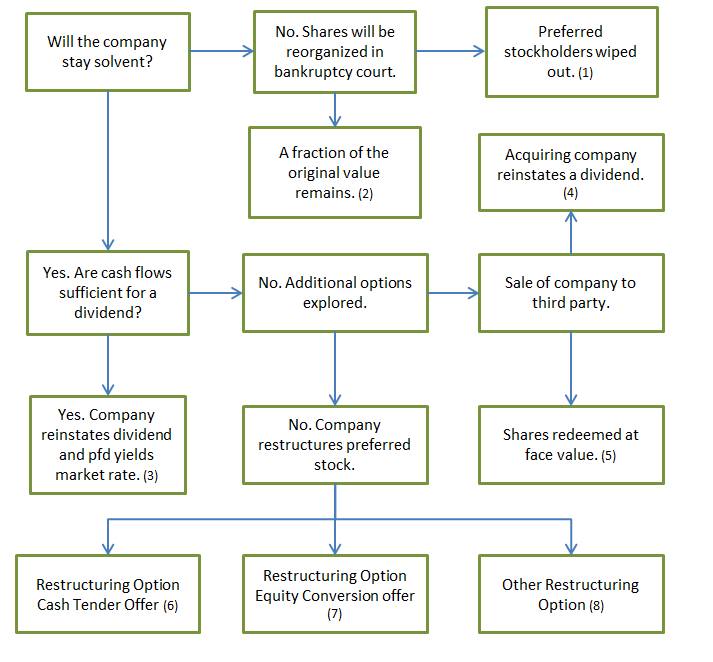
While the diagram doesn't outline all of the possible outcomes, it gives a large number of non-judicial outcomes. Sometimes, stockholders may want to try and force a decision through the court system, but most of the time, a company is forced to take one of these options, providing a resolution.
Why can't a company do nothing at all?
Failure to pay your debtors sends a pretty negative message to investors. In fact, the equity valuation of a company could be discounted to reflect all of the possible outcomes show above. For instance, a cash tender offer could result in a loss of working capital, which would then force the company to raise cash through an equity offering. A equity conversion offer could dilute earnings power. The biggest reason for finding a resolution, though, is that working towards a final resolution sends a message of confidence to the markets.
Using the diagram above, one may be able to create a model that provides the appropriate valuation for a preferred stock.
Here's a quick example for a typical perpetual preferred stock.
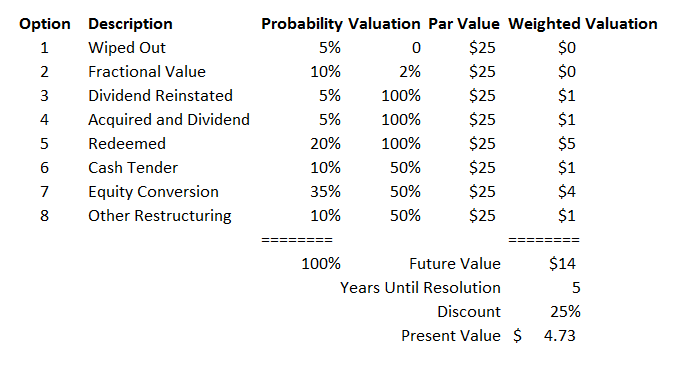
As you can see, there are about eight possible outcomes that would result in a final resolution to this preferred's stock's current suspended dividend status. In the first two options, the company becomes insolvent and the stock is destroyed. In the remaining outcomes, some value is unlocked for the shareholder. Using a discount rate and waiting period, a present value can be computed for the equity.
Here's a quick list of some preferred trading between $0.50 and $9.00. Before investing in any of these stocks, see if you can predict the answer to the first question in the decision tree above. REVISION * This post originally included another list of cheap preferred. I've deleted the original list and put this list below, sorted from cheapest to most expensive. I have done little due diligence over preparation of this list. Some of these preferred may not be ideal investment options. This is just intended to show that there are a number of preferred shares available for research.
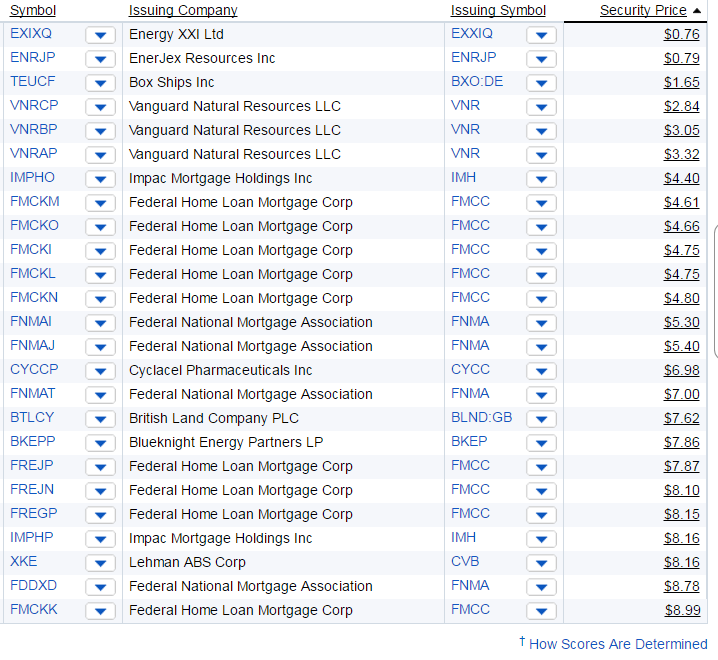
Do your own due diligence. If the answer to whether a company is going to go bankrupt is unclear, then steer clear of that equity and find an alternative investment option. Use a model to predict the final outcome and provide your own valuation of any preferred stock.

Comments
Log in or sign up to join the conversation.