

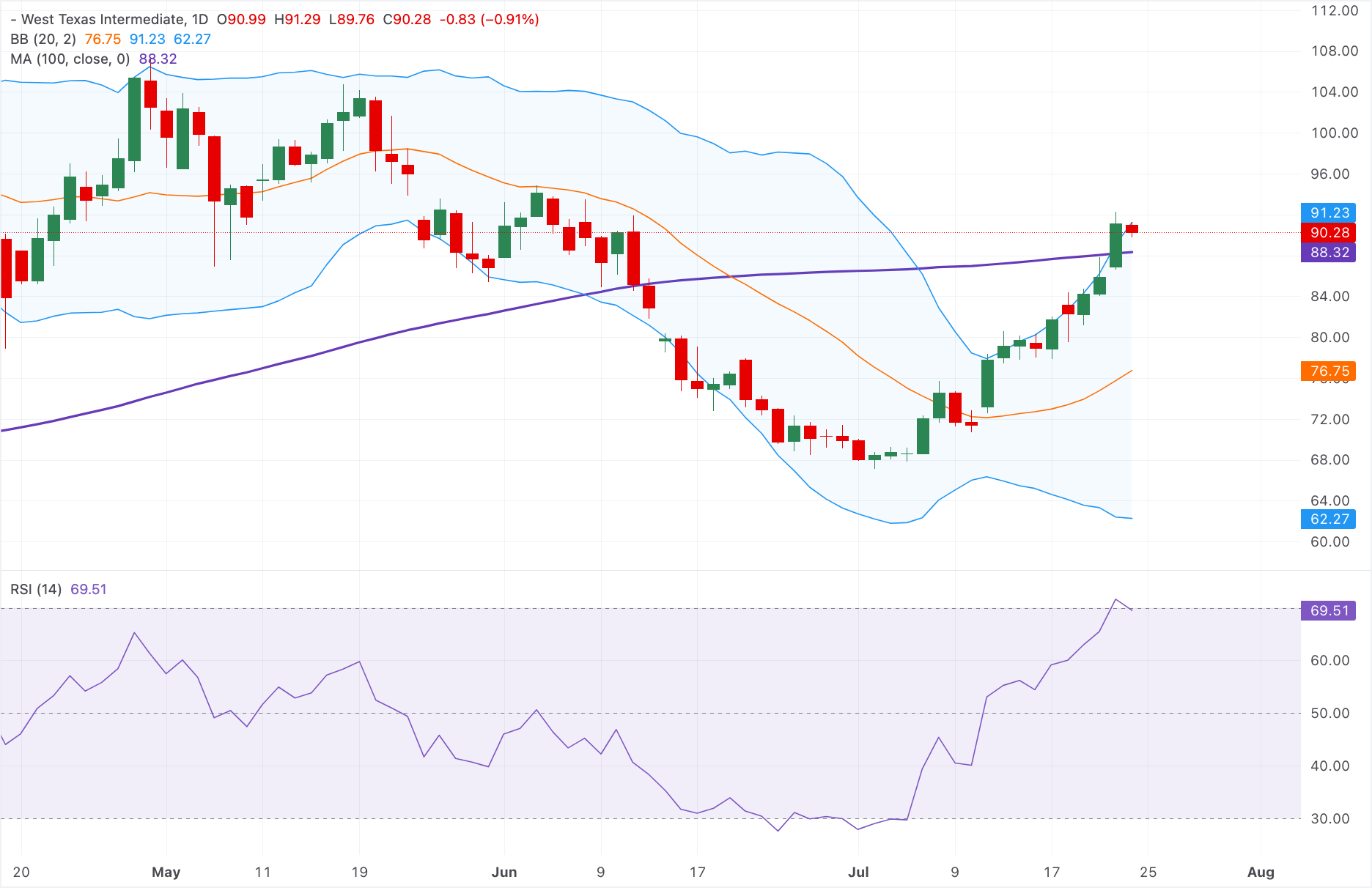
West Texas Intermediate (WTI), the US crude oil benchmark, is trading around $90.05 during the early European trading hours on Friday. WTI tumbles as traders book some profits. However, the potential downside might be limited as the escalating conflicts in the Middle East reignite fears over global energy supplies.
The US Central Command (CENTCOM) said on Friday that it has carried out a 13th consecutive night of strikes on Iran, targeting drone facilities, coastal surveillance sites and more. Iranian state media reported explosions along the Strait of Hormuz in Qeshm and Bandar Abbas as well as to the north-west near Andimeshk and Omidiyeh. Fears of oil supply disruption could boost the WTI price in the near term.
Furthermore, Yemen’s Iran-backed Houthi rebels attacked oil tankers in the Red Sea, threatening a key export route that Saudi Arabia has used to bypass the Strait of Hormuz. US President Donald Trump said that the US would hold Iran responsible for the Houthis’ actions and warned that Iran and its Houthi allies would both soon receive a “major military punishment.”
Technical Analysis:
In the daily chart, WTI US Oil holds above the 100-day simple moving average (SMA) and comfortably over the Bollinger middle band, keeping the near-term structure bullish despite the recent pullback from the highs. The Relative Strength Index (14) at 69.5 hovers just under overbought territory, suggesting upside momentum is still present but could be at risk of fatigue if buying extends without consolidation.
On the topside, immediate resistance is seen at the Bollinger upper band around $91.25, where renewed supply could emerge. Further north, the next hurdle is seen at the May 26 high of $93.57, en route to the June 3 high of $94.87.
On the downside, initial support is located at the $90.00 psychological level. The next contention level to watch is the 100-day SMA at $88.30, with deeper protection aligning with the Bollinger middle band near $76.75 and the lower band around $62.27 if a more pronounced correction unfolds.
Energy complex rallies as US-Iran tensions and Ukraine conflict intensify
Rabobank’s energy strategists observe that mounting geopolitical risks have been a key driver of the latest move higher across the energy complex. They highlight that “the escalation between the U.S. and Iran following the collapse of the interim peace deal, as well as intensifying strikes between Ukraine and Russia, drove price rallies across crude oil, refined products, natural gas, and European power markets over the past week.” Set against their medium-term view of gradually easing Brent and WTI prices, the bank suggests the current risk premium embedded in near-dated contracts may not be fully reflected further out along the curve.

Comments
Log in or sign up to join the conversation.