

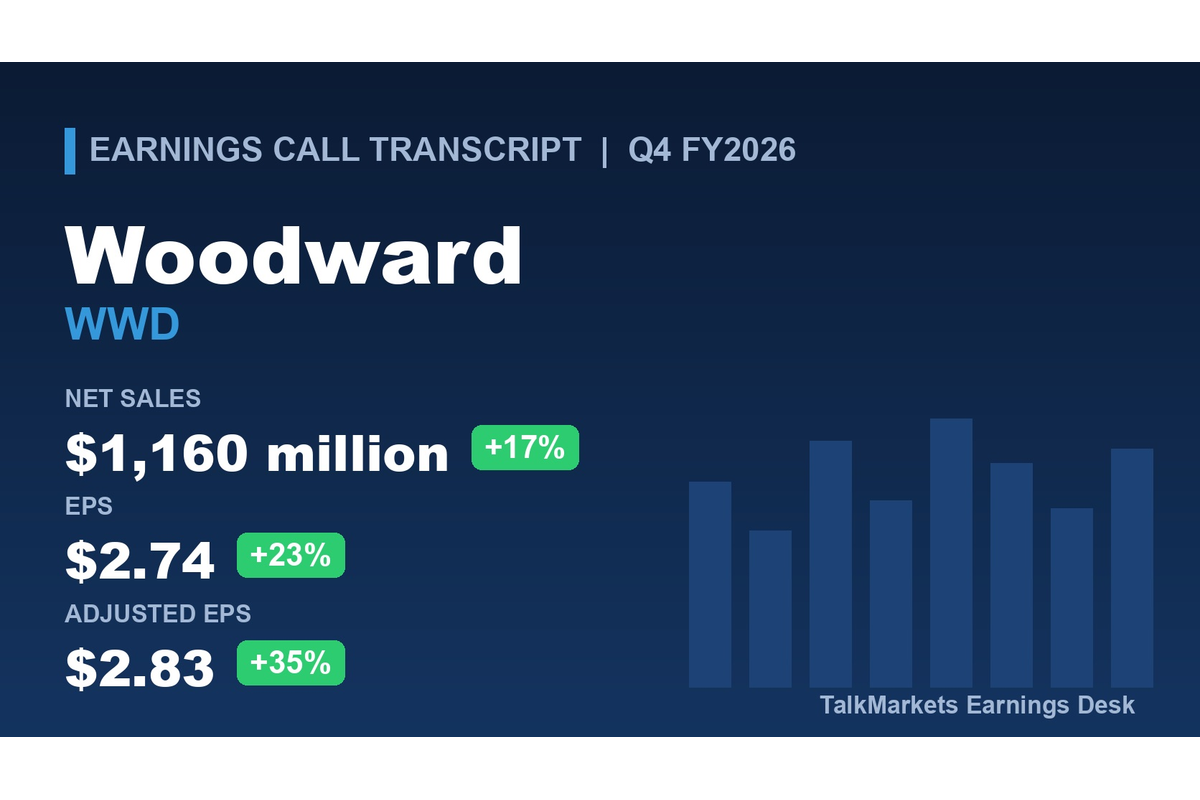
Woodward's Q4 fiscal 2026 net sales rose 17% to $1.2 billion, EPS rose 23% to $2.74 and Industrial segment earnings jumped 61%, capping a year of record sales and earnings.
Ticker: WWD
Woodward, Inc. (WWD) reported results on 18 November 2026 for its fourth quarter and fiscal year ended 30 September 2026, which the company described as a year of record sales and earnings. Industrial segment margins expanded sharply, while free cash flow fell as capital expenditures rose.
The key numbers (fourth quarter fiscal 2026, $ millions)
Metric | This year | Last year | Change |
|---|---|---|---|
Net sales | $1,160 | $995 | +17% |
Net earnings | $166 | $138 | +20% |
EPS | $2.74 | $2.23 | +23% |
Adjusted EPS | $2.83 | $2.09 | +35% |
Adjusted EBITDA | $267 | $205 | +30% |
Net cash from operating activities | $294 | $233 | +26% |
Free cash flow | $131 | $181 | -28% |
Capital expenditures rose 210% to $163 million from $52 million.
Results by segment
Aerospace: sales $781 million, up 18%, with Commercial OEM up 26%, Commercial Services up 25%, Defense OEM up 11% and Defense Services down 12%. Segment earnings were $190 million, or 24.3% of segment sales.
Industrial: sales $380 million, up 14%, with Transportation up 11%, Power generation up 18% and Oil and gas up 11%. Segment earnings rose 61% to $79 million, and margin expanded to 20.7% from 14.6%.
Dividends and buybacks
Woodward paid $19 million in dividends in the quarter, compared with $17 million, and made share repurchases of $154 million, against $49 million a year earlier. Total debt was $1,422 million at year end.
Chairman and CEO Chip Blankenship said Woodward delivered another year of record sales and earnings, with 22% sales growth and significant margin expansion across both segments. He pointed to higher aircraft production rates and strong inputs to repair centers in Aerospace, and strong demand across Industrial end markets.
Full fiscal year 2026
For fiscal 2026, net sales rose 22% to $4,357 million, net earnings rose 31% to $580 million and EPS rose 32% to $9.49. Adjusted EPS was $9.78, up 42%, and free cash flow was $327 million, down 4%.
Source: SEC Form 8-K Exhibit 99.1
Full call transcript
Operator:
Thank you for standing by. Welcome to the Woodward, Inc. fourth quarter and fiscal year, 2026 earnings call. At this time, I would like to inform you that this call is being recorded for rebroadcast and all participants are in a listen-only mode. Following the presentation, you were invited to participate in a question and answer session. Joining us today from the company, our Chip Blankenship, Chairman and Chief Executive Officer, Bill Lacey, Chief Financial Officer, and Dan Prabaznik, Senior Director of Investor Relations.
I would now like to turn the call over to Dan Prabaznik.
Senior Director of Investor Relations:
Thank you, operator. We would like to welcome all of you to Woodward's fourth quarter and fiscal year, 2026 earnings call. In today's call, Chip will comment on our strategies and related markets, and Bill will discuss our financial results as outlined in our earnings release. At the end of our presentation, we will take questions. For those who have not seen today's earnings release and presentation materials, you can find them on our website at Woodward.com.
A webcast of this call will be available on our website for one year. All references to years on this call are references to the company's fiscal year unless otherwise stated, and all comparisons are to the prior year unless otherwise stated. I would like to highlight our cautionary statement that's shown on slide two of the presentation materials. As always, elements of this presentation are forward-looking, including our guidance, and are based on our current outlook and assumptions for the global economy and our businesses more specifically.
Those elements can and do frequently change. Our forward-looking statements are subject to a number of risks and uncertainties surrounding those elements, including the risks we identify in our filings with the SEC. These statements are made as of today, and we do not intend to update them except as required by law. In addition, we are providing certain non-U.S. gap financial measures. We direct your attention to the reconciliations of non-U.S. gap financial measures, which are included in today's slide presentation and our earnings release.
We believe this additional financial information will help in understanding our results. Now, I'll turn the call over to Chip.
Chip Blankenship (Chairman and Chief Executive Officer):
Thank you, Dan, and thanks everyone for joining the call this evening. I'm pleased to report that Woodward delivered an exceptional fourth quarter, closing out a record year for 2026 with significant sales and earnings growth across both segments. Looking back at the last three years, Woodward has come a long way. Sales grew at a three-year compounded annual growth rate of 14%, and adjusted EPS has more than doubled for a compounded annual growth rate of 32%.
Our performance demonstrates our ability to transform strong demand and disciplined execution into profitable growth. I'm proud of how our global team responded to robust and growing demand across all our end markets. Our members took on the challenge to find capacity and deliver for our customers. I'm also thankful for our customers' continued partnerships and trust as we deliver the products and services they need today and collaborate with them on their future product platforms.
Woodward achieved record sales for both the fourth quarter and the full year, up 17% and 22% respectively. We had strong earnings growth in both periods and full year adjusted EPS reached $9.78, up 42%. Both our industrial and aerospace segments reached all-time highs for sales and earnings for the full year. Bill will cover more details around the financials in a moment. As we enter 2027, we're building on the strong performance while investing in capacity and capabilities to deliver on durable customer demand.
Our 2026 performance reflects our focus on our three pillars for creating shareholder value, profitable growth, operational excellence, and innovation. Here are a few highlights of our performance and market trends shaping our opportunities, starting with growth. In 2026, both segments benefited from robust demand and continuously improving operational performance. Aerospace had its strongest year on record across both commercial OEM and services. We increased output to meet the high growth in customer demand.
Just as important, we did this with consistent output throughout the year, avoiding end of month, quarter, year, heroics. This demonstrates that we're improving our ability to align the pace of our operations to the pace of customer demand. In 2026, we stepped up deliveries to meet aircraft production rate increases, which resulted in commercial OEM growth. We see long-term optimism across the aviation industry with a clearer focus on safety, fleet expansion, maintenance requirements, and modernization.
Even if airlines make decisions to moderate capacity in the near term, substantial aircraft backlogs and desire for the most fuel-efficient equipment continues to support planned OEM production rate forecasts. In services, we continue to see growing inputs into our repair shops. The large backlog for new aircraft is keeping legacy aircraft in service longer, sustaining legacy maintenance and repair demand. At the same time, we continue to experience increases in LEAP and GTF-MRO service orders as more of those engines enter maintenance cycles.
Total LEAP and GTF services sales exceeded legacy for 2026, while LEAP and GTF repair sales were in the same neighborhood as legacy engine repairs. This is a very exciting milestone, as the legacy fleet has been on a high plateau for the last couple of years, and this crossover results uniquely from LEAP and GTF maintenance growth.
Our services strategy includes delivering on growth through our own operations, as well as partnering with leading MRO providers to create a network of high-performing repair centers for our airline customers to choose from. We made substantial investments in our loves part facility to expand test and capacity, and we initiated a project to double the capacity of our Prestwick MRO center. This year, we established three LEAP-level repair centers for Woodward LEAP LRUs, and we continue to strengthen parts distribution relationships.
Defense grew moderately in the year, led by smart defense. As governments prioritize readiness, replenishment, and modernization, we anticipate sustained defense demand moving forward, with timing likely impacted by the usual lag to contracting authorizations and flow down to sub-tier suppliers like Woodward. Looking ahead, annual passenger and cargo traffic will continue to grow over the long term. Sure, there will be local ups and downs, as well as plateaus, but the health of this demand, coupled with the strong backlog, provide a firm foundation for a positive outlook.
I have full confidence that Woodward is ready to capture near-term opportunities from increasing OEM production rates and services demand. Remarkably, it is still early days in the LEAP and GTF LEAP maintenance cycle, and Woodward has poised to capitalize on long-term opportunities through both the substantial production run and the resulting maintenance cycle that remained squarely in front of us.
Turning to industrial, in 2026, we saw broad-based demand for our industrial solutions, and revenue and earnings grew across each of our end markets, expanding global demand for power generation, grid flexibility, and investments in both energy efficiency and resilience, support our industrial opportunities. These trends create opportunities for Woodward and OEM sales, as well as services growth over the operating life of the installed base.
The data center built out contributed to industrial strong sales and earnings in 2026, as we fulfilled increased demand for our products and services that support both grid-based and behind-the-meter on-site power plant applications. We were working closely with customers to assess the underlying demand, delivery requirements, and commitments that support their forecasts. Our objective is to match investments to customer demand while earning attractive returns on any capacity that we add at the same time managing the risk associated with over-investing and capacity.
Marine transportation was a notable contributor to industrial's 2026 growth, supported by a multi-year shipbuilding up cycle. Equipment orders provide visibility into future activity while the operating fleet supports ongoing service demand. Oil and gas also had a strong growth in 2026, driven by investments in LNG, natural gas infrastructure, and desire for national energy security. Across our industrial markets, new installations expand the base of Woodward controls and fuel systems that we can support through maintenance, repair, and upgrades.
That connection between equipment and services is an important part of our growth strategy for industrial. Overall, our industrial members did an outstanding job in this past year, improving operational performance and increasing capacity, which resulted in delivering robust growth. This brings me to operational excellence. Our efforts to become a lean company are beginning to flow through to our results.
We are improving our ability to apply lean principles and systems thinking to how we operate on the production floor and in our business processes as envisioned in our Woodward business system. We continue to refine and reinforce our safety programs. This includes our safety management system to ensure product safety for our customers in both segments and meet the rigorous regulatory requirements and aviation while our human and organizational performance program provides a framework of proactive safety awareness to keep our members safe.
In addition, we expanded the number of automation projects delivered in 2026 and increased our internal capabilities to execute even more projects in 2027. These investments will allow us to scale operations and increase output with less hiring and have the opportunity to move any impacted team members toward higher value, less repetitive work. We also made several strategic investments in our product portfolio and operational footprint to prepare for the growth ahead.
We acquired a valid research and manufacturing in April adding key precision solenoid technologies to our aero portfolio. Spartanburg plans are on track, building construction is complete and we will install all production lines this year. In addition to the A350 spoiler actuation systems, Spartanburg will support aerospace products transferred from our Santa Clarita facility which will be closed. 2027 will be a significant year for the transformation of our footprint as we transition production to our highest performing facilities and divest some smaller legacy product lines.
We are executing six projects that involve work transfers as well as closing two facilities and opening Spartanburg for production all in 2027. These projects will sharpen our portfolio, optimize our footprint and focus our operations where our highest capability exists, making an even better, stronger Woodward. While we are executing on these projects, we will remain focused on operational excellence to overcome the additional project expense and still deliver strong 2027 results.
As these projects are completed, we expect aerospace to reach a run rate of approximately $50 million in annual margin benefit in 2028 and beyond, both from lower costs and productivity gains. Turning to innovation, we continue to match our technology development pace for the next single aisle aircraft with our customers. These investments will increase as airframe and engine OEMs down select configurations. For now, we continue to participate in trade studies and customer focused demonstrators for next single aisle aircraft systems.
Recently, we announced that Airbus selected Woodward to provide the complete actuation system for its ground based folding wing demonstrator. The project explores how to manage airport ground environments and gate requirements using a wing fold system to allow higher aspect ratio, longer wing designs that offer higher aerodynamic efficiency. Our hydraulic and electromechanical actuation capabilities make Woodward uniquely positioned to solve this complex challenge. Following our outstanding results in 2026, our 2027 guidance assumes a sustained strong demand environment supporting continued sales growth and margin expansion.
During the year, we will allocate additional resources to optimize our footprint, reduce costs, and improve customer delivery all while continuing to expand margins. This improved aerospace production system will deliver exceptional shareholder value in the coming years. Earlier this week, we announced several planned leadership transitions affected January 1, reflecting the strength of our leadership pipeline and our focus on executing our long-term strategy. Tom Cromwell will lead our aerospace footprint optimization projects to ensure successful execution.
John Geithheimer's promotion to industrial segment president demonstrates the depth of our internal talent pipeline, while Randy Hobbs will build on his success in industrial to accelerate our enterprise-wide lean transformation. These appointments position us to sustain our operational momentum and drive long-term shareholder value. We look forward to giving you the opportunity to hear directly from these leaders at our investor day in March.
2027 is underway here at Woodward, and we remain focused on serving customers, achieving major milestones on our investments in capability and capacity and continuing to create shareholder value. Bill, over to you.
Bill Lacey (Chief Financial Officer):
Thank you and good evening everyone. As Chip mentioned, Q4 was another outstanding quarter in Woodward delivered record sales in earnings in 2026, delivering on strong customer demand with improved operational execution. Fourth quarter net sales increased 17% to $1.2 billion, and net sales for 2026 were up 22% to 4.4 billion, with over half of the full year sales growth driven by volume. Our fourth quarter earnings per share were $2.74, an increase of 23%, and our adjusted earnings per share were up 35% to $2.83.
2026 earnings per share were $9.49, an increase of 32%. Adjusted earnings per share increased 42% to $9.78. This performance represents all-time highs for sales and earnings in both the quarter and the year. At the segment level, the performance across the segment was impressive this year. Both aerospace and industrial achieved record levels of sales and earnings. Our global team is executing really well in a robust demand environment, and we're beginning to see benefits from our operational investments loaded through.
Fourth quarter aerospace sales increased 18% to $781 million led by continued strong growth in commercial aerospace. Commercial OEM sales increased 26% as we deliver on increasing airframe of build rates. Commercial services sales grew 25%. The continuum momentum in commercial services is encouraging with high utilization of legacy aircraft and increasing LEAP and GTF MRO activity. In defense, OEM sales increased 11%, and services decreased 12%. Aerospace segment earnings increased 17% to $190 million with margins of 24.3%. Compared to 24.4% last year.
Higher volume and favorable pricing is supported earnings growth. Partially offset by higher inflation and continued strategic investments to add manufacturing capability. These investments are necessary to support growing customer demand, including increasing services to activity, while establishing a more efficient cost structure over time. For the full year, aerospace sales increased 22% to a record 2.8 billion. Commercial OEM sales grew 28% as we deliver on increasing airframe of build rates.
While commercial services increased 32%, driven by favorable pricing, higher MRO activity and sustained demand across legacy and current generation engines. As expected, LEAP and GTF MRO activity continues to increase further contributing to commercial services growth. Defense OEM sales increased 8% primarily driven by improved JDAM pricing and defense services sales increased by 4%. Full year, aerospace segment earnings increased 32% to $666 million, with margins expanding 170 basis points to 23.6%.
The higher segment earnings were driven by price realization and higher sales volume, partially offset by inflation and strategic investments in manufacturing capability. Turning to industrial, in the fourth quarter, China on highway was not a significant contributor to industrial sales or earnings falling to successful wind down of that business. With the China on highway wind down complete, the industrial portfolio is now focused on our key markets and long term strategy.
Fourth quarter industrial sales increased 14% to 380 million with double digit growth across all three end markets. Core industrial sales grew 15% to 370 million. Power generation led the growth, increasing 18% on strong data center demand for both base and backup power. Marine transportation increased 14%, underpinned by a strong multi-year ship building cycle. Oil and gas sales grew 11%, primarily driven by LEG infrastructure related volume. We also continue to see increasing investments from oil companies and desire for national energy security.
Total industrial segment earnings increased 61% to 79 million with margins expanding 610 basis points to 20.7%. Core industrial segment earnings increased 58% to 77 million with margins expanding 560 basis points to 20.8%. The significant margin expansion was driven by higher sales volumes and price realization, partially all set by inflation. Four year industrial sales increased 22% to 1.5 billion while core industrial sales grew 19%. Marine transportation increased 27%. Oil and gas sales increased 17%. Empowered generation sales increased 13%.
Adjusting for the March 2025 combustion divestiture, power generation sales growth would have been approximately 20% for the year. Growth was broad based across each of our end markets, reflecting sustained demand for power generation, marine transportation, and energy infrastructure. Full year industrial segment earnings increased 64% to 300 million with margins expanding 500 basis points to 19.6%. Core industrial earnings increased 45% to 263 million with margins expanding 330 basis points to 18.5%.
The significant increase in segment earnings was driven by higher sales volumes and price realization, partially offset by inflation and strategic investment in manufacturing capabilities. As the consolidated Woodford level, 2026 net cash provided by operating activities increased at 37% to 646 million, largely driven by higher earnings. Capital expenditure with 319 million and free cash flow was 327 million. Compared with 340 million last year, as Chip indicated his remarks, the investments we are making are focused on expanding capacity, improving productivity, and strengthening our services capability.
As these investments begin to generate return, we expect stronger cash generation, which you will see when we lay out our long-term outlook and financial targets at our investor day in March. As of September 30th, 2026, debt leverage was 1.6 times either die. Our strong balance sheet provides flexibility to act decisively as compelling opportunities emerge. Our capital allocation priorities remain unchanged. We continue to support organic growth, selectively pursue strategic emanating and return capital to shareholders.
During 2026, we return 785 million to shareholders, 711 million through share repurchases, and 74 million in dividends. We expect to continue to be in the market on a regular basis to offset dilution, with the option of making additional opportunistic repurchases. Turning to our 2027 guidance, as we look ahead, we remain focused on our value drivers' profitable growth, operational excellence, and innovation.
Our fiscal 2027 guidance reflects continued strong underlying demand across both segments, supporting continued sales growth, and further margin expansion, while simultaneously investing to increase our manufacturing capability. These investments will ensure we can continue to support increasing production volumes, improve our structural cost position, and fully capitalize on the growth that lies ahead. For 2027, we expect to follow. At the consolidated level, sales growth is expected to be between 6 and 10%. In aerospace, sales are expected to increase 8 to 13%.
Primarily based on strong commercial OEM sales as airframeers build rates trend higher. In addition, commercial services will benefit from continuing legacy aircraft utilization, but more importantly, strongly in GTF MRO activity. On the defense side, we anticipate a better year in 2027. For aerospace, we expect segment margins to expand to a range of 23.8% to 24.3%. Which reflects continued volume growth and operational improvements. Partly offset by an OEM weighted salesman in elevated spending on capacity extension, input print optimization initiative.
As these initiatives are completed, investment related spending moderate, we expect higher production volumes, improved productivity, in a more efficient cost structure to support further aerospace margin expansion in fiscal 2028 and beyond. Industrial sales growth is expected to be between 1% to 5%. Excluding the 110 million sales headwind from the wind down of China on highway, industrial sales are expected to grow approximately 11%. With growth across all three in markets. For industrial margins, we are guiding to a range between 18.2% and 18.7%.
Woodward adjusted earnings per share are expected to be between $10.20 and $10.70 based on approximately 60 million shares outstanding and an adjusted effective tax rate of approximately 22%. Our 2027 free cash flow is expected to be 400 to 450 million with capital expenditures of approximately 290 million. We expect to return approximately 675 million capital to shareholders in 2027 through dividends and share repurchases. Lastly, to help with your modeling, our 2027 guidance also assumes annual price realization at approximately 4%.
Nonsegmented expenses of approximately 3.4% of sales in a higher net interest expense or approximately 75 million. This concludes our prepared remarks on the business and results for the fourth quarter in fiscal year 2026.
Senior Director of Investor Relations:
Operator, we are now ready to open the call with the questions.
Operator:
Thank you. The question and answer session will begin at this time. If you're using a speakerphone, please pick up the handset before pressing any numbers. Should you have a question, please press star one on your push button phone. Should you wish to withdraw your question, press star one again. Woodward has also asked everyone in the queue to consider your fellow analysts and ask one question so we can get to as many people as possible. Your question will be taken in the order it is received.
Please stand by for your first question, sir. Our first question comes from Noah Poponak. Please state your question.
Noah Poponak (Analyst):
One thing that I've been emailed a bunch and somebody's gonna ask is why is the interest expense up? 50%, so I'll just toss that out there. But I also wanted to try to dig into aerospace margins just because you're talking about the incremental investments and you've talked about the 30% to 35% framework and now you've referenced 50 million of runway positive. So just kind of a bunch of moving pieces there.
I guess maybe if you can quantify the investment this year so we know how much of a temporary headwind that is. And I guess if I take the 24% in the middle of the range and then if I added that, whatever that is, if I added it back, and I think 50 million is 100, 150 basis points of margin, just wanna make sure that there isn't something we should be netting against that. And then we would then we'd be looking at your normal incremental as well.
It would seem like the aerospace margin can get into the kind of high 20s by the end of the decade. Just wanna make sure I'm not missing anything on that.
Company Executive:
That's a lot, Noah. I'm gonna let Bill answer a bunch of this, but I just wanna address the 50 million run rate improvement. We've looked at this a lot of ways and we say there's a lot of moving parts and there really are. There's a lot of transfer of work going on, we're closing two facilities, we're moving towards much higher productivity environments and much higher capability to support production of highly technical precision manufactured parts.
So we believe that this is a major lever we're pulling to improve productivity and reduce costs and have the right footprint going forward to be the most competitive company we can be. We talked a lot about the first three years where we've got a lot of margin expansion from price and the next three years we're trying to at least lay out a roadmap so you all can understand what we're doing to improve productivity.
It's not just Kizans, it's not just getting a little bit more proficient at the workstations. There's some big moving parts we're doing to generate that kind of run rate improvement 28 and beyond. So over to Bill maybe on that.
Company Executive:
Yeah, so in the first part, Noah, in one with our capital structure strategy, we added about in our desire to stay between about one and two times leverage, we added about $450 million of debt towards the end of last year, last fiscal year. And so that is what generated the increase in interest expense we had about $50 million last year and in 27 we're forecasting it to be roughly 75.
Right now those funds again gives us a lot of flexibility to execute our capital allocation strategy and right now those funds are enabling us to buy back some shares. So that's kind of the main driver behind the interest rate expense and simply to the last part about the 50 and the math that you did, that is exactly the math in terms of how much extra it would add to marketing expansion in fiscal 27.
Noah Poponak (Analyst):
Bill, I think your interest expense rate would need to be up a lot, is that the case? I'm sorry, say that again? Just very interested to be up that much, I think the weight would have to be up a lot.
Company Executive:
No, the rate is not up. We actually got, again, some pretty good rates on trying just that we laid in. It is the amount of debt that we put on.
Noah Poponak (Analyst):
All right, I'll double check my math there. And can you just quantify what you're spending above and beyond normal on these investments in 27?
Company Executive:
Yeah, we're not gonna release that level of detail on this. Some of the investment is reallocation of R&D and other kinds of engineers and production folks that we would have. But just think about when you're moving something from one place to another, for a bit of overlap time, you've got direct labor and indirect labor in both locations. So there's a lot of double counting of costs there that we're gonna be able to liberate as we execute these projects.
And then we're gonna end up with an even better cost per unit and productivity and throughput and yield at the new location. So all that goes together. As Bill was saying, 150 basis points, that's the right math, but we're gonna leave that detail out for this year.
Noah Poponak (Analyst):
Okay, thank you.
Company Executive:
Thank you.
Operator:
Our next question comes from Scott Micas. Please state your question.
Scott Mikus (Analyst):
Good evening, Chip and Bill. Within the aerospace guide, you called out that you expect the legacy CFM56 and B2500 platforms to be resilient, just curious to peel back the onion. Are you expecting sales volumes on those programs to be flat in fiscal 27, similar to the messaging from GE and RTX regarding shop visits on those platforms?
Company Executive:
Yes, Scott, we are looking at sort of a flattish forecast. Our inputs have held constant and I kind of characterize it as a high plateau. We're gonna try to work through what kind of price we can get in the coming year's catalog and prepare a piece part and repair catalog pricing. But it's also a little bit of a shared game.
We wanna make sure that we're fine in the work and doing the work to keep that in our shops and then our OEM materials as much as we can.
Scott Mikus (Analyst):
Okay, that's helpful. If I could squeeze in a quick follow up. In the guide, are you assuming that LRU sales and the leap in GTF, are they up flat or down year-over-year given that fiscal 26 was very strong for LRU sales?
Company Executive:
We see that again as a little bit flatish year-over-year which should be about in the same neighborhood as 26 was.
Scott Mikus (Analyst):
Okay, got it, nice results, thank you.
Company Executive:
Thank you very much.
Operator:
Our next question comes from Christopher Glenn. Please state your question.
Christopher Glynn (Analyst):
Thank you, good evening, good afternoon. Yeah, question was on the industrial margin guide. I think it ran about 21% on the core industrial margin excluding China in the second half of your fiscal 26 and the fiscal 27 guides about 250 basis points lower than that, just wondering what it counts for that.
Company Executive:
Yeah, so, yeah, Chris, you're right. It is down slightly versus the second half. Industrial has had a heck of a run here and in volume, we have seen the last 18, 24 months, volume ramp up considerably. A lot of that margin expansion in the last 18, 24 months is coming from that sales levering nicely through as we held cost of flat.
As we continue to see the growth, we are having to invest a bit in order for us to be able to catch and sustain the growth that we've seen. As well with the growth in data centers, you're gonna see a little heavier mix towards OE versus the services. So those all in concert is what's yielding a slightly lower guide versus the second half margin run rate. But still quite good margins for that business. We're very happy with the performance of Industrial.
And that team has really delivered for us on getting output for the customers. And the range that we're showing, we think is quite a good range for that business.
Christopher Glynn (Analyst):
Okay, sounds good. And I'll honor the request for one question on the first task. Thanks a lot.
Operator:
Our next question comes from Scott Deuschle. Please state your question.
Scott Deuschle (Analyst):
Hi, good evening. Can you walk through the drivers of the 25% commercial aftermarket growth to fall in the quarter in a bit more detail? And then, you know, connect you with that. Can you give us a rough sense as to what the aerospace guide is assuming for commercial aftermarket growth in 2027?
Company Executive:
Yeah, for the fourth quarter, I think it has your questions about not the full year, right, fourth quarter? Yeah, fourth quarter, then also your forward at what's your 2027 on the application side? Yeah, again, it's sort of a tale of all contributors are up into the right in fourth quarter. So we look at LEAP and GTF repairs. That was strong growth.
When you look at wide body, business, aviation, and regional, every single one of those repair work streams were up in terms of a number of units input to our shop, as well as just volume and sales and some price realization contributing. You know, I mentioned in my prepared remarks that LEAP and GTF crossed over the legacy narrow body, CFM-5 and B2500 that we service. And that's a major milestone for us.
So the power of those earnings and sales growth available with the LEAP and GTF ship set content that we have and the service content that we have, you know, bodes really well for the future. And I think fourth quarter was starting to tell some of that story.
Scott Deuschle (Analyst):
Thank you. And we're spare LREU sales relatively flat, personally.
Company Executive:
Yeah, they sort of came in at that same level that we've been seeing.
Scott Deuschle (Analyst):
Okay, thank you. Last question, Bill. Do you say we're price realizations ultimately landed for 2026 at the two seconds?
Company Executive:
For 2026, it was around 8%.
Scott Deuschle (Analyst):
Thank you.
Company Executive:
You're welcome. Welcome.
Operator:
Our next question comes from Gavin Parsons. Please state your question.
Analyst:
Hey guys, thanks. This is Joel Santas on behalf of GAVING. Thanks for taking my question. Jessica, can you share a little bit your thoughts on the long term implications of the license repair agreement when you expect that you kick in? And if we should see anything this year?
Company Executive:
Yeah, so we're about a year away from our partners getting test stands and operations and doing, you know, major type of repair of work scopes. But in the interim, they can be doing some minor work scopes that don't require test capability.
So, you know, longer term, what that means is once they get the full test cells delivered and set up and correlated and get the start fulfilling orders from their customers, we'll be selling, we'll have more growth in our spare parts, spare piece parts sales category compared to repair. Repair will still be up, but, you know, right now there's not a major source for us to sell spare piece parts in the leap segment right now.
So that'll be the, that'll be the changes that those spare piece parts pick up and that should be about a year away.
Analyst:
Gotcha. And when the doubling of Scotland and more capacity comes online?
Company Executive:
I'm so, oh, press week. That's a little bit over a year away. They're doing plenty of leap work right now, but in order to really catch the growth that we want to internally, we need them to about double in size.
Analyst:
Okay, thanks.
Company Executive:
Welcome.
Operator:
Our next question comes from David Strauss. Please state your question. Your line is open. Please state your question.
Company Executive:
Hello, David.
Operator:
Our next question comes from Lewis Raffetto. Please state your question.
Louis Raffetto (Analyst):
Good evening, guys. Give me low. So, you know, these two assets help for sale, I believe it's pilot controls and the assets and property in the Senate, Clarita. I guess how, how are you handling that in the guide for these assets? And sort of additionally, is there any update on either of those along with potential strike at Niles?
Company Executive:
I'll let Bill handle the asset details in a minute. As far as Niles goes, we're, we have a great relationship with the workforce there. People are showing up for work. They're working diligently and doing quality work and increasing the output and smart defense, as well as in the motors and sensors and actuation product lines. So, all is good there from a production standpoint.
There's still plenty of, you know, work going on in the legal channels with us and the NLRB and things of that nature that I won't really get into in the call, but just, that's sort of a happening over there as a, somewhat of a distraction. The people as of now are doing great work with us and we're very much in line and focused on serving customers. As far as the assets help for sale and things like that, Bill.
Yeah, yeah, from a guide standpoint, we took it out of the guide based on when we expect those revenues to fall out and so, so it's in the guide so to see. Yeah, as far as the, as far as the announced deals go, they're, you know, in the closing process, ones in the HSR world and others in the CFIUS world and we'll keep you updated as things move towards closure.
Louis Raffetto (Analyst):
Thank you very much.
Company Executive:
Welcome.
Operator:
Our next question comes from Gautam Khanna. Please state your question.
Gautam Khanna (Analyst):
Yeah, and I apologize. I also have maybe one and a half questions. Just to follow up on Noah's question about the interest expense, was there actually a increase in total debt? Cause it looked like short-term borrowings are down, long-term debt is up on a sequential basis. So I'm just surprised by the, the increment of higher interest expense. Just, if you get answered that, maybe I missed it. And then just separately. Is that happening to vary in this one?
So it's not reflected in the, it's not reflected in the 26 year-end number.
Company Executive:
No, no, no, we did this in September. And again, at a 450 million of debt, we got rates around, you know, the low fives and that, that equals for 27 and incremental 24, 25 million of interest.
Gautam Khanna (Analyst):
Okay, but that is on the balance sheet as reported for Q4, correct?
Company Executive:
The debt numbers are, that was all in there. Yes, the 450 would be in the, they didn't even, but we wouldn't have paid interest on it. It wouldn't have started the interest, right? I'm third.
Gautam Khanna (Analyst):
I get that, okay. Okay, separately, just on the A350 spoiler actuation, could you just talk a little bit more about when that ramps, and if you could remind us what that does to the content on the A350, so why don't we start seeing that kick in and earn us when we model revenue per ship set? Thank you.
Company Executive:
Yeah, so we're still working through that transition and introduction and tree into service plan with Airbus. Obviously, it's gonna be a flight test and have a lot of elements to it. We're gonna be ready for production in the late 2028 timeframe, second half of 28, and we'll see how the certification campaign and priorities for flight tests at Airbus go and how the entry into service comes about, but that's what we're planning toward.
But as everyone knows on this call, that has experience with aerospace and certification, these plans can extend and rarely get, rarely happens sooner than planned.
Gautam Khanna (Analyst):
Thanks.
Company Executive:
Yep.
Operator:
Our next question comes from Kevin Liu. Please state your question.
Analyst:
Hey guys, thanks for taking the question and nice results. Just one question from me. Could you guys talk about for your guide for spare LRU sales being relatively flat over year? Just curious, do you guys see any meaningful risk to this? Just as airlines may look to conserve cash under the current higher oil environment?
Company Executive:
Yeah, I think there's always risk with a higher dollar value items that an airline customer or any customer can defer. But we believe based on deliveries and spare LRUs in inventory, ready for installation out there in the fleet that these numbers are achievable in 2027. And we really have a number of levers in the commercial aero services, portfolio of how we serve customers. So not really concerned about the overall commercial aero services contribution to our guide in terms of aero sales growth or margin rates.
As I said, we have a number of different ways, whether it's spare piece parts or repairs that we perform on the LRUs and spare LRUs that we ship. I think we've got enough moving parts and ways of serving customers there in the way that we've developed our plan that we're conservative enough, but also it's an exciting enough plan to pursue.
Analyst:
Great, thank you.
Company Executive:
Welcome.
Operator:
Our next question comes from Pete Skibitski. Please state your question.
Pete Skibitski (Analyst):
Hey, good evening, guys. Hey Chip, on the defense side, you see a lot of these new smaller firms kind of coming into the space, some of them are prime, some of them are sub primes. How do we think about kind of for you guys, the new bid pipeline, just kind of giving the dynamism in defense right now in the new programs?
Is that something you guys are kind of active on and ramping on or is it just kind of not really a focus for you guys just giving the commercial aerospace outlook?
Company Executive:
Yeah, it's a dynamic environment, Pete. We want to participate in any way that makes sense. We've engaged with a number of these smaller firms as they've come around and we've kind of made suggestions about how we might help them.
But as you might imagine, some of these firms have such a small engineering resource that in order for them to look at ways of collaborating with others, sometimes they just don't have the bandwidth to do that and they're really focused on getting product number one out the door. So we're looking for the right windows of opportunity.
We've got a couple of different ideas about how to help a couple of the different firms and we're just watching for the right time in their procurement cycles with the government to see how we can help. Because I think we can. And I think that as we look at the sheer numbers of some of these smaller types of munitions or unmanned vehicles that it might work its way to provide a sweet spot for control actuation or fuel control systems.
And so without naming any names, just let you know that we're working alongside some of them and we'll see if there's opportunity.
Pete Skibitski (Analyst):
Okay, got it. Appreciate it. Maybe just one last one for Bill. I guess we're both here. I know the company's invested a lot in training, new labor over the last two or three years. Is that something that's going to kind of level off at some point or because you're going to continue to grow the training cost will continue to be there or can you leverage that? I'm just curious kind of how the training cost will trend.
Company Executive:
I think that's going to be with us for a little bit. You know, we have this, you know, all the projects and strategy that we're bringing to bear to automate, especially the dark, dirty, dangerous, dull jobs, the four D's and making sure that we can get a payback from not only those investments in automation, but reduced training requirements, reduced labor demand.
And I think I said either last call or two calls ago that, you know, our three year plan is to automate out a little bit over a thousand jobs. And so, you know, some of these kinds of levers that we're pulling will reduce the training amount of expenditure eventually. But over the next couple of years, I still think that's going to be with us as we work through the automation opportunities and try to, you know, handle all this growth.
Pete Skibitski (Analyst):
Yeah, it makes sense. Thank you.
Company Executive:
Welcome.
Operator:
Our next question comes from Kriti Kumbokar. Please state your question.
Analyst:
Hi, good evening. Just looking at the defense aftermarket, seeing that decline year every year, kind of thinking about, you know, what were the drivers of softness there? Thank you.
Company Executive:
So the defense aftermarket has always been lumpy for us. We're on a certain number of programs we're not widely invested in the defense aftermarket.
So when you think V22, F35, and you think about from an engine standpoint, F110 on the F16 and certain applications like that, T700 on some of the helicopters, we have a reasonable base load of business in the defense, but it can be quite lumpy for us, depending on whether the DoW's decide to do the work themselves and they already have a large inventory of spare parts or they send the units to us.
And quite often, a quarter is a very, you know, poor way to measure the time horizon of this business because we can get a batch of units in from the, you know, defense logistics or some other defense customer that have been sitting in their depot for a long time. And then we take our time to return those to service and that can last a number of quarters, last three quarters of a year. And then we don't see them again for a while.
It's just that kind of business for us since we're not, we don't have a giant portfolio of defense products and applications. We are subject to, you know, seasonality, not from a calendar standpoint, but just by a procurement standpoint.
Analyst:
All right, thank you.
Operator:
Our next question comes from Sheila Kahyaoglu. Please state your question.
Sheila Kahyaoglu (Analyst):
Thanks, good afternoon, Chef Bill. My team plays, hey, my team plays a question bingo trying to guess everybody's question. So I got to say, not do so and no one never disappoint us. But maybe my question is on aero margins twofold. I guess first one I would say, you know, as you think about, you highlighted 50 million in run rate operational excellence, that comes in 28. 27, what's really driving margins flattish? I know it's up 20 to 50 bits.
And then maybe related to that, how come with an industrial, we don't necessarily see that 50 million run rate savings or, you know, operational potential. I know it's had a decent run from here, but if you guys could answer that, thank you.
Company Executive:
I think the easy math that we mentioned earlier in the call is there's sort of 150 basis points embedded in our work to improve 2027, you know, so there's a drag based on what we're doing to improve the footprint and the productivity of the labor and the supply chain that will come to fruition in 2028.
So I think that's, you know, that margin pressure we have in 27 because we've decided to invest in making the future better with really very good return on investment for the amount of resources we're putting into the 2027. If we didn't do that, you know, we'd be quite a bit better, we'd have better margins in aerospace in 2027, but, you know, we believe that this is a good investment and gonna pay back dividends way beyond what we're investing in 27.
And in the industrial side, you know, we haven't decided to make any major footprint changes or take any structural cost actions based really on the fact that the amount of growth we're seeing, you know, we got to stick to our knitting in industrial and make sure we can catch the capacity that our customers are demanding there.
Sheila Kahyaoglu (Analyst):
Okay, and so on the arrow side, is it the safe focus is basically that thousand employees and automation and Spartanburg starting to start up? Is that kind of what it consists of?
Company Executive:
But it also consists of taking a, you know, a high cost, low yield environment in our California plant and putting that work into Rockford and Spartanburg, where we can better serve customers with higher first PC yield and higher quality and more capable engineering support to deliver coming out of those sites that we're placing the work in, as well as moving from Peter Burrow to Krakow, same story, same story there.
So we're making some major moves, executing some complicated projects, transfer of work, is not for the faint of heart, it takes a lot of planning, a lot of project management, and you know, we're in the middle right now of the move of for servo hydraulic controls from Santa Clarita to Rockford, we move three out of 23 test stands, we've got them up and we're correlating them right now and going through what we call PPAP, the first, you know, article inspection and making sure we can produce the quality in Rockford.
And we chose those three test stands because they can produce 80% of the part numbers that we had at Santa Clarita. So it takes a lot of work to get this right, we think we're on the right track and we're very confident that the financial results are gonna be both substantial and rewarding.
Sheila Kahyaoglu (Analyst):
That's super helpful, thank you.
Company Executive:
Welcome.
Operator:
Our next question comes from David Stress. Please state your question.
David Strauss (Analyst):
Thanks, we'll try this again. Chip, I'm gonna miss it, but within your high single digit to low double digit, arrow guide, revenue guide for 27, did you talk specifically kind of what you're assuming for aero-OE and aero-app remark within that? And then second question within that, can you just talk about the margin profile, you know, leave GTF aftermarket versus kind of legacy at this point where that sits, thanks.
Company Executive:
Sure thing. And I'm, you know, as I've said before on these calls, I'm terrible at predicting which, how each of these things are gonna go with the commercial aero-OE versus services. So I'm not gonna try. But what I believe we've done is developed a pretty, a robust plan based on air-framer rates that they've published and demonstrated. And then we were also, you know, pay close attention to shop visit forecasts by customers and look at aircraft utilization.
And we calculate what we think our removal rates for our LRUs will be. And we come up with our forecast based on that. So that's really all I can say about that because I've proven that I'm not very good at predicting that in advance. As far as margin profiles go, you know, there's not really as big of a learning curve as you might think on our overhaul process. So the margin rates of our GTF is similar to the margin rates of our legacy.
And our team is really sort of agnostic about which of those we work on because, you know, there's well-trained and cross-trained and the results that we're seeing from lead GTF are matching our legacy from a repair service standpoint.
David Strauss (Analyst):
All right, great, thanks very much.
Company Executive:
Welcome.
Operator:
Mr. Blankenship, there are no further questions at this time. I will now turn the conference back to you.
Chip Blankenship (Chairman and Chief Executive Officer):
All right, thanks very much everyone for joining us. We'll see you again in January and then hope to see you at our investor day in March.
Operator:
Ladies and gentlemen, that concludes our conference call today. A rebroadcast will be available at the company's website, www.woodward.com for one year. We thank you for your participation in today's conference call.
Comments
Log in or sign up to join the conversation.