

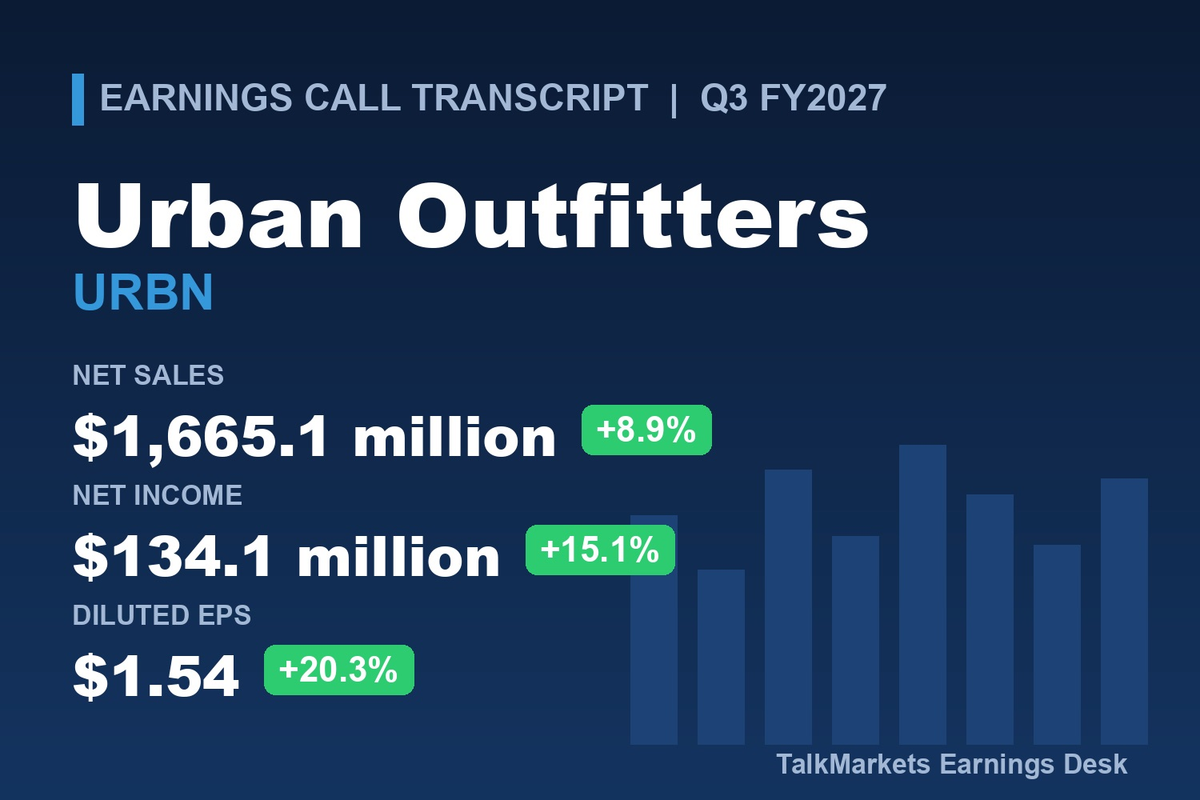
Urban Outfitters' third quarter net sales rose 8.9% to a record $1.67 billion, subscription sales grew 28.0% and diluted EPS rose to $1.54 from $1.28. It bought back about $300 million of stock in nine months.
Ticker: URBN
Urban Outfitters, Inc. (URBN) reported its third quarter results on 24 November 2026, covering the three months ended 31 October 2026. The owner of Anthropologie, Free People, FP Movement, Urban Outfitters and Nuuly posted record third quarter sales and profits, with every brand and segment growing.
The key numbers (three months ended 31 October 2026)
Metric | This year | Last year | Change |
|---|---|---|---|
Net sales | $1,665.1 million | $1,529.4 million | +8.9% |
Gross profit | $617.6 million | $563.3 million | +9.6% |
Income from operations | $172.1 million | $144.3 million | +19.2% |
Net income | $134.1 million | $116.4 million | +15.1% |
Diluted EPS | $1.54 | $1.28 | +20.3% |
The gross profit rate rose 26 basis points, helped by lower tariff costs and leverage on delivery and store occupancy, partly offset by higher Retail markdowns at Anthropologie Group. Selling, general and administrative expenses rose 6.3% but leveraged 64 basis points as a share of sales.
Sales by segment and brand
Retail: net sales up 6.1%, with comparable Retail sales up 4.4%. Comparable sales rose 8.5% at FP Group, 5.8% at Urban Outfitters and 1.7% at Anthropologie Group.
Subscription: net sales up 28.0% to $185.1 million, driven by a 27.6% rise in average active subscribers at Nuuly.
Wholesale: net sales up 18.8% to $104.8 million, led by a 20.8% increase in FP Group wholesale sales.
By brand, Anthropologie Group sales were $655.1 million, FP Group $457.6 million and Urban Outfitters $355.4 million.
Buybacks
In the nine months, the company repurchased and retired 4.6 million shares for approximately $300 million, leaving 10.0 million shares under its program.
CEO Richard Hayne said the teams delivered record third quarter sales and earnings per share, with every brand and segment contributing.
Nine months so far
For the nine months ended 31 October 2026, net sales rose 10.2% to a record $4.81 billion. Net income was $490.4 million, or $5.61 per diluted share. Adjusted net income, which excludes one-time tariff refund benefits, related interest income and a tax valuation allowance release, was $399.3 million, or $4.57 per diluted share.
Source: Urban Outfitters, Inc. third quarter earnings release dated 24 November 2026, SEC Form 8-K Exhibit 99.1
Full call transcript
Operator:
Good day, ladies and gentlemen, and welcome to the Urban Outfitters Inc. third quarter fiscal 2027 earnings call. At this time, all participants are in a listen-only mode. After the speaker's presentation, there will be a question and an answer session. To ask the question during the session, you will need to press star 11 on your telephone. You will then hear an automated message advising your hand is raised. To withdraw your question, please press star 11 again. We ask that you limit yourself to one question only.
I would now like to introduce Oona McCullough, Executive Director of Investor Relations.
Oona McCullough (Executive Director of Investor Relations):
Ma'am, you may begin. Good afternoon, and welcome to the URBN third quarter fiscal 2027 conference call. Earlier this afternoon, the company issued a press release outlining the financial and operating results for the three- and nine-month period ending October 31, 2026. The following discussions may include forward-looking statements. Please note that actual results may differ materially from those statements. Additional information concerning factors that could cause actual results to differ materially from projected results is contained in the company's filings with the Securities and Exchange Commission.
For more detailed commentary on our quarterly performance and the text of today's conference call, please refer to our investor relations website at www.urbn.com. I will now turn the call over to Dick.
Dick Hayne (Chief Executive Officer):
Thank you, Oona, and good afternoon, everyone. Thank you for joining us. Our teams delivered another record quarter with every brand contributing positively to our third quarter results. Q3 sales grew 9% to $1.7 billion, and earnings per share climbed 21% to $1.54 per share. This marks URBN's ninth consecutive quarter of record sales. All retail segment brands delivered positive comps, once again demonstrating the strength of our brands and the consistency of our execution. The Free People Group produced standout results with record third quarter sales and operating profit.
And the Anthropology Group maintained positive comparable sales and double digit operating margins as their team continued to refine their product offering. Complementing their retail performance, both our wholesale and newly subscription segments delivered record third quarter revenues and operating profits. Our outlook for Q4 and the holiday season is a bit more cautious than when we last spoke in August. Total comp store traffic dipped into negative territory in October.
Despite less traffic, higher average transaction values and solid conversion rates help keep overall comp store sales positive, but at a lower rate. Our digital business, however, remains strong. We anticipate higher promotions during the fourth quarter as anthropology works through its product transition. That said, we feel confident our portfolio of strong brands and our multi channel model will continue to please our customers and drive long term value for our shareholders.
Now, Frank Conforti, our Co President and Chief Operating Officer, will discuss our third quarter performance in more detail, after which our CFO, Melanie Marein-Efron, will give our thoughts about the fourth quarter and fiscal year 2027. I will then wrap things up before opening the call for your questions. Frank?
Frank Conforti (Co-President and Chief Operating Officer):
Thank you, Dick, and good afternoon, everyone. Today, I'm excited to share our company's third quarter record results. Then I will dive into some detailed notes by brand, followed by an update regarding fuel costs. Overall, our teams delivered another outstanding quarter, setting new sales and operating profit records. Total, URBN sales grew by 9%, reaching a Q3 record of $1.7 billion. All our retail segment brands delivered positive retail segment comps, while four of our five brands posted record third quarter sales.
Newly continued its impressive double digit revenue growth, and our wholesale segment also delivered exceptional double digit revenue growth. Our total URBN sales growth was partly driven by a 4% increase in the retail segment comp, with digital and store comps performing at similar levels. Newly delivered strong 28% revenue growth, driven primarily by an increase of over 109,000 average active subscribers compared to Q3 last year.
Additionally, the wholesale segment delivered a 19% increase in revenue, driven by growth at the FP Group across both specialty and department store accounts. Next, I will turn your attention to gross profit. URBN produced a 10% increase in gross profit dollars, while the gross profit rate increased by 26 basis points to 37.1%. This expansion was driven by improvement in initial merchandise margins due in part to the year-over-year reduction of tariffs, which were only partially offset by higher inbound freight costs.
Additionally, due to strong sales, we nicely leveraged store occupancy expenses, and through our ongoing initiatives that improved customer service and lowered our cost per package, we were able to continue leveraging delivery expenses. These benefits were partially offset by higher markdowns at the anthropology brand. Overall, through the team's strong execution, we were able to drive an improved gross profit margin rate despite the negative impacts of increased fuel costs. In the quarter, SG&A increased by 6%, resulting in 64 basis points of leverage.
We are pleased to report that strong top-line performance allowed us to continue investing in the business while also driving meaningful expense leverage. This leverage was primarily driven by strong sales, which helped us to successfully leverage store payroll expenses. As you will hear from Melanie, there is some timing in marketing spend that also benefited the third quarter. We are still planning on SG&A expenses being in line with sales for the full fiscal year.
Overall, total URBN operating income grew by 19% compared to last year, reaching a third quarter record operating income for URBN of $172 million. Net income increased to $134 million, while earnings per share increased by 21% to $1.54 per diluted share. Now moving on to brand performance, starting with anthropology. The anthropology brand reported total revenue growth of 3% driven by a 2% retail segment comp with positive results in digital and flat performance in stores.
Results were driven by positive comps in women's apparel and accessories, while home was slightly negative for the quarter. Looking closer at anthropology's product performance, women's apparel delivered positive comps, though the quarter played out a bit differently than we initially anticipated. Coming out of the second quarter, we were encouraged by early reads from our July/Fall event. However, as the third quarter progressed, it proved more difficult than we anticipated to move through some of our legacy styles.
While the new fashion deliveries are emerging as customer favorites in several categories, others are taking longer to reach their full potential, resulting in regular price and overall sales to fall short of our plans in the third quarter. Accessories remained a bright spot, delivering strong comp growth driven in part by continued strength in shoes. Meanwhile, home was slightly negative. While furniture delivered a positive comp, it was not enough to offset softness in home accessories.
A category that has remained challenging all year and represents a higher penetration of our business in the third and fourth quarters. Despite the pockets of product softness, anthropology's results reflect a well-managed business that continues to deliver positive top-line growth and a healthy double-digit operating margin rate. Customer growth remains positive as the brand grew total customers by 3%, displaying well-executed marketing campaigns and the overall underlying strength of the brand.
As we look ahead to the fourth quarter, we are taking a slightly more measured view of the brand's near-term trajectory. Moving through, the remaining legacy product is requiring more time and deeper promotions than originally planned. And while our new product is resonating, the pace of adoption has been more gradual. As a result, rather than seeing the markdown improvement we had previously anticipated against last year's elevated levels, we now believe fourth quarter markdowns at anthropology will be higher than the fourth quarter last year.
We believe the brand is positioned to deliver flattish comps in the fourth quarter as the team continues to refine the assortment. Now turning to the Urban Outfitters brand. Total Urban Outfitters sales grew by 5% and the global retail segment comp was 6%, with strength across both North America and Europe. Store comps outperform digital comps in both markets during the quarter. In North America, the team delivered a 4% retail segment comp.
This comp marks a healthy acceleration on a two-year stack as the brand in North America was up against a 10% comp increase in the prior year third quarter. All categories except home delivered positive comps in the quarter. Strength in women's apparel continues to be driven by a strong bottom strength, without performance coming from our own brands, including BDG and ES France.
BDG is truly evolving into a full lifestyle brand, seeing great success expanding into sweaters, knits, and handbags, while ES France continues to deliver exceptional bottoms performance. The brand continued to build momentum with its marketing initiatives, shifting a large portion of its social media strategy to video and leaning heavily into user-generated content.
By deploying these assets across the right channels, the team is effectively meeting customers where they are, expanding their reach on platforms like TikTok, Reddit, and Chat GPT, while continuing to partner with DoorDash on unique customer activations. Building on the success of their first-ever back-to-school connected TV campaign, the brand launched its The More the Marrier holiday campaign to carry that momentum into the fourth quarter. In Europe, the business has remained consistently strong, even against increasingly impressive multi-year comparisons, delivering its ninth consecutive quarter of positive comps.
The European team produced an 8% retail segment comp this quarter, with stores outperforming the digital channel. This performance was driven by positive comps in all major categories, with strong results in women's accessories and apparel. Through compelling product assortments and highly engaging marketing campaigns across multiple platforms and customer experiences, the brand continues to capture meaningful market share in the region.
Looking ahead to the fourth quarter, we believe the global Urban Affiters retail segment comp could be in the mid-single-digit positive range, with both North America and Europe delivering mid-single-digit positive comps. Overall, the total brand has delivered nine consecutive quarters of improved profitability, and we still believe Urban Affiters can deliver low single-digit operating profit rate for the full year, even when factoring in the headwinds from higher freight and delivery expenses driven by increased fuel surcharges. Next, let's turn to the FP Group.
The FP Group delivered another impressive performance this quarter, achieving a total revenue increase of 15%. This growth was driven by positive retail segment comps, new store growth, and strong gains in the wholesale segment. The retail segment comp of 9% was broad-based across both the store and digital channels, with store performance outpacing digital during the quarter. Customer traffic and AUR were nicely positive across both channels, and positive comps were driven by strong regular price sales, reflecting the high quality of the brand's offering and strong customer demand.
Meanwhile, the FP Group's wholesale segment delivered a 21% increase in revenue during the quarter, led by continued strength in FP movement, apparel, accessories, and intimates across our wholesale partners. This execution, combined with disciplined inventory management, enabled the FP Group to deliver record operating profit dollars for the third quarter. Within the FP Group, the Free People brand had a strong third quarter, delivering total revenue growth of 11% and a retail segment comp of 7%.
These positive comps were driven by continued strength in key categories, led by bottoms, accessories, and intimates. The FP movement brand also remained a standout, delivering exceptional results with total revenue growth of 27% and a 12% retail segment comp. Both brands executed highly effective marketing campaigns during the quarter that showcased their creativity and built deeper brand awareness.
At Free People, the team launched a clever take on celebrating product innovation titled "Jacket Too Good to Take Off", which featured a live coat check girl activation in a New York City store window that drove significant awareness across social platforms. The team also launched a campaign with musician and actress Willow Smith, highlighting a true brand fan while celebrating her creativity.
Meanwhile, FP movement created meaningful community moments by partnering with Dick's Sporting Goods for the Move With Us tour, celebrating women-owned studios as well as collaborating with the Montauk General Store on an in-store pop-up event. Both initiatives deepened FP movement's connection with its target customer. Finally, we also want to highlight the continued strength of the brand's international business.
While still a relatively small portion of the overall brand, international is steadily building awareness and traction, with 16 stores currently open and delivering an impressive 19% retail segment comp in the quarter. Looking ahead, the FP Group continues to carry strong momentum into the holiday season, and we believe the retail segment can deliver mid-single-digit positive comps in the fourth quarter. Now moving to the newly brand, which delivered another strong performance this quarter, continuing to scale both its subscriber base and its profitability.
Total revenue grew by 28%, driven by an increase of over 109,000 average active subscribers compared to the prior year Q3. This subscriber growth reflects continued strong demand for the brand, supported by effective marketing campaigns and healthy subscriber retention. Notably, newly launched a microdrama marketing campaign across Instagram, TikTok, and YouTube, leveraging celebrity and influencer talent to reach new audiences. Additionally, newly launched several new brands in the quarter, including J-Crew, Nike, and supermodel Gigi Hadid's sweater brand, Guest in Residence.
Newly generated $14 million in operating profit in the third quarter, representing a 7.5% operating profit rate, an increase of over 130% compared to last year. This improvement was driven by both gross margin and SG&A leverage as the business continues to scale. Gross margin leverage came in part from leverage in delivery expenses, while SG&A leveraged across all line items due to their strong top-line sales growth.
The brand's ability to expand its subscriber base while simultaneously driving meaningful margin expansion is a clear indicator of the health and scalability of the business. We remain committed to growing newly toward its significant long-term revenue potential while continuing to improve its profitability. The last topic I want to briefly touch upon is the overall transportation cost environment and its impact on our business.
As we have discussed previously, we are currently navigating higher inbound freight costs, domestic transportation costs, and higher delivery expenses driven by fuel surcharges associated with the ongoing war in the Middle East. These additional costs had a negative impact of approximately 55 basis points in IMU and approximately 20 basis points in outbound delivery and freight expense. We are assuming these costs and their negative margin impact will remain consistent for the remainder of the year.
As noted earlier, through the team's disciplined execution, we were able to more than offset these macro headwinds and deliver increases in gross profit margin dollars and rate in the quarter. If the price of fuel declines and stabilizes, at any point in time in the future, we would expect to see a corresponding reduction in these expenses.
In closing, our third quarter results reflect the underlying strength of our diversified portfolio, delivering 9% total revenue growth, positive comps across all of our retail brands, double-digit subscription, and wholesale segment growth, driving a 21% increase in our earnings per share. As we enter the holiday season, our teams remain focused on delivering compelling products and engaging customer experiences across every brand. I will now turn the call over to Melanie Marein-Efron, our Chief Financial Officer, to share our outlook for the fourth quarter.
Melanie Marein-Efron (Chief Financial Officer):
Thank you, Frank, and good afternoon, everyone. On today's call, I will discuss our thoughts on the fourth quarter and full-year fiscal 27. We are planning for Q4 total company sales to grow in the mid-single-digit range. Our retail segment comp sales could grow low single digits, driven by mid-single-digit positive retail segment comps at the FP Group and the Urban Outfitters brand, and flattish comps at the Anthropology Group. At newly, the brand could deliver approximately 20% revenue growth, driven by continued subscriber momentum.
Finally, our wholesale segment could produce low single-digit positive growth. We continue to believe we could deliver positive high single-digit total company sales growth for the full-year fiscal 27. Based on the current sales performance and plans, we believe our fourth quarter gross profit margins could improve by approximately 25 basis points versus last year.
The increase in Q4 gross profit rate could be primarily due to higher IMU due in part to lower tariffs versus last year, and occupancy leverage partially offset by higher fuel surcharges, higher markdowns at the Anthropology Group, and increased labor fulfillment costs versus last year. We are assuming that current oil surcharges related to the ongoing Middle East War remain in effect for the remainder of fiscal year 27.
These surcharges, which began in March 2026, impact inbound freight and outbound delivery and freight expenses, and we estimate they will have an approximate 75 basis point unfavorable impact on the fourth quarter gross margin. Based on our current plans, we believe our full-year fiscal 27 adjusted gross profit margins could improve versus last year, despite the fuel surcharges, which we have experienced for much of the fiscal year.
Based on our current sales performance and financial plan, we believe that total growth in SG&A could outpay sales growth in Q4. The growth in SG&A dollars are based on planned marketing investments at all brands to support new customer acquisition along with increased store payroll costs related to sales growth. In Q4, SG&A could grow to rate slightly ahead of sales due to the timing of marketing investments. For the full year, we believe that SG&A could grow at a rate in line with sales growth.
As always, if sales performance fluctuates, we maintain a certain level of variable SG&A spending that we can fluctuate up and down depending on how our business is performing. We're planning for an adjusted effective tax rate of approximately 25.5% for the fourth quarter and 24.1% for the full year. The increases versus last year are primarily attributable to the ratio of foreign taxable earnings to global taxable earnings. Now, moving on to inventory, we continue to be focused on increasing our inventory productivity and product terms.
We believe that our inventory levels could grow at a rate at or below sales growth in Q4. For fiscal year '27, capital expenditures are planned at approximately $475 million. The capital project spend is broken down as follows. Approximately 30% for retail store expansion and support, approximately 55% for logistics investments, and the remaining 15% for technology investments and home office expansion to support our growing businesses. The logistics investments are to expand our capacity and automation in both the subscription and retail segment businesses.
We will be opening approximately 47 new stores and closing approximately 14 stores during fiscal year '27. Our net new store growth is primarily being driven by growth in FP Group stores. During FY '27, we plan on opening 17 FP Movement stores, 11 Free People Brand stores, 10 Anthropology Group stores, and 8 Urban Outfitters stores. As a reminder, the foregoing does not constitute a forecast, but is simply a reflection of our current views. The company disclaims any obligation to update forward-looking statements.
Now, it is my pleasure to turn the call back to Dick Hain, Chief Executive Officer of URBN.
Dick Hayne (Chief Executive Officer):
Thank you, Melanie. In closing, my sincere thanks to our entire URBN family across all brands and shared services for their dedication this quarter. I want to recognize the hard work of our brand and shared service leaders, their teams, and our co-presidents, Megan Frank. I deeply appreciate the commitment and talent you bring to making our brands resonate with our customers. I also thank our global partners for their continued collaboration and our shareholders for their ongoing support. That concludes our prepared remarks.
As a reminder, please limit your questions to one per caller. We now invite your questions.
Operator:
Thank you. Ladies and gentlemen, as a reminder to ask the question, please press star 11 on your telephone, then wait for your name to be announced. To withdraw your question, please press star 11 again. Please stand by while we compile the Q&A roster. Our first question comes from the line of Lorraine Hutchinson with Bank of America. Your line is open.
Lorraine Hutchinson (Analyst, Bank of America):
Thank you. Good afternoon. I wanted to focus on anthropology for a minute. It sounds like 4Q will be characterized by some additional markdowns. But what is the strategy for spring transition and beyond? Do you expect to make any changes in audited marketing? What do you think the key is to really turning this business back to growth?
Tricia (Company Executive):
Hi, Lorraine. This is Tricia. Thank you for your question. I think as we look to getting through Q4, we thought it was prudent to make sure that we were a little bit more conservative and expect, as we've seen, some of those legacy styles that have been underperforming in our business are taking a little bit longer to allow for the newness to be able to offset that.
I think as we look forward into spring transition and into spring product, the investment is deepening in those new fashion newness. And as we then lap, I think as some of the legacy styles come down from a marketing perspective, we're leaning into really making sure that we're introducing some of these new customer favorites that are already starting to see some nice traction in a much more deliberate way and getting those in front of our customers.
And I think that's the key to getting the full price business going. We're encouraged by the newness and seasonal product that's performing. We just needed to accelerate at a faster rate to offset the decline of some of our legacy styles.
Analyst:
Thank you.
Operator:
Our next question comes from the line of an analyst with Barclays. Your line is open.
Analyst (Barclays):
Thank you so much. So we've been going through a number of earnings in the apparel sector and I did not hear kind of weather. We know that October was weather challenge. So I know that you don't like to use that as a crutch, but can you talk to maybe, Tricia, or for the brand, can you talk to any noticeable slowing across all of the brands or was this kind of specific to anthropology?
Are you seeing any changes on the days or the times when weather has gotten a little bit cooler? So if you can start there, that would be great. Thank you.
Company Executive:
Adrienne, this deck, I'll start with that because I'm going to talk about it across all brands. You're right. I don't like to talk about weather as an excuse, unless there's some very inclement weather like a hurricane or a big snowstorm. In this case, it was actually days were a little bit warmer than normal. And I don't think it had any impact that I could tell, particularly since one of our best performing classes in all of our brands was outerwear.
So I don't think it was a weather related issue. Do you have anything else to say? So they're all nodding their eyes. No, I guess I have that one. Correct.
Analyst:
Thank you.
Operator:
Our next question comes from the line of an analyst with JP Morgan. Your line is open.
Analyst (JP Morgan):
Thanks. So at anthropology, maybe, could you help quantify the progression of comp trends that you saw in the third quarter and elaborate on what you've seen so far in November relative to the flat outlook for fourth quarter comps at the brand and maybe to ask the last question in a different way, aside from weather. What's your overall view on on holiday this year, based on underlying consumer demand that you're seeing across all the banners just your thoughts on holiday 26 as a whole.
Company Executive:
Okay, Matt. I'm going to start with the overall view. My belief is that Q4 and holiday this year is probably going to be slightly more promotional than some of the more recent quarters. I mean, recent holidays that we've had. And I think the customer is still in very good shape. There's a lot of reasons behind that but I think in terms of just their income and how they're feeling I think they want fashion, they're willing to pay for it.
So I don't have any problem with that. I do think it's very promotional and very competitive season now.
Tricia (Company Executive):
I'm going to ask Tricia to talk about the, the, the anthropology comps in the progression. Yeah, hi Matt. The quarter as we had said in August, we, we were expecting August to be the tougher month on the quarter as we had comped against our pretty significant full funnel brand launch campaign for May.
And that helped be true August was definitely our tougher month we didn't see the improvement that we expected to see in September coming off of some encouraging signs from our July performance to the degree that we had wanted to. However, I would say the from a progression standpoint, particularly in stores we did see the store improvement over the course of the quarter and that was really driven by improved conversion.
Which is nice to see we did not see that in Q2 so I think it speaks to the fact that the teams have been working incredibly hard at working on our store assortment. So with improved conversion and flat ATV. We delivered a flat comp for stores that got better at the quarter progress. However, it wasn't enough to offset some slight softness from a traffic perspective in stores. I would say towards the end of the quarter.
And then DTC I would say was, was, was challenged, you know, from a progression from Q2 as it relates to going up against that brand campaign so you know unfortunately, some of that was driven by higher markdowns and more promotions and so we're working to correct that as we move into Q4 in order to be able to return to full price comp.
Operator:
Thank you. Please stand by for our next question. Our next question comes from the line of Dana Telsey with Telsey Advisory Group. Your line is open.
Dana Telsey (Analyst, Telsey Advisory Group):
Hi, just to expand on anthro. So would your expectation be to return to full price comps in early 27. And is it new product existing product fashion product. How do you slice and dice, what needs to get back to drive the consumer interest. And then Melanie you talked a little bit about marketing spend. It sounds like there's a timing benefit to 3Q versus 4Q. Can you expand on that.
And given the success of Maeve and you talked about BDG and own brands in the urban business doing so well. Is there ever a time period when those become separate brands given the extension of product categories that they're engaging the customer with. Thank you.
Company Executive:
Hi Dana I'll start. I think, you know, yes, our, our, our goal would be to continue to drive improvement and our product assortment into Q1.
We have significantly bigger investments in new product in the season and then we have some really great new products that is becoming new customer favorites that we're building on and continuing into the quarter I think it's going to come down to how we're able to offset some of those legacy styles we have, we have real strength in some categories in women's business and some of that we're seeing progress a little bit faster than others so bottoms has been driven by you know two really great new items that are offsetting the decline of our colette pants.
One being our Marnie it's a taffeta to drawstring pants and the other being a reverie which is a lace trim pants so in the pants category we're seeing some nice progression of driving newness, and I think as we are able to deliver improvement in some of the other categories into spring, we would expect to see that. I think it's going to, it's going to depend on how the team, the team of all that.
I think we're continually encouraged by our accessories business that turned positive in Q2, and also positive in Q3 but multiple categories within accessories and shoes, and we expect those categories to continue to improve and then I would say, as Frank mentioned, the home accessories category lessens as a penetration to the total for us in Q1, and so we continue to expect to see the strength in both the textiles and the furniture category, you know, offsetting it to a greater degree than, than they were able to in, they were expecting them to in Q4.
Dick Hayne (Chief Executive Officer):
Yeah, Dana this is Dick talking. I think to your question about returning to mid singles. I think we would plan it more gradually. I don't think it's going to be a transition from basically flat to mid single digits it's going to be gradual, that we would plan. Now if it turns out to be right to mid singles, great, but we wouldn't plan it like that. You want to talk about labels going separate brands.
Sheila (Company Executive):
Sure. This is Sheila Hi, I can talk about urban outfitters labels internally I think it's a global conversation between Shay and Emma. I think urban has always been a house of brands, and the development of those brands have been extraordinarily important into our growth with our consumer and our profitability, but overall we still want to continue to invest in urban outfitters as a brand. We are looking at it from as a potential opportunity that we're experimenting with, but it's in early stages.
Company Executive:
Great. Thank you. And just to answer your question, Dana on marketing, we did nicely leverage SG&A and Q3 were planning for SG&A to be in line with sales for the full year. There was just some timing events that moved some of the spend from the third quarter into the fourth quarter, which could result in the SG&A to leveraging the fourth quarter but, as I mentioned, we still believe will be in line for the full year.
Operator:
Thank you. Our next question comes from the line of Brooke Roach with Goldman Sachs. Your line is open.
Brooke Roach (Analyst, Goldman Sachs):
Good afternoon. Thank you for taking our question. Can you quantify the proportion of the anthropology business that's sourced from these down trending legacy styles, and how this is informing your management of styles within the assortment on a go forward basis. And then on margins, how should we be thinking about the magnitude of the anthropology brand margin pressure in both the third and fourth quarters, and what that means for the pace and opportunity for anthropology brand recovery back to that low to mid teens margin rate range.
Analyst:
Thank you.
Frank Conforti (Co-President and Chief Operating Officer):
Thank you for your question, Brooke. This is Frank. I can handle the margin question. So, as you know, we were able to drive gross profit margin improvement in the third quarter of 20 spaces points. That was due to favorable IMU across the company. As we started to experience lower year over year tariff costs, as well as nice leverages or occupancy from our strong top line business.
Anthropology did have an elevated markdown rate in the third quarter so they partially offset those gains but not fully offset those gains. We are also planning for anthropology of an elevated markdown rate in the in the fourth quarter which was partially offset. Again, the opportunity that we have in IMU as well as store occupancy there in the fourth quarter.
As you think about sort of, you know, if you paint this picture as a glass half full, right, we're still driving really strong results and anthropology has an elevated markdown rate. The opportunity for anthropology from a markdown rate recovery perspective next year will be larger than 100 basis points at the anthropology brand. Obviously, that has a lesser impact on your VN.
So, it does present a nice opportunity for margin and profit recovery for your VN next year as a healthy driver of, you know, driving bottom line improvement.
Tricia (Company Executive):
And this is Tricia I'll talk a little bit about the penetration, you know, I think, when our, when our business is strong. And when we're developing new items that that drive the business that the rate of those items can vary within the mix. I think, as we, we always look for newness to drive a disproportionately higher percentage of the business and it does.
I think, as we lap, you know, the decline of big items like our Colette pant like things like our icon juice glasses I think that takes more time. The majority of the business is still driven by newness and newness in season product, and we'll continue to, and we expect that rate to continue as we move into Q4 as we pull that down.
Analyst:
Thank you.
Operator:
Our next question comes from the line of an analyst with Morgan Stanley, your line is open.
Analyst (Morgan Stanley):
Perfect. I got one final quick one for you Tricia just on AMPRO, maybe just outside of the merchandising this is there anything else you all have changed or discovered that can be driving the lower recent comp trend at AMPRO.
And then for Frank or Melanie I know you aren't providing 27 guidance but just qualitatively, can you help us with the major puts and takes as we think about margin progression and next year, what are just the main buckets we should thinking about, we should be thinking about versus 2026. Thanks a lot.
Company Executive:
Hi, I'll start, Alex so I think as we look at, you know, the evolution of what we expect to see in the business I think that the only thing I'm a little bit concerned about is store traffic as I had mentioned, we have conversion improving in stores. We have traffic and conversion, nicely positive online.
I think as we look towards driving better conversion in stores, we're going to watch store traffic closely it started to decline at the very end of Q3 and that was the first time we had seen a decline in store traffic. So, our marketing efforts are driving growth in sessions, growth in customers. I think we're watching stores closely to see what happens with our store traffic patterns. And that would be kind of the one additional thing that the team is focused on.
I think I can tell you that we're watching the same thing at all three brands, store traffic declined in the last part of October, and it's recovered somewhat, but not fully. And as I said in my prepared remarks, we had better AOVs, and we had better conversions. So, that grows positive comps, but they were a little bit lighter than they had been previously.
And Alex, as it relates to operating profit improvement opportunities for fiscal 28, you know, heading into next year, you know, obviously you still got the Urban Outfitters global progression going on. I think this marked the ninth consecutive quarter of that brand driving operating profit improvements. And, you know, we certainly are planning and, you know, working towards continuing that throughout next year.
We're really driving really healthy top and bottom line gains, improving their operating profit dollars and rates, and, you know, we would continue to do that into next year. If you think about sort of from a macro perspective, you've got IMU opportunities, you think about lapping potentially lower year over year tariffs in the first half of the year next year, assuming the tariff environment remains consistent.
And then you do have some markdown rate opportunity, you know, in anthropology into next year, and then maybe a little bit on the Urban Outfitters side there as well. So, there's still, you know, a lot of things that we have that can drive improved margin rate improvement from a gross profit as well as from an operating profit perspective as we head into fiscal 28.
Analyst:
Thank you.
Operator:
Our next question comes from the line of an analyst. Your line is open.
Analyst:
Thanks for taking my question. I wanted to ask about Urban Outfitters North America. Looks like it comps about 4%. I think the plan was high single digits that you had referenced back in August. I think you said you're planning mid single for the fourth quarter. Beyond the tougher comparisons, can you speak to what if anything changed as the quarter progressed and specifically how that business, Urban North America, has started the holiday?
Shay (Company Executive):
Yeah, hey, it's Shay. First off, just want to mention that on a two year stack, the business is accelerating quarter over quarter. Really proud of the team and I want to remind us that it was Q3 last year that the business really started to break out. Our regular price business is strong. The core business is really healthy. Women's business continues to accelerate and our core strategic categories are performing really well. What changed in the quarter with our home business similar to anthropology?
For us, home really is less about furniture and in the quarter, it was really about a shift in categories happening in the marketplace. Hydration is a key category for us, represents some really big items in our business and it became really, really pervasive in the marketplace. The team tried to offset that by reinvesting and diversifying the hydration mix as well as investing in some other categories. We anticipate that investment paying off and gifting as we enter into the fourth quarter.
Additionally, another part of gifting is our novelty business. This is a very volatile side of the business as we are at the mercy of a lot of these vendors with respect to how they shift and we are just a little late in receiving some of these novelties. So we're hoping to receive these and really, really start winning as we enter the fourth quarter.
Analyst:
Thank you.
Operator:
Please stand by for our next question. Our next question comes from an analyst with UBS.
Analyst (UBS):
Your line is open. Thank you so much for me. One is there's a lot of talk this week of new tariffs. How are you thinking about that? What are you doing in advance to try to prepare for potential new tariffs? And secondly, on AI, they can maybe give us an update on how your AI strategies evolved over the last 90 days and the opportunities you see going forward. That would be great. Thank you.
Company Executive:
Jay, I can take the tariff rumors that I think continue to persist. I think until something is out there, as far as what countries and what the exact rates are, there's not a lot we can do right now. What I can tell you, though, is we've already done a lot. Right.
So we've been we've been through this before we diversified our country of origin, which I think is the most important thing that we can do, you know, as a company, as an organization, being able to have things like tool sourcing and the ability to be flexible and agile within our within our organization. And, you know, unfortunately, or fortunately, we've been through this before and we've had to try to adjust and react accordingly.
And, you know, we'll continue to do so if and when something else comes out.
Dick Hayne (Chief Executive Officer):
And hey, Jay, this is Dick Hayne. I'm going to take the question. We've really been working very hard. I feel like I said it last call and I'm going to say it again, but I feel like every day I'm talking about something new in AI and the teams are really working very hard on figuring out how to deploy it across the company so that we can maximize the efficiency potential that we see from AI, which is very exciting.
So we've been making great progress, putting AI tools into the hands of all of our associates and really trying to enable them to optimize a lot of their workflows and a lot of their processes on a daily basis. That's really kind of contributed to a really interesting and exciting kind of explosion of creativity across the teams that are that are getting their hands on these tools.
At the same time, in a tech team, you know, we really started to deploy AI very significantly and how we develop and deliver software across the organization. So we're very pleased with that progress. So I think we're really driving measurable efficiencies across a lot of complex areas. I do think it's going to take time as our teams get familiar with these new processes and capabilities and technologies.
But I do think that, you know, the potential here, obviously, as you hear the news every day, the potential is just so significant that, you know, we're very excited about the potential and we feel very encouraged by the progress that we're making. So a lot happening on that front.
Analyst:
Thank you.
Operator:
Our next question comes from the line of an analyst with The Retail Tracker. Your line is open.
Analyst (The Retail Tracker):
Hey, guys, Tricia, I'm going to believe that you named that amazing restaurant after me. And by the way, I'm a small petite for the record. But my questions are actually for Sheila, I think, or Shay. Can we just talk a little bit about the urban traffic because it's been increasing nicely. I'm guessing in part it's driven by, or in all it's driven by social, but also better products. So is the customer coming back more frequently? Are you getting lapsed shoppers and new shoppers?
Also, I'm curious, this is a customer that tends to be a little bit more sensitive to price. And you talked about change in behavior. I'm guessing that means you haven't seen any change in behavior yet. And then just one more, the bottom of this is what's driving it, but your going out tops have been unbelievable, just so hot. So are they picking up the average two going out tops to bottoms? What's that starting to look like there? Sorry to throw all that out there.
I'm just excited about what I see.
Shay (Company Executive):
Hey, Marnie, it's Shay. Thank you for the compliment. We'll be sure to pass that along to the team. Let me first start with the question on customer and traffic. Relative to the rest of the brands, our retail traffic has really been in line with the rest of the brands. I will say in the digital channels, yes, we've seen a nice progression in our digital channels.
I think that speaks to our team's ability through their social tactics and really their ability to be moving across channels, meeting the customer where they are, and our customer acquisition. In addition, as we've been acquiring customers, the team's been working hard to retain those customers, and yes, bring them back to shop more frequently with us. So your hypothesis is correct, and the team's been doing a fantastic job. Second, I think, was relative to price.
As you know, that's been one of our big initiatives is to make sure that we maintain price elasticity. We maintain an opening price point so that we have accessibility that's more important in certain categories than others, and the team's been doing a nice job. So we have a price hierarchy, but most importantly, we want to offer the right price value for every item that we sell. We offer things that are at an opening price point.
We offer things that are at a mid price point, and we offer things that are at a more inspirational price point. And our customer is telling us she likes them all. You heard Dick mention earlier that jackets are one of the more popular categories, and they're winning right now, and they are not at an opening price point. So I think that we're doing a nice job with price and seeing that manifest itself through conversion.
And then last, thanks again for recognizing top bottoms are working, we have been working really hard to recover the top business and women's apparel. And I mentioned earlier that the women's apparel business has been accelerating in the business and that's largely because of the top recovery so teams been doing a nice job, and a part of that has been definitely a focus on some of those going out top. So, thanks for noticing.
Analyst:
Thank you.
Operator:
Please stand by for our next question. Our next question comes from the line of an analyst with JJK Research. Your line is open.
Analyst (JJK Research):
Hi, everybody. I wanted to talk to Tricia for a second about price, and what she's viewing out there in terms of price pricing architecture, did some of the legacy brands, maybe or styles, maybe have lower price points than what the new flow of goods in the third quarter produced. And I also just wanted to know if you thought appropriate adjustments would be made in the assortment architecture by the end of the fourth quarter.
Company Executive:
Hi, Janet, I don't think we see price as the challenge in our business, I think where we have newness, whether it's new customer favorites or it's new fashion, the customer.
I think similarly to what she was saying is is voting kind of across all price points so we're selling opening price points well in many categories but we're also selling higher price points very well in new fashion related to party elevated brands and sweaters, you know, where we're, where we're investing in newness it's more about that I would say than price so there's not a big.
There's not a big correction I would say from a price perspective it's more about us getting in to more depth and the newness and what the customer is voting for and that's what we plan to do going into q four and into q one.
Analyst:
Thank you.
Operator:
Our next question comes from a line of semia and seagull with the Guggenheim securities, your line is open.
Analyst (Guggenheim Securities):
Thanks. Hey, good evening everyone and happy Thanksgiving to you and your families.
I'm sorry to do it again but just Trisha that's another one in anthropology as possible, just recognizing the higher conversion, and you are, I'm curious if you, why do you think the transactions and answer are lagging, I get that there's promotional driven lists, but when the better conversion that you are ubt is give a positive read that people are buying once they're in the source I'm just curious your opinion and what you think is keeping them out in the first place.
And then, I think, I think you had said there's higher you are then also the higher markdown so that you are dynamic a mix shift. Is that from the non that from that from the home that is working or is there another dynamic they're just thinking through what you are versus higher markdowns. Thanks guys.
Company Executive:
So me and I'll let Trisha talk a little bit about some of that. I just want to clarify the store traffic. As I said, it is slightly less in all three brands. It's being made up by the AOV, and the conversion in all three brands. So I don't think there's anything unique about anthropology and that. When we get the traffic, and it has gotten better. More recently, we see nice store comps, like we used to two months ago.
I don't know, you know, we have been discussing this internally maybe for two or three weeks now, what is causing the store traffic to be less and we really don't have any definitive answer that we can prove. So I don't know is the answer to your question. What's causing the store traffic to be a little less. And I can't give you any better answer than that. And soon I would say like if you watch the progression I think as I mentioned earlier, in stores.
We didn't see declines in traffic and we haven't seen declines in traffic all year until the end of q three so I think what what we were encouraged by was the improvement in conversion improvement and flat AOV.
Whereas that was really more the challenge for us in q two and q one so I think as I said earlier, I think it speaks to the fact that the teams are doing a better job getting enough depth and newness in stores and I think as that progresses throughout the future quarters I think we'll continue to see that I'm very encouraged by the hard work that the teams have put into getting improved conversion in stores and we're going to commit to continuing that.
Analyst:
Thank you.
Operator:
Our next question comes from the line of Ike Baruchow with Wells Fargo. Your line is open.
Juliana (Analyst, Wells Fargo):
Hi, good evening. This is Juliana on for Ike. So given three people wholesale is up over 20% this quarter I was just wondering what your thoughts are on the brand sustaining the solo growth into holiday and into 2027. Thank you.
Sheila (Company Executive):
I'll take that. So, this is Sheila. Just to talk about free people wholesale they delivered tremendous growth double digits, basically all year, and coming into q four. We are projecting a single, single digits. What we see is healthy demand coming both from free people and empty movement on our wholesale partners floor. That feels really good. And we're planning for this.
We're planning for single digit, just as we always have is evaluating who our wholesale accounts are, how the doors are performing to ensure our distribution remains in line and discipline. We're in line and closely align to our retail position on DTC and in our stores. So it's really important for us to have a really strong brand presence in both of our brands. And we want to make sure that's aligned retail and direct. So there's constant evaluation of how we're performing. We're performing really well.
Our demand is high. But we have to make the long term decisions for our end correctly.
Company Executive:
And thank you, Sheila. I know you've a process of losing your voice. I hope everyone got that. And she's muscling through it.
Analyst:
Thank you.
Operator:
Our last question comes from the line of Kelly Crago with BMO Capital Markets. Your line is open.
Kelly Crago (Analyst, BMO Capital Markets):
Thanks, guys, for squeezing me in here. Sorry if this was discussed in a different way. I just wanted to just clarify on the quarter to date. And it's for the guide overall. So you guided 4Q to upload singles. And are you running below that knowing we have a lot ahead of us in the quarter? Obviously, a lot more. We've seen the consumer kind of show up to shop at key times.
So I'm just curious how much of the lowered expectation in the fourth quarter is based off what you've seen over the last call it four weeks. And we could see some of that come back as we get into the peak season. And then my second question is just on the freight that 75 bits had wind. Do we assume that kind of carries forward? Obviously, assuming rates hold where they are, we can't predict the future here.
But the 75 bits continues into 1Q and then we're sort of in the base after that. Thank you.
Frank Conforti (Co-President and Chief Operating Officer):
Yeah, and this is Frank. I'll take freight and then I'll let Dick talk about our trends. Yes, we're assuming that 75 base point headwind carries through the fourth quarter and into the first quarter of next year. So assuming nothing changed in the market as it relates to fuel and related prices, we would start to anniversary where we started to experience the increased pricing in the second quarter.
So we did have those headwinds start for a large portion of the second quarter and then certainly are fully hitting us here in Q3 and Q4. But you're right, they would be a negative headwind, completely a negative headwind in Q1 on a year of year basis. And then that starts to abate in Q2 and going forward.
Dick Hayne (Chief Executive Officer):
Kelly, this is Dick. The guidance that Melanie gave in her prepared statements, we are reasonably close to that as we speak. So we're reasonably confident that the guidance that she gave will be what we get, what we end up with. Okay, I think that that does it. I wish you all a happy Thanksgiving and those of you on the East Coast, I hope you don't get dislodged by the storm coming up.
Operator:
Ladies and gentlemen, that concludes the various conference calls. You may now disconnect.
Comments
Log in or sign up to join the conversation.