

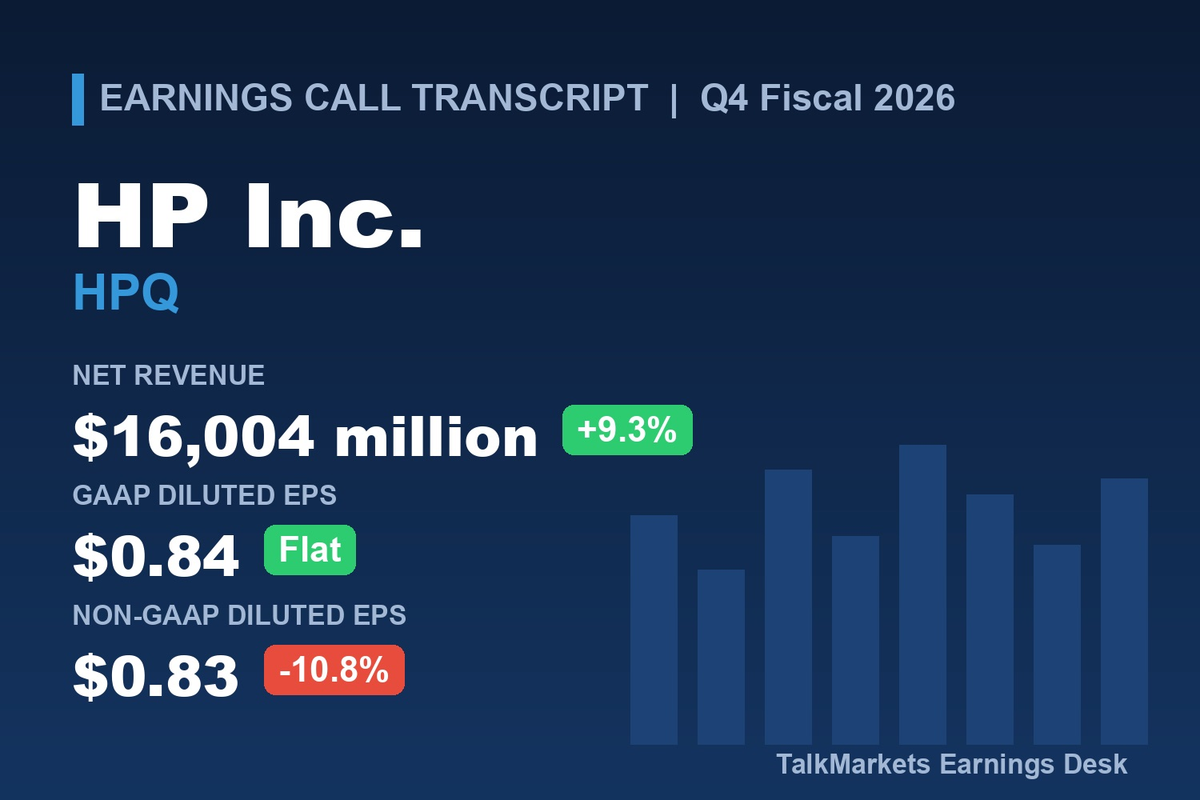
HP Inc.'s fiscal Q4 2026 net revenue rose 9.3% to $16.0 billion, with Personal Systems up 14%. GAAP diluted EPS was flat at $0.84, non-GAAP EPS fell 10.8% to $0.83 and the dividend rose to $0.31.
Ticker: HPQ
HP Inc. (HPQ) reported results on 24 November 2026 for the fourth quarter of fiscal 2026, the three months ended 31 October 2026. The PC and printer maker grew revenue on strong commercial PC demand, with AI PCs reaching nearly 60% of shipments, but margins narrowed and non-GAAP earnings per share fell. Both GAAP and non-GAAP diluted EPS included a $0.15 favorable impact from tariff refunds.
The key numbers (three months ended 31 October 2026)
Metric | This year | Last year | Change |
|---|---|---|---|
Net revenue | $16,004 million | $14,639 million | +9.3% |
Earnings from operations | $844 million | $959 million | |
Net earnings | $769 million | $795 million | |
GAAP diluted EPS | $0.84 | $0.84 | Flat |
Non-GAAP diluted EPS | $0.83 | $0.93 | -10.8% |
Free cash flow | $0.80 billion | $1.49 billion |
GAAP operating margin fell 1.3 percentage points from a year earlier, and non-GAAP operating margin fell 1.8 points. Net revenue rose 8.6% in constant currency.
Results by segment
Personal Systems: net revenue of $11.8 billion, up 14%, with a 3.0% operating margin. Commercial PS revenue rose 23% while Consumer PS fell 7%. Total units were down 29%.
Printing: net revenue of $4.3 billion, down 1%, with a 19.7% operating margin. Commercial Printing revenue rose 2%, Consumer Printing fell 1% and Supplies fell 2%.
Dividend and buybacks
HP returned $0.8 billion to shareholders in the quarter. It paid a dividend of $0.30 per share and spent $0.5 billion repurchasing approximately 15.9 million shares. The board declared a higher quarterly dividend of $0.31 per share, payable on 6 January 2027 to stockholders of record on 9 December 2026.
Interim CEO Bruce Broussard said: "In the fourth quarter, we continued to grow our higher-value businesses, with AI PCs reaching nearly 60% of shipments, while taking steps to address memory and storage cost pressures."
Full year
For fiscal 2026, net revenue rose 9.5% to $60.5 billion. GAAP diluted EPS was $2.62, down 1.1%, and non-GAAP diluted EPS was $3.33, up 6.7%. Free cash flow was $3.3 billion and HP returned $2.3 billion to shareholders.
Source: SEC Form 8-K Exhibit 99.1
Full call transcript
Operator:
Good day, everyone, and welcome to the fourth quarter of 2026 HP Inc earnings conference call. My name is Regina, and I'll be a conference moderator for today's call. At this time, all participants will be in listen-only mode. We will be facilitating a question-and-answer session toward the end of the conference. Should you need assistance during the call, please signal a conference specialist by pressing the star key followed by zero. As a reminder, this conference is being recorded for replay purposes.
I would now like to turn the call over to a little to you all, global treasurer and head of investor relations. Please go ahead.
Global Treasurer and Head of Investor Relations:
Good afternoon, everyone, and welcome to HP's fourth quarter, 2026 earnings conference call. With me today, I'm Bruce Broussard, HP's Interim Chief Executive Officer and Karen Parkhill, Chief Financial Officer. Before handing the call over to Bruce, let me remind you that this call is our webcast and replay will be available on our website shortly after the call for approximately one year. We posted the earnings release and accompanying slide presentation on our investor relations webpage at investor.hp.com.
As always, elements of this presentation are forward-looking and are based on our best view of the world and our business as we see them today. For more detailed information, we see disclaimers in the earnings materials relating to forward-looking statements that involve risks, uncertainties, and assumptions. For a discussion of some of these risks, uncertainties and assumptions, please refer to HP's SEC reports, including our most recent form 10K, HP assumes no obligation and does not intend to update any such forward-looking statements.
We also note that the financial information discussed on this call reflects estimates based on information available now and could differ materially from the amounts ultimately reported in HP's SEC filings. During this webcast, unless otherwise specifically noted, all comparisons are year over year comparisons with the corresponding year ago period. References to HP's channel inventory refer to the tier 1 channel inventory and market share references are based on calendar-quarter information.
In addition, unless otherwise specified, all financial measures discussed today are non-gap and EPS refers to non-gap diluted net earnings per share. Please refer to the tables in today's earnings release and the accompanying slide presentation on our website for reconciliations of these non-gap measures to the most directly comparable gap measures. With that, I will note them to call the Lutubus.
Bruce Broussard (Interim Chief Executive Officer):
Thank you, Alok, and thanks everyone for joining us today. I'd like to start by saying how pleased we are that Emma Wamsley will be joining us on January 4th as HP's next CEO. Consistent with what the board has been seeking in a new leader, Ms. A proven CEO who has led large global businesses through significant change and are experiencing fresh HP well, forward to introducing her on our next earnings call.
Our near-term priorities remain unchanged, strengthening our operating infrastructure, advancing AI at the edge, bringing our solutions together, and sharpening our strategic priorities. We're making solid progress across these areas, and I look forward to supporting Emma and the entire HP team as we move forward under our leadership. Today, I'll share our quarterly and full-year results, highlight the innovations we're bringing to customer outline the actions we're taking to position HP for the future. Let's start with our results.
We delivered fourth quarter revenue of $16 billion, up 9% systems led the way and performed above our expectations. We are successful on our commitment of executing the plan with discipline while continuing to invest for the future. These results reflect the strength of our portfolio, our innovative pipeline, and the focus of our teams.
We grew revenue delivered on EPS, generated strong free cash flow, and advanced key areas of our business, while investing in innovation, expanding our presence in higher-value markets and strengthening the capabilities that will support HP's future. In personal systems, revenue grew 14% driven by strong performance and commercial and record revenue and advanced compute solutions. The demand for our AIPCs continued, representing nearly 60% of our shipment this quarter, ahead of our expectations. We continued strong growth in higher-value areas, gaining share in AIPCs, workstations, and premium commercial PCs.
Workforce solutions continued to gain traction across PS and print, showing revenue double digits to $5.5 billion for the full year. That said, higher-component costs and challenging pricing environment, particularly in consumer pressured profitability. Consumer demand softened in the latter half of the quarter, with channel partners reporting slower sales and higher inventory levels. Our immediate focus is to restore channel health and improve profitability. The actions we've initiated will take time to flow through, and Karen will discuss the financial outlook in more detail.
In print, fourth quarter revenue was $4.3 billion, down 1% but above our expectations. Growth in industrial graphics, subscriptions, and tank printers helped offset lower supply volume. The hardware market was stronger than expected, and maintained our number one position while gaining share in developed countries for our office. We are progressing well with our focus on profitable unit growth, big tank and increasing customer lifetime value. In the quarter, home tank revenue grew 33%, driven by market strength and share expansion.
Industrial graphics grew 9% and reached $2 billion in revenue for the full year. Customers continued to leverage our digital printing solutions to adapt to changing demand and drive business growth. Turning to our full year performance, revenue was $60.5 billion, up 9.5%. We strengthened our position in important markets and expanded our innovation portfolio.
We delivered the EPS outlook we set at the beginning of the fiscal year, while we have more work to do, the progress we've made gives us a strong foundation for which to compete and grow, and provide more detail later in our call. Turning to innovation, our focus is on helping customers implement and manage AI across their environments. We believe that the future of AI is hybrid with workloads running both in the cloud and closer to where people work and data is created.
In fact, IDC forecasts that by 2030, 50% of enterprise AI inference workloads will be processed locally on endpoints or edge nodes. The shift gives customers greater flexibility to balance performance, cost, and security. We bring distinctive advantages that few others can match. With half a billion devices around the world, we have deep expertise in how devices perform, how they're secured, and how they're managed at scale. Together, with our technology and channel partners, we bring devices, software, and services to customers deploying AI closer to where work happens.
We are focused on turning that customer value into durable, profitable growth. Let me share how this is coming to life. In manufacturing, Edge AI can identify defects near the production line in real time without sending sensitive operational data to the cloud. In September, we announced a collaboration with Red Hat and NVIDIA to address use cases like this, with a planned solution that brings enterprise AI to the CGX theory, closer to where customers' operations and data reside.
Uber, Microsoft, and NVIDIA demonstrated windows running on our device for the first time. Another step towards making advanced AI accessible with existing environments. We're already seeing the value of Oracle AI for customers. A visual effects customer is using our CGX Nano AI stations to run AI locally and keep client footage on site. Getting to two to three times more work done.
For professionals, our Z-Book Ultra-G3A brings workstation class performance and local AI in a mobile device, enabling them to run large AI models, multiple agents, and demanding applications locally. For creators and developers, our new OmniBook Ultra-16 and OmniBook X14, powered by NVIDIA RTX Spark, bring personal agents, local AI, and advanced creation into highly portable PCs. Across our print business, we are also applying AI and automation to help customers reduce manual work and improve productivity.
We expanded our AI powered print and scan capabilities with AI-precise scan for SMB customers. We also introduced a new HP Future Smart Enterprise release, expanded guided reduction capabilities worldwide to help customers better protect sensitive information. In industrial print, we enhanced HP Neo, our AI powered assistant, to help operators quickly resolve issues and improve productivity. We are also extending automation beyond the press with robotic solutions that help streamline material handling.
We also introduced AI capabilities that simplify order intake and production, including the new Latex i30 AI printer. Together, these innovations help customers reduce manual work and scale their operations. Making AI useful at work also means making technology easier to manage. Workforce experience platform or WXP, IT teams see device and application information across their environment, identify issues, and improve the user experience. At the end of Q4, WXP managed 5.5 million devices, about 130% since last year, for over 5,000 customers.
AI workflows helped reduce application freezes by 35%, GPU critical events by 47%, and BIOS issues by 34%. Compari Group, a global spirits company, and one example of how our devices and software work together. They've deployed more than 2,000 of our AI PCs and use WXP to help their IT team identify device issues before they disrupt employees. These examples show how our portfolio can help customers deploy and manage AI. Next month at Amplify, our customer and partner conference, we will showcase the next wave of innovations.
Now, let's turn to the operating environment. Throughout the year, we've managed rapidly changing cost on them. We've taken decisive action to manage cost, secure supply, and respond to shifts in demand, contributing to our FY26 performance. At the same time, we've strengthened how we operate. That means better connecting our planning, decision-making, and execution, becoming more data-driven and responding faster to changing market conditions. These actions weren't about more than managing any one quarter. They're about building a stronger foundation for consistent execution and long-term profitable growth.
These foundations should benefit HP as we begin a new chapter under EMMA's leadership. At the same time, we anticipate the cost and demand environment, particularly for PCs, remain challenging in the near term. With that in mind, we've chosen to take a prudent approach. In personal systems, we expect demand to remain under pressure in the near term. Over time, we believe the growing need for Edge AI and refresh cycles driven by the changing nature of compute workloads will support their return to unit growth.
Our immediate priorities are to improve profitability while continuing to strengthen our position in commercial and higher value categories. We will also accelerate our Edge AI portfolio to help our customers manage their evolving AI needs. In print, we intend to drive further share gains in Big Tank through portfolio extensions and targeted promotion. In an office, there are highly secured AI-enabled portfolios.
We expect continued momentum in our subscription business as we start to ramp our all-in plan outside the U.S., and we're focused on extending our leadership and industrial graphics. We are confident in the opportunities ahead for HP as customers bring AI into their work and daily lives. We're well positioned to help them, bringing together the devices, services, and partnerships they need to. I'm proud of what HP has accomplished in a challenging year.
There's more work to do, but HP enters this chapter with significant strengths, a global customer base, trusted brand, deep technology expertise, a broad portfolio, and talented teams around the world. Thank you to our employees for all their contributions, and thank you to our customers, partners, and investors for their continued trust. With that, I'll turn it over to Karen.
Karen Parkhill (Chief Financial Officer):
Thank you, Bruce, and good afternoon, everyone. We are pleased with our fourth quarter results, delivering another quarter of solid performance to close out the fiscal year. Our team strove continued revenue momentum and execution against our priorities in a dynamic environment. We delivered better than expected top-line growth and EPS above the midpoint of our guidance range, even when excluding the benefit of tariff refunds above what we had previously signaled.
Across the business, we made progress positioning HP for long-term profitable growth, while maintaining financial discipline and returning significant capital to shareholders. Personal systems delivered double-digit revenue growth for the fourth consecutive quarter. In line with our strategy, we continued to shift toward premium categories, expand services and attach, and take disciplined pricing actions to address higher input costs. And in print, we executed well against our priorities, including driving continued momentum and industrial inscriptions and gaining share in tank printers.
We also took advantage of a hardware market that performed better than expected by placing incremental units that support long-term profitability. Taking a look at the details in the quarter, we delivered 9% revenue growth, both reported and in constant currency, with solid performance across all regions. In constant currency, revenue increased 10% in the Americas and APJ, and 5% in EMEA, driven by double-digit growth in personal systems across all regions.
A growth margin at 17.5% was down, as expected, with higher component costs and increased contribution from personal systems. That said, we drove good operating leverage, with operating expenses down as a percent of revenue, while still enabling important investments in innovation and strategic growth areas. All in, our operating margin was 6.2%. Below the operating profit line, we drove lower net financing costs, which contributed to better than expected other income and expense in the quarter.
Our net earnings per share was 83 cents, which includes an estimated 15 cent benefit from tariff refunds received in the quarter. Note that this benefit was 7 cents more than we had signaled on our Q3 earnings call. Now let's turn to segment performance. In personal systems, we delivered better than expected top line growth, with revenue up 14% from continued strength and commercial.
In line with our strategy, we gained share in premium categories, such as workstations and AIPCs, an increased AIPC penetration to nearly 60% of shipments in the quarter, well ahead of our 50% target. Advanced Compute Solutions delivered record quarterly revenue, up over 50% year over year, driven by share gains and continued shift to richer configurations through our new generation Z4 and Z8 platforms and ZGX Nano. And hybrid systems grew double-digit, fueled by strong performance and video collaboration.
By customer segment, despite lower unit volumes, commercial revenue grew 23% with stronger pricing and a greater contribution from premium products and services. In consumer, our performance fell below expectations, declining 7% in what was a more competitive pricing environment amidst continued commodity inflation, declining demand and increasing channel inventory. Our PS operating margin of 3% was below our long-term range and down sequentially as previously signaled.
And given the challenging environment and consumer, we proactively took pricing adjustments to address channel health in the quarter, which resulted in a margin below our initial expectation. We continue to expect margin recovery from here and are taking additional actions, including new designs with lower costs and competitive sourcing to drive sequential improvement through next year.
Turning to print, while lower supplies volume drove revenue down 1% year over year, we delivered strong performance in strategic areas, including consumer subscriptions and 3D, which both grew double-digit, and industrial graphics, which grew 9%. Notably, we also drove above seasonal revenue growth of 9% sequentially, on share gains in both home and office. By customer segment, consumer revenue was down 1% year over year, with strong performance and tank printers offset by market-driven declines and traditional printer volume.
In fact, we drove over 30% unit growth in tanks, gaining 5 points of market share and advancing our strategy in this profit upfront category. Commercial hardware revenue increased 2% with discipline pricing, despite a modest unit decline, and supplies revenue declined 3% in constant currency, in line with expectations. Our print operating margin was 19.7%, above our target range, and up roughly 1 point year over year, reflecting the benefit of tariff refunds and discipline pricing.
Without the benefit of refunds, our margin would have been closer to the low end of our range, as expected, with a stronger hardware mix and commodity cost headwind. Now, let me move to cash flow and capital allocation. We generated 0.9 billion dollars in cash from operations, and roughly 0.8 billion in free cash flow in Q4. And as expected, we delivered free cash flow for the fiscal year of more than 3.3 billion dollars.
Importantly, even without the uplift from tariff refunds, we drove strong free cash flow growth for the year. We returned over 2.3 billion to shareholders for the year, through both dividends and share repurchase, including nearly 800 million in Q4, and ended the quarter within our target leverage range. As always, we remain committed to returning approximately 100% of our free cash flow to shareholders over time, as long as our gross leverage ratio remains under two times, and there aren't better return opportunities.
Our results reflect discipline execution in a challenging environment, which enabled us to meet or exceed our commitments each quarter this past fiscal year, and ultimately deliver full year EPS above the midpoint of the guidance range we laid out at the beginning of the year, all while continuing to invest in innovation. Looking ahead, we enter FY27 with meaningful opportunities across our portfolio.
At the same time, our guidance prudently reflects a cost environment that remains challenging, with continued commodity headwinds across both personal systems and print, and softer near-term PC demand. That said, and as we have demonstrated this year, we have a strong track record of actively managing challenges. We will continue to invest in areas that strengthen our long-term position, and as always remain focused on driving the best possible outcome for our shareholders. Now, turning to our segment outlook for FY27.
In personal systems, we are aligned with industry experts projecting the PC unit TAM to decline high single to low double digits in calendar year 27. We expect a revenue TAM to remain roughly flat, though, as pricing and continued shifts to more premium devices help offset the unit decline.
Against that backdrop, we expect to continue to gain share in premium categories, including AIPCs and workstations, by capitalizing on the growing shift of AI workloads to the edge, and leveraging our industry-leading portfolio designed to meet the needs of users with more demanding workloads. We also remain focused on increasing a patch of higher margin offerings across peripherals and solutions, and we anticipate revenue to be stronger in the second half of the year, given both market dynamics and typical seasonality.
Last quarter, I said that Q4 would be a low point in PS margins and that we would improve from there. And as already mentioned, you can continue to expect that from us with sequential improvement as we move through the year. We are further optimizing product design and component configurations to drive that improvement. Along with a continued focus on premium share gains, expanding higher value attach, and maintaining discipline pricing and cost management.
And as we said before, we expect to be back into our long-term range before the end of the year. In print, we expect a low single-digit decrease in the hardware market in calendar 27, with growth in the tank and industrial markets offsetting declines in traditional hardware. Aligned with industry experts, we anticipate tank printers will represent roughly a third of hardware market shipments at the end of 2027.
Within this market environment, we intend to continue gaining share in tanks, driving new product and solution introductions, and globally expanding our all-in subscription offering. We also remain committed to growing share in office with new products and solutions designed for SMB and enterprise customers, reinforcing HP's leadership in manageability, security, and AI. And we are focused on strengthening our leadership and industrial graphics, building on the continued shift in the market from analog to digital printing with AI-enabled solutions.
We also anticipate supplies revenue to be down low to mid-single digit and constant currency within our long-term guidance range. On operating margins, we expect to be in the lower half of our 16 to 19 percent range for the year, reflecting inflationary commodities and the near-term impact of placing long-term profitable units. Similar to FY26, we expect the print OP rate to be seasonally higher in the first half of the year.
And as always, we will continue to focus on strengthening the quality of our installed base while executing with disciplined pricing, mix, and cost management. Beyond the segments, we expect OINE to be approximately 500 million in FY27, up year over year on higher net financing costs. For our corporate costs, please note that we will be presenting stock-based compensation expense as gap-only, starting in fiscal 27, in line with industry practice and consistent with almost all of our peers. You can see more about this in our earnings presentation.
As a result of this move, we expect our FY27 non-gap effective tax rate to now be 17 percent. Taking this into account, we expect corporate other to be roughly 500 million in fiscal 27, with seasonality slightly higher in the first half of the year. I would note that we anticipate total OP-X to be down year over year, even when excluding the impact of a change in stock-based compensation, as we continue to drive important cost reduction and still invest in innovation.
We are continuing to advance the AI-enabled transformation plan announced at the end of last year, driving solid progress across our supply chain, go-to-market and customer support organizations. We are modernizing software development and delivery, consolidating platforms, simplifying applications, and using AI to boost developer productivity and deliver better customer experiences faster. And we remain on track to generate approximately one billion in gross annualized run rate savings by the end of fiscal year 2028.
With all of this, we expect FY27 net earnings per share to be in the range of $3.15 to $3.45. Note that we have now received all of the tariff refunds that we have applied for, so our fiscal 27 outlook assumes no further benefit from refunds. For Q1, we expect both print and PS revenue to be below historical seasonality, given the market dynamics discussed. On margin, we expect print to be near the midpoint of our long-term range, and as mentioned, PS to sequentially improve from Q4.
All in, we expect Q1 net earnings per share to be in the range of 66 cents to 76 cents. On free cash flow, we expect to deliver between $2.9 and $3.1 billion for the fiscal year. As is typical, we expect the second half to be stronger than the first, consistent with our earnings.
And at this point, given the timing of our incentive comp payment and the impact of market-driven PC demand softness on our business mix, we anticipate our Q1 free cash flow to be negative, with marked improvement as we move through the year. Lastly, we are pleased to announce today that we are raising our quarterly dividend to 31 cents per share. This is the 11th consecutive annual increase since our separation in 2015, and reflects the confidence we and our board have in our long-term outlook ahead.
Turning to Q&A, we've invited Kate and Patel, head of personal systems to join us. With that, I'd like to hand it back to the operator and open the call for your questions.
Operator:
Thank you. We will now begin the question and answer session. To ask a question, you may press star, then one on your touch tone phone. If you are using a speaker phone, please pick up your hand set before pressing the keys. To withdraw your question, please press star, then one a second time. We also ask that you please limit yourself to one question and a single follow-up. Our first question will come from the line of Joseph Cordoso with JP Morgan. Please go ahead.
Analyst (JP Morgan):
Hi, good afternoon, and thanks for the question. Maybe for the first one here, I just wanted to touch on the margin, so it does seem like you are tracking to your prior guidance around dropping or on PS margins in 4Q and guiding for sequential improvement next quarter and through the 2027. Can maybe you just touch on how you're thinking about the puts and takes around how we get to the sequential improvements and what are the right moving pieces there to support it?
And then as we think about the long-term PS margin range of 5 to 7%, do you think that's achievable in 27 itself? And then I do have a follow-up. Thank you.
Karen Parkhill (Chief Financial Officer):
Thanks for the question, Joseph. You know, I'll start by saying we're confident in our ability to drive the sequential improvement in our PS margins as we move through the year. And our plan really incorporates four key actions, but it starts with restoring channel health and consumer. So as mentioned, we've already taken pricing and Q4 to address this, and we expect sequential improvement as a result of that. And secondly, we've been designing and recently launched lower-cost products, particularly in consumer that will help.
We've also, we're also continuing to shape demand around the right configuration to match device capabilities with our customers' workloads. And lastly, we will continue to drive premium product mix and higher value attach. And I would just say in FY26, replacing and richer mix supported good revenue growth, but did not fully cover the rapidly rising cost. And as we move to 27, we expect a greater market contribution from premium categories along with slower cost increases. And I would also add that these environmental factors will also help.
But ultimately, we do expect our margins to be back in our long-term range before the end of the fiscal year. And I'll ask Kate and to provide some more color too.
Speaker:
Sure, Karen. Thank you. I'll add a few more additional comments. As we just announced, we executed strongly in our commercial business profitably with 23% of top line growth. And we are very pleased with the progress we are making in winning high value categories like premium AIPCs and workstations. In fact, as per the recent IDC calendar quarter through results, our premium mix is 69% now, up 19 points. And I had of competitors. And similarly, our AIPC mix is up 20 points.
And workstation share also was at 35%. So along with premium, we are also accelerating mix of a non-hardware attached business. So as we look forward in 2027, market tem is likely to be stronger in premium categories, which we expect will grow high single digits and AIPC penetration is also expected to expand. And we will capitalize on our current performance to improve our share further and expand margins, given where we are in quarter four, 2026.
And along with the acceleration of premium and non-hardware attached, as Karen mentioned, we are also making very good progress in shaping demand with our workforce experience platform-based insights to match system configuration needs of customers, helping them choose and spend wisely. And we have worked to do on consumer, as Karen mentioned, we will accelerate promotions to ensure China's inventory comes to the healthy levels in coming months.
And apart from promotions on the lower cost products, we launched all new OmniBook 5 in October 2026 at US$1.699, which with an improved cost structure that will help meet customer budgetary needs while helping us grow profitably. So all these actions gives us confidence that will sequentially improve in 2027 from here on.
Analyst (JP Morgan):
Nope. Got it. Makes sense and appreciate all the color there. And then maybe just a follow-up there, you talked about the strength or maybe the resilience in terms of the higher-end PC market, but also at the same time, you're still introducing products to the lower-end. Can you maybe just double-click there in terms of how you're thinking about potential share loss versus maybe deliberately walking away certain products, either by price band or by region.
And then there was also a big jump in the AI mix in the quarter, just wondering if there was any influence around that dynamic there in the sense that maybe the denominator essentially was a bit lower as you kind of maybe walked away from maybe non-AIPCs or some of those undesirable as areas of the market. Just curious how you're thinking about that strategy broadly as we go into 27 just giving kind of the market to overarching market dynamics?
Speaker:
I'll take that. As we narrative, we see that demand for higher compute workloads is increasing, and more resilient buying power is there for those customers. So that's where the market is shaping demand, and we are making sure that we are participating in that profitably, increasing our mix as well as share. There is also a portion of the market, which is mainstream price bands, which is where the competitive landscape and the pricing pressure is higher.
That's where we are doing a lot of work around our cost efficiency, both in terms of product design as well as our sourcing strategies in order to make sure those products turn profitable and only book file launch which we did in October. An example of that, and we are also launching a new product called ProBook 4 in November 2026 in those lines. So this balance of premium and mainstream price band helps us participate in the high value market, and also participate profitably in the mainstream market.
Operator:
Our next question will come from the line at the David vote with UBS. Please go ahead.
Analyst (UBS):
Hi, this is Brian on for David. Thank you for taking the question. So just a big picture, one to start. So with the appointment of a new CEO taking a step back, how should investors think about the fiscal 2027 guide was the incoming CEO involved in the process? Then I'm going to follow up. Thank you.
Speaker:
Thanks for the question, Brian. You know, I would just start with, we mentioned that we're taking a prudent approach on purpose, and that's given the continued commodity headwinds and near term pressure on PC demand, along with the start of a new fiscal year and a new CEO coming on board. So our outlook does reflect the operating environment and also the mitigation actions that we've talked about. We're excited to have Emma join us soon.
I would say as she comes on board, she's going to be focused on spending time with our teams, customers, partners, and also doing a listening tool with investors. And all of this will not only give her a better understanding of HP, but also help as she begins to shape the priorities for the longer term. Hope that helps.
Analyst (UBS):
Got it. That's helpful. Thanks for the color. And just for my follow up, any update on the Windows 11 refresh, is that still a benefit that you expect going forward? Or is it more so customers looking to feature-proof their devices for AI and agentic use cases going forward? Thank you.
Speaker:
Yeah, thanks for the question, Brian. At this point, we do believe that the refresh is mostly behind us. Most of the customers that we're going to refresh have done so, and it's in line with how other refreshes have gone. There might be a little bit left in some consumer and SMB customers, but for the most part, it's behind us. So what we see going forward is really an environment that is very focused on being able to conduct AI at the edge.
And you see that with a significant movement that we've got, not just in commercial, but in the premium segment of commercial and with AI PCs and workstations.
Operator:
Our next question will come from the line of Katherine Murphy with Goldman Sachs. Please go ahead.
Analyst (Goldman Sachs):
Thank you for the question. I wanted to ask about the strategy of attaching more peripherals and non-hardware solutions, particularly in the consumer and commercial portfolio. How much did that contribute to the personal systems group in the quarter? And what's contemplated in the guidance and anything you could share to help us think about HP's right to win in the software and peripherals category? Thank you very much.
Speaker:
Yeah, thanks for the question, Katherine. Attached did play a role in our performance so far, but we have plenty of more opportunity ahead to drive even greater attach of these higher premium products and services. We do intend to drive against that opportunity next year, and that is included in our outlook. And I'll ask Kate and if he has anything else to add there.
Speaker:
Just to give a little context on our performance on hybrid systems, which has the non-hardware businesses, we grew revenue double-digit in Q4 fueled by strong performance in video collaboration, workforce solutions. They all grew double digits. And overall WXP progress, which Bruce mentioned in his opening remarks is also showing up into our non-hardware revenue drive. And we have refreshed our portfolio on Poly recently, which has improved demand particularly in collaboration business.
And we also expanded availability of HP dimension with Google Beam to six countries and have begun deploying the solution with our first customers bringing immersive 3D video experiences to more workplaces. So increased high value attached definitely helps in our overall balance of portfolio.
Analyst (Goldman Sachs):
Thank you both.
Operator:
Our next question will come from the line of WAMC Mohan with Think of America. Please go ahead.
Analyst (Bank of America):
Yes, thank you for taking my question. I'd like to get a little more clarity on two things. One on free cash flow. You're guiding fiscal 27 free cash flow 2.9 to 3.1 a bit down from fiscal 26. Can you just bridge that decline? How much of that comes from earnings versus working cap, commodity purchases, tariff refunds, if you could just flush that out. That'd be helpful. And I will follow up.
Speaker:
Yeah, thanks for the question, WAMC. So yes, we do expect our 27 free cash flow to be 2.9 to 3.1 billion. And we said that we expect it to be stronger in the second half. And that's really just consistent with our earnings and typical seasonality. We have not included any tariff refunds in this outlook. So these expectations are largely driven by earnings, which do reflect some continued component inflation and pressure on demand with offsets from improving PS profitability as we move through the year.
We have planned our CAPX to be roughly flat for the year. And we also intend to drive working capital improvement, particularly through lower inventory levels as we move through the year. I hope that's helpful.
Analyst (Bank of America):
Yeah, I know that is. Thank you. And then just in terms of your assumptions right on commodity pricing, it seems as though the market has kind of split expectations around what could happen with parts of the memory market into calendar 27 and 28. And just wondering, what are you baking in in terms of DRAM and NAND and other commodity price inflation embedded within next year's outlook?
And just your comment on sort of the backend loaded earnings profile, as you think about PS margin recovery, should that also be pretty backend loaded back to that typical range?
Speaker:
Yeah, thanks for the question. So just starting on commodity costs, we do expect memory and storage costs to continue to increase, but at a lesser rate than what we saw last fiscal year. And you can really see this in some of the external market indicators too. We also expect CPU costs to increase, but not as much as what we've seen with memory storage, with memory and storage. And all of that is baked into our outlook. On PS margin improvement, again, we do expect sequential improvement.
We do expect the actions that we're taking to compound over time. And so that's why we say that we believe that we'll be back to our long-term range before the end of the fiscal year. You know, hard to predict the exact amount in each quarter, but again, sequential improvement.
Operator:
Our next question will come from the line of David Page with RBC capital markets. Please go ahead.
Analyst (RBC Capital Markets):
Hi, thanks for taking my questions and congrats on the results. I want to ask on personal systems, you've built like an ecosystem partnership within personal systems. So just curious how much of that flexibility and options you give your customers is helping to drive continued growth and supporting ASPs despite a lower unit market. Thank you.
Speaker:
I think that we've been working with various ecosystem partners to, of course, make our solutions come together apart from the products we deliver. And as Bruce mentioned, in his opening remarks, around how AI at the edge is accelerating. And we are seeing this across different examples he quoted, like Compari with AI PCs, using AI PCs and Visual Effects Studio using our GZX Nano AI solutions.
We also see these partnerships coming stronger in developer category, where we are running coding agents on HP workstations and Omnibook Alt-R-R-T-X pop laptops. Several agents here work in parallel on screen with code assembling itself from one shared repository. The agents right and test code locally are on the clock with no token meter running. And our own developers are also using similar solutions within HP.
And similarly, in the area of architects, we see those teams are running generative design locally accelerating iterations while keeping decades of proprietary work inside the studio. And we have similar kind of use cases across automotive, as well as different sectors. And all of these are coming together through HP's own stack of solution, as well as the third-party ISV or software ecosystem, which we are combining.
Speaker:
I'll just add to the question that you had, is it helping with the AST? I would say yes. It's allowing us to bring a solution that's integrated together. It brings not only the hardware and a lot, whether it's a workstation or AIPC, just to bring solutions to calls that are needing the solutions, such as what Keith was mentioning about a manufacturing. We see it in healthcare. We see it in other sectors where they're looking for more solutions than just the PC itself.
Analyst (RBC Capital Markets):
Thanks. That's it for me. I appreciate the color.
Operator:
Our next question will come from the line. I'm Erik Woodring with Morgan Stanley. Please go ahead.
Erik Woodring (Morgan Stanley):
Thank you very much for taking my questions. As we look at fiscal 27, obviously, I'm carrying you alluded to the PC unit challenges and your prepared remarks, given where pricing stands. How do you think about looking through the year, if there was a worse or elastic response to pricing, how do you think about raising pricing to try to continue to protect PC profitability versus maybe lowering prices to re-accelerate unit growth at some point?
Just trying to understand how you think about that trade off, just given where PC pricing stands today relative to history and the need at some point to re-accelerate demand. Then have a follow-up, please.
Speaker:
Thanks for the question, Eric. Clearly, this is a dynamic that we've been managing since the start of this memory cost cycle. We've been focused on doing all mitigation action that we can before we need to take price increases that can obviously have a negative effect on demand. We want to minimize that. We'll continue to do that, to work to drive everything that we can and use price as the last lever.
But we're also focused on driving market share where we believe that we should be winning, particularly in the premium categories and on maintaining our margins. It's a balancing act, and I think we've been doing it nicely so far as we've been in this cycle.
Erik Woodring (Morgan Stanley):
I'd appreciate that. Maybe just as a follow-up, just as we focus on the October to January personal systems operating margin improvement, can we maybe just simplify to how you think your bill of materials will change sequentially versus how you think pricing will change sequentially? How do those two variables change sequentially to support expanding our personal systems operating margin? Thank you.
Speaker:
Thanks for the question. Obviously, both are dynamics that are going to play out over time and are difficult to predict by quarter. I do note that at the beginning of last year, we did say that memory and storage costs represented 15% to 18% of the bill of materials at the beginning of the year, and we expected that to double in the year. That did hold true for last year, and by FQ4, our memory and storage was closer to 40% of the bill of materials.
But at this point, we don't plan on providing an updated projection for that because really the moderating cost curves and the rapidly evolving PC mix, and with new devices and the changing configurations, it just really makes that bomb percentage less useful. But this is a dynamic that we're going to be focused on managing both to help us drive improvement as we in our margins as we move through the year.
Operator:
Our next question will come from the line of Amit Darianani with Evercore ISI. Please go ahead.
Analyst (Evercore ISI):
Hi, this is Kayden on for Amit, just one for me. I guess what you're thinking about your memory procurement, how much is coming from international sources, and do you see room for that to further increase and potentially help optimize your cost structure at all? Thank you.
Speaker:
We are using suppliers from all over the world. We are a global company, and so we're ensuring that we get the right mix of components that we need at the right prices that we think are competitive. So at this point, we don't split out how much comes from where, but we are global and we do source globally.
Operator:
Our next question will come from the line of crease send car with TD Cowan. Please go ahead.
Analyst (TD Cowen):
Hi, thanks for taking my questions. This is Steven calling on behalf of Chris. My first question, if I could on the AI PC mix, as you mentioned, you exit the fiscal year at CP percent, but I think last quarter you had a target for 60 to 70 percent on average for fiscal 27, just kind of curious, is that 67 percent for the current fiscal year still apply, or do you think you might be a higher blended rate for the year, just giving the current momentum?
Speaker:
Yeah, thanks, Steven. We were pleased with our AI PC performance this past fiscal year, and noted that we did reach 60 percent of our shipments by the end of the fiscal year. We just expect that to continue as we move into next fiscal year. We're not going to set a target, but we believe it's going to be about 60 percent and just continue to rise.
Analyst (TD Cowen):
Thanks so much, and just a quick follow-up in terms of memory and storage, and also CPU component procurement, which is kind of curious for fiscal 27, just based on your growth plans. At this point, what is the sort of percentage or amount of expected business for the coming year is already addressed by any kind of long-duration supply agreements? That'd be helpful.
Speaker:
Yeah, at this point, we are confident that we've got all of the components, including memory and storage, that we need to meet the demand for next fiscal year.
Operator:
Our next question will come from the line of Michael Cadiz with Citigroup. Please go ahead.
Analyst (Citigroup):
Hi, good afternoon. This one question for me. I know you touched a little bit on PC research earlier in this call, but I wanted to ask, as your AI PC penetration grows, could you give more color phase about your enterprise customer conversations, their use of AI PCs, whether to run models locally, like for pilots or at scale, and whether or not premium slash AI PCs have become, basically, they'd be set those standards for refreshes or replacements for future positions. Thanks.
Speaker:
I'll start, and then I'll ask Kate and then add some further. And meeting with our customers, they have three things that are top of mind for one is around the token cost, the second is around security, the third is around latency. And we constantly hear both from the CIO point of view, but also from the CEO and CIO, those areas are very important to them.
And so what we're seeing is this move to a more hybrid model where they are wanting more and more at the local level, but knowing that they still need to have the access to the cloud. And I think that's one of the reasons why you see the AI PCs and our penetration in the AI PCs is as a result of that demand.
We're also seeing it in small business or in small business, specifically on the workstations and the ability to offer a complete solution as opposed to having to rely on the cloud. Do you have anything to add?
Speaker:
Yeah, I think we are seeing accelerated movement now beyond demonstrations into real customer environments. As Bruce mentioned, the benefits of local AI are tangible and customers are seeing that. I quoted a couple of examples just to quote a few more. In automotive manufacturers, they are processing images for multiple cameras in real time, identifying defects faster and training inspection models locally without any cloud latency. And that's when that sector they see clear benefit.
In defense, we see departments use custom fine-tuned models to run locally, for mission operations on the field diagnostics without connectivity or mission operations. And on the security side, security teams are running open source models in-house, detecting threats, keeping sensitive data local and replacing unpredictable cloud usage with more predictable costs. So we see accelerated deployment now with real use cases and different environment on benefits of local AI.
Analyst (Citigroup):
Thanks. Have a good night.
Operator:
Our next question comes from the line. If Alex Valera with Loop Capital, please go ahead.
Analyst (Loop Capital):
Yeah, hi. Thank you for taking my question. My question is, at a recent conference, you said that some of your new memory suppliers are Chinese and the recent use report also said that you're moving some of your PC builds back to China. So I wanted to ask, do you plan to source more from China on fiscal 27, and will that help bring down that 40% build materials?
Speaker:
Yeah, thanks for the question, Alec. We don't expect any material changes in our suppliers right now. We're confident in the suppliers that we have, and we are confident in the supply that we have what we need to fulfill the demand this year.
Analyst (Loop Capital):
Got it. That's helpful. Just a quick follow-up. I think in September, you released the AK saying that you expect PC units for QR27 to be down mid-single digits. Do you still see that way, or has anything changed since then?
Speaker:
Yeah, thank you. As part of our outlook this year, we do expect PC, the unit, the hardware market to decline low single digits in high single digit, I'm sorry, in this calendar year.
Operator:
This concludes our question and answer session. I'll hand the call back over to Bruce Broussard for closing comments.
Bruce Broussard (Interim Chief Executive Officer):
Thank you, operator, and I want to convey what a privilege it's been to lead HP. I'm proud of our teams and confident in the foundation we're handing to Emma. AI at the edge is a majority as a major opportunity with our portfolio, our partners, and trusted brand, HP is well positioned to lead. And thank you to our customers, partners, and investors for your continued confidence. For those of you in the US, we wish you a very happy Thanksgiving and good evening.
Operator:
This concludes today's call. Thank you all for joining. You may now disconnect.
Comments
Log in or sign up to join the conversation.