

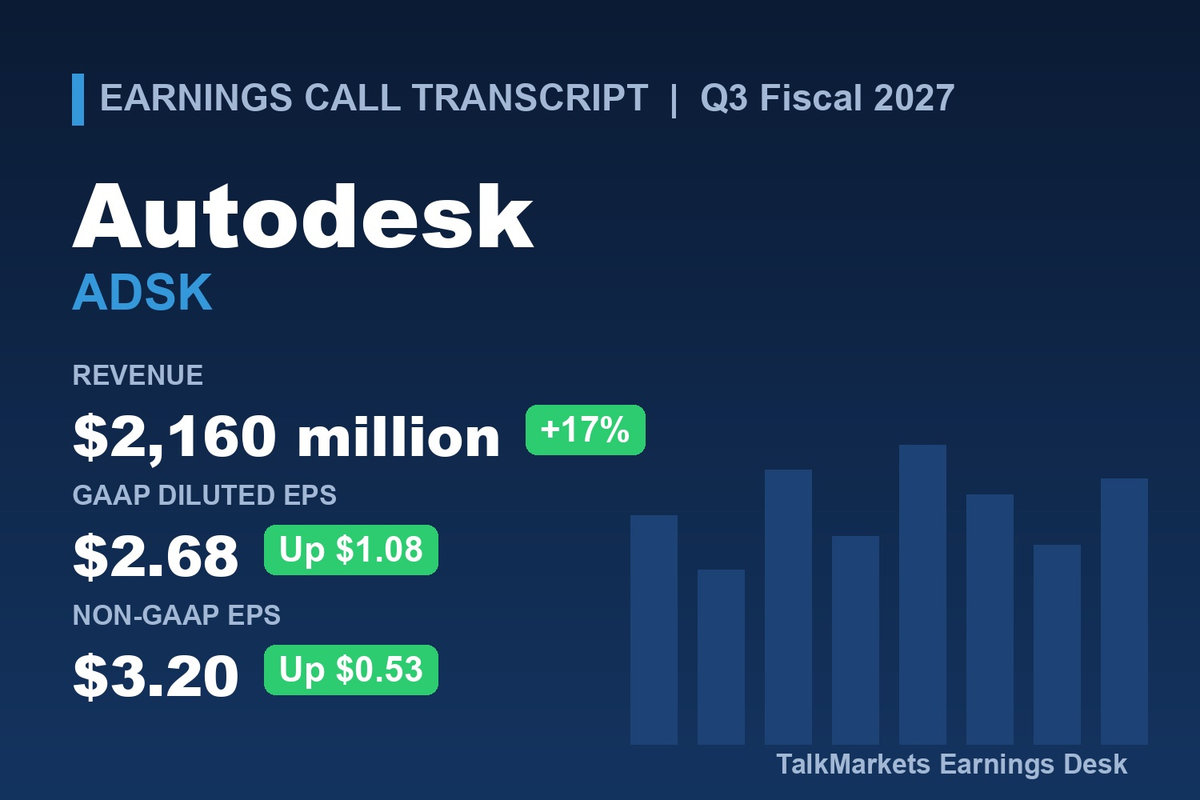
Autodesk's fiscal Q3 2027 revenue rose 17% to $2.16 billion, or 14 percent in constant currency, with billings up 12%. Net income rose to $563 million and GAAP diluted EPS to $2.68; non-GAAP EPS was $3.20.
Ticker: ADSK
Autodesk, Inc. (ADSK) reported results on 24 November 2026 for the third quarter of fiscal 2027, ended 31 October 2026. The design and engineering software company grew revenue in every region and product family, with Architecture, Engineering, and Construction its largest business. GAAP income taxes in the quarter included a benefit of approximately $105 million from an approved change in treatment of certain non-US R&D costs.
The key numbers (three months ended 31 October 2026)
Metric | This year | Last year | Change |
|---|---|---|---|
Total net revenue | $2,160 million | $1,853 million | +17% |
Billings | $2,070 million | +12% | |
Income from operations | $551 million | $470 million | |
Net income | $563 million | $343 million | |
GAAP diluted EPS | $2.68 | $1.60 | Up $1.08 |
Non-GAAP EPS | $3.20 | Up $0.53 |
GAAP operating margin was 26%, unchanged, and non-GAAP operating margin was 39%, up 1 percentage point. Cash flow from operating activities was $518 million, up 18%, and free cash flow was $505 million, up 17%.
Revenue by region and product
Americas: $967 million, up 18%.
EMEA: $838 million, up 17%.
APAC: $355 million, up 12%.
By product family: Architecture, Engineering, and Construction revenue was $1,097 million, AutoCAD and AutoCAD LT was $525 million, Manufacturing was $403 million and Other products was $135 million.
Deferred revenue was $4,231 million. Remaining performance obligations were $7,592 million, and current remaining performance obligations were $5,302 million.
Buybacks
Autodesk spent $1,251 million repurchasing common stock in the first nine months of fiscal 2027, against $1,071 million a year earlier.
CFO Janesh Moorjani said: "Our third-quarter results reflect the consistent underlying momentum of our business, with continued strength in AEC, particularly construction and emerging markets, alongside strong renewal rates."
Nine months so far
For the nine months ended 31 October 2026, total net revenue was $6,140 million against $5,249 million. Net income was $1,546 million against $808 million, and diluted EPS was $7.33 against $3.76.
Source: SEC Form 8-K Exhibit 99.1
Full call transcript
Operator:
Thank you for standing by, and welcome to Autodesk's third quarter fiscal year 2027 earnings conference call. Currently, all participants are in a listen-only mode. After the speaker's presentation, there will be a question-and-answer session. To ask a question during the session, you will need to press 11 on your telephone. To remove yourself from the queue, you may press 11 again. I would now like to hand the call over to Simon Mays-Smith, Vice President, Investor Relations. Please go ahead.
Simon Mays-Smith (Vice President, Investor Relations):
Thanks, operator, and good afternoon. Thank you for joining our conference call to discuss Autodesk's fiscal 27 third quarter results. Andrew Anagnost, our CEO, and Janesh Moorjani, our CFO, are on the line with me. During this call, we will make forward-looking statements, including outlook and related assumptions on products, artificial intelligence, sales and marketing optimization, go-to-market strategies, and trends. Actual events or results could differ materially.
Please refer to our SEC filings, including our most recent Form 10Q and the Form 8K filed with today's press release for important risks and other factors that may cause our actual results to differ from those in our forward-looking statements. Forward-looking statements made during the call are being made as of today. If this call is replayed or reviewed after today, the information presented during the call may not contain current or accurate information.
Autodesk disclaims any obligation to update or revise any forward-looking statements. We will quote several numeric or growth changes during this call as we discuss our financial performance. And as otherwise noted, each such reference represents a year-on-year comparison. All non-GAAC numbers referenced in today's call are reconciled in our press release and supplemental materials available on our investor relations website. And now I will turn the call over to Andrew.
Andrew Anagnost (CEO):
Thank you, Simon, and welcome everyone to the call. We delivered another strong quarter and signed our largest-ever enterprise business agreement. Revenue and earnings per share were above the high end of our guidance ranges. Despite incremental headwinds from U.S. dollar appreciation, we've raised the midpoint of our full-year buildings and revenue outlook to reflect the third quarter beat and stronger underlying expectations for the remainder of the year.
Autodesk's strategy is to build project intelligence across the asset lifecycle by connecting data, context, and experience across design, make, and operate. AI creates new opportunities to turn that accumulated intelligence into action, hoping customers automate complex tasks, scale their expertise, and deliver better outcomes.
Our work with a global engineering and consultancy company is an example of this strategy in action and shows how we are enabling our customers both to free up capacity to take on more work while also increasing human and agentic participation in our ecosystem. The company is collaborating with Autodesk to rethink how engineering work gets done, combining AI-powered workflow automation with access to decades of accumulated engineering knowledge.
Together, we have developed an AI-orchestrated workflow in Revit that automates architectural documentation using model data and established drawing standards. In a focused test, the company reported a more than 90% reduction in drawing generation time before accounting for full production review and quality assurance. Even after those additional steps, it's estimated that net time savings could still reach at least 50%, alongside improved consistency and quality. This efficiency frees up capacity to do more and win more business. The potential extends beyond architecture.
The company is exploring how similar capabilities could eventually support structural engineering, mechanical and electrical design, and other disciplines where documentation consumes significant time. The broader opportunity is to make specialized knowledge more accessible across the organization and improve engineering outcomes. The company has accumulated knowledge across thousands of projects, much of it embedded in models, documents, and the experiences of its people.
It is exploring how Autodesk Assistant can make relevant insights into engineering workflows, helping engineers draw on past solutions, technical standards, and calculations to make better decisions. AI can make the intelligence embedded in complex BIM models accessible to a much wider group of people, including those who aren't specialist modelers. This could broaden participation in project workflows and extend the value of that information and our tools across the organization. This collaboration also illustrates how our customer relationships are evolving.
The company increasingly sees Autodesk not simply as a software provider, but as a platform partner helping shape the future of engineering. It brings engineering expertise and real-world challenges. Autodesk brings the technology and development capabilities to help solve them. This is the opportunity we see across our industries, moving beyond creating project information to turning it into reusable intelligence that expands what customers can accomplish.
As knowledge from each project informs the next, it creates a reinforcing cycle of richer project intelligence, better decisions, and more valuable outcomes across the asset lifecycle. Janesh, over to you to discuss our quarterly financial performance and guidance.
Janesh Moorjani (CFO):
Thanks, Andrew. We delivered another strong quarter in Q3, once again exceeding the high end of our revenue and EPS guidance. Overall, the underlying momentum of the business remained consistent with prior quarters, with continuing strength in AEC, particularly in construction and in emerging markets. Renewal rates remained strong, contributing to our outperformance in the quarter. The impact of our sales reorganization continued to diminish across most regions, with Western Europe remaining slower to normalize.
Total revenue in the third quarter grew 17% as reported and 14% in constant currency. MaintainX had an outstanding first quarter within Autodesk, with revenue of almost $33 million, and integration progressing as planned. We plan to extend MaintainX across more geographies and segments next year, including through EVAs. We've already begun to build a good pipeline of opportunities. Please see the tables in our press release, earnings deck, and Excel financials for details on our total revenue by product and region.
Billings increased 12% as reported and 13% in constant currency, reflecting the underlying trends discussed earlier. We also closed several EBA renewals during the quarter as part of a sizable second-half renewal cohort. RPO and current RPO growth continue to reflect the program to reduce multi-year discounts that we called out last quarter, including the wind-down of multi-year renewals for the maintenance description program. As we've said, we expect these dynamics will continue to weigh on total RPO and current RPO growth for some time.
Turning to margins, third-quarter gap and non-gap operating margins were 26% and 39% respectively. Gap operating margin was broadly flat year-over-year with underlying margin improvement and a further reduction in stock-based compensation as a percentage of revenue, mostly offset by the effects of the MaintainX acquisition. Non-gap operating margin was up approximately one percentage point. This primarily reflected operating leverage, the timing of investments, and the benefits from our sales optimization, partly offset by margin dilution from the MaintainX acquisition.
Third-quarter free cash flow was $505 million, reflecting the timing of billings and collections during the quarter. Moving on to capital allocation, we repurchased approximately 1.5 million shares during the quarter for $350 million. We now expect to buy back $1.5 billion of shares in Cisco 27, slightly ahead of our prior expectations and up from $1.4 billion last year. As I said last quarter, we've made a few minor changes to simplify our revenue presentation and reflect the acquisition of MaintainX.
We've summarized these changes in the slide deck on our website. Let me finish with guidance. Our guidance philosophy is unchanged. Our guidance continues to be based on the range of possible outcomes in our bottom-up sales forecast, which is grounded in the momentum of the business and embeds some prudence against our expectations of sales productivity normalization. We've continued to assume the macroeconomic environment will remain broadly stable through the remainder of the year.
There are some incremental foreign exchange headwinds to billings from a stronger dollar. For billings, we've raised the midpoint of our fiscal 27 guidance range to $8.625 billion to reflect an underlying improvement in our expectations, partly offset by the additional headwinds from foreign exchange movements. As a reminder, our largest product subscription cohort and second-largest EBA cohort in fiscal 26 create a tougher comparison this year, particularly in the fourth quarter.
For revenue, we've raised the midpoint of our fiscal 27 guidance range to approximately $8.368 billion to reflect our strong results in the third quarter and an underlying improvement in our expectations, partly offset by a smaller tailwind from foreign exchange rates. As we outlined in February, our guidance still factors in a headwind to revenue growth from our sales reorganization earlier this year.
While there is no longer any meaningful measurement benefit to billings or revenue from the new transaction model, our full fiscal 27 revenue growth rate still has an approximately 1.5 percentage point tailwind from the first half of this year. For gap operating margin, we've increased our fiscal 27 guidance to approximately 27%, primarily to reflect an underlying improvement in our expectations.
For non-gap operating margin, we've modestly raised our fiscal 27 guidance to a range of 39.2% to 39.3%, reflecting higher underlying margin from operating leverage. We continue to generate efficiency through the business while also investing more in our strategic priorities. We expect fiscal 28 non-gap margins to improve modestly from our current guidance level, despite the annualization of MaintainX operating costs. We remain on track to achieve 41% non-gap operating margin in fiscal 29.
And for free cash flow, we've maintained our fiscal 27 range of $2.725 billion to $2.75 billion, reflecting strong underlying expectations offset by the operating and net financing costs for MaintainX. We continue to manage our stock-based compensation with discipline. We expect stock-based compensation as a percentage of revenue to be about 9% in fiscal 27, which is within our targeted range and down from about 11% in fiscal 26.
In summary, we remain disciplined and focused on the controllable factors that drive our revenue, operating margin, earnings per share, and capital allocation, which are the key building blocks of free cash flow per share. The slide deck on our website has modeling assumptions for the fourth quarter and full year fiscal 27. Andrew, back to you.
Andrew Anagnost (CEO):
Thank you, Janesh. Through our platform, Industry Clouds and AI, Autodesk is focused on creating project intelligence from connected design and making it accessible where customers work and make decisions. For our customers, this convergence increases efficiency and resilience, reduces risk and downtime, and helps them deploy fewer resources to every project so they can bid on and win more projects with the resources they have. Let me give you some examples of our progress this quarter that demonstrate how this differentiated strategy works.
DPR Construction, a top 10 U.S. general contractor, renewed its enterprise agreement, building on a partnership of more than 15 years, and continuing its use of FormaBuild and Rumbix to connect teams, partners, and workflows from pre-construction through job site execution. Span Construction and Engineering, a U.S. steel building and design build contractor, selected Forma for Construction to unify its project workflows and reduce system silos as it continues to grow.
FOSS, a U.S. engineering and consulting firm, standardizes infrastructure and environmental teams on Civil 3D and expanded its use of Forma as a company-wide design and project data solution. In the U.K., a major regional water utility expanded its use of Forma to connect how it delivers capital projects with how it manages its water assets, carrying information created during construction into operations.
In Southeast Asia, a diversified group adopted the Forma AECO Industry Cloud, initially piloting it with 1,000 users while expanding its use of Autodesk AEC solutions to connect project documents, design data, owners, consultants, and contractors across multiple business units as it advances its digital twin and AI initiatives. These stories have a common theme, creating project intelligence by converging people, processes, and data across the project lifecycle to increase efficiency and resilience, decrease risk, and prepare for an agentic AI world.
This also strengthens Autodesk's growth potential, with construction sustaining strong growth and building on its momentum alongside our outstanding first-quarter contribution from MaintainX. In manufacturing, customers are seeking convergence as they invest in their digital transformation to leverage granular and unified data and embrace the AI-driven automation capable of industry transformation. By consolidating on our platform, customers have the flexibility and connectivity across workflows to increase agility, innovation, and resilience.
Our customers are using more of Fusion's functional breath with larger installations and design-throughmate convergence, which drove strong growth during the quarter. For example, in the US, John Zink, a global engineered solutions provider, selected Fusion, our cloud-based design, engineering, and manufacturing platform, to replace a competitive solution as its global PLM platform, bringing more than 300 users into our design-and-make ecosystem and creating a foothold for broader PLM adoption across the enterprise.
In Italy, engineering startup Claret moved its industrial automation work to Fusion to give its distributed engineers cloud collaboration across design and manufacturing after a competitive design tool hit performance limits on complex assemblies. In India, a global engineering and product development company selected Fusion to expand from simulation into AI-assisted design with Autodesk Assistant and to spot manufacturing issues earlier and speed-up design decisions.
And in Europe, a global industrial manufacturer extended its use of Flex, our consumption-based model, to give engineers across departments end-to-end access to our design, engineering, and manufacturing tools with the flexibility to bring in additional teams as needs evolve. As these examples show, customers are expanding their use of our platform, from global PLM deployments and cloud collaboration to AI-assisted design and flexible end-to-end access, bringing more teams into our design-and-make ecosystem. Let me finish by talking about AI.
AI presents an extraordinary opportunity to expand the value software creates for customers. As with any major technology transition, it will reshape the competitive landscape, amplifying some existing advantages while creating new sources of differentiation. We believe Autodesk is particularly well-positioned to benefit from both. AI is fundamentally changing how software is delivered and consumed, accelerating the transition from standalone applications to specialized capabilities delivered on demand. As we discussed last quarter and reinforced at Autodesk University, our technology architecture brings together three key elements.
Autodesk Assistant is the harness through which people can guide, review, and apply trusted design and engineering capabilities. Autodesk Platform Services exposes the data models that deliver the industry context, workflows, and project intelligence, while API and MCP interfaces make Autodesk capabilities available to applications and agents. An Autodesk AI orchestrator coordinates models, tools, and capabilities to deliver accurate, fast, and affordable outcomes.
Autodesk is making these capabilities available in two complementary ways, directly to agents within workflows where they can invoke trusted engineering services and through Autodesk Assistant, where people can guide, review, and act on AI-generated outcomes. This represents a fundamental shift in how customers interact with software. Rather than adapting their work to individual applications, customers can access the capabilities they need, when and where they need them.
Autodesk Advantage lies in bringing together decades of engineering expertise, industry-specific data and workflows, and the AI orchestrator that is built on an open platform that can coordinate Autodesk capabilities alongside customers and partners' own tools, data, and AI models. Together, these strengths extend the reach of our software while maintaining the precision, reliability, and control our customers require. As AI models become more capable, inexpensive, and interchangeable, differentiation increasingly depends on connecting them to proprietary capabilities to manage complex workflows with trusted data.
Autodesk can combine probabilistic AI with deterministic engineering through the engines and intellectual property we own, delivering precise, reliable outcomes in the physical world while using AI to improve those capabilities. As the cost of intelligence falls, more workflows become economically viable to automate. We're already demonstrating how AI can orchestrate complex engineering workflows using trusted model data and established engineering standards, but the opportunity goes beyond productivity.
It's about scaling expertise, making project intelligence accessible to more people, and enabling better decisions and outcomes across the asset lifecycle. As more workflows flow through our platform, it creates richer project intelligence, improving the context for AI and the value of subsequent outcomes. This creates a reinforcing flywheel of greater automation, better decisions, and more valuable capabilities.
Richer project intelligence within our platform will not only amplify the value of our existing platform, but fundamentally expand what we can deliver, who we can serve, and the value we can create for customers.
Simon Mays-Smith (Vice President, Investor Relations):
Operator, we would now like to open the call up for questions.
Operator:
Reminder to ask a question, you will need to press star 1-1 on your telephone. To remove yourself from the queue, you may press star 1-1 again. Please stand by while we compile the Q&A roster. Our first question comes from the line of Saket Kalia of Barclays. Your line is open, Saket.
Saket Kalia (Barclays):
Excellent. Hey, Andrew. Hey, Janesh, thanks for taking my questions here. Hey, Andrew. You know, maybe I'll start with you, and I want to pick up on your last comments there in your prepared sections. And maybe the question is, where do you stand on sort of the harness versus headless debate vis-a-vis Autodesk?
Andrew Anagnost (CEO):
Yeah, I don't really think that's much of a debate. We want to really meet our customers where they're at, but also recognize that they need more accuracy and precision and workflow orchestration that is possible with your frontier models today. So what we're doing is we're trying to be very agent friendly. I mean, Fusion is a great example of this.
You can see in the Fusion communities, a lot of people are using Claude and other types of tools to automate tasks in Fusion and drive various outcomes. And we love seeing that. We want to be where they're at, and it provides great exposure for our application. But we also are investing significantly in the Autodesk Assistant to develop our own harness that has its own context layer, its own orchestration layer, because frankly, our customers have very deep and complicated context.
And they also have a strong need for precision in a lot of the work they do. So in our context layer, we capture who the user is, what they've done, their history, how they're working, where they are in the design process. And then we orchestrate across various models. Our models for higher precision and higher predictability, and frontier models for the tasks the frontier models are good for.
So we're able to deliver speed, accuracy, and cost-effectiveness for our customers through the harness that we developed with the Autodesk Assistant. So we're meeting them in both worlds, headless for the agentic workflows, the Autodesk Assistant harness to deliver that speed, precision, that accuracy, and that cost efficiency.
Saket Kalia (Barclays):
Makes sense, meeting the customer wherever they are. Janesh, maybe for you for my follow-up, you don't realize it's still early, but are there any high-level thoughts that you want to share on billings or revenue growth in fiscal 2028 as we just think about fine-tuning our models?
Janesh Moorjani (CFO):
Hey, Saket, I know a lot of people are thinking about that, although it's a bit early, but look, I'll start by saying the business is performing well. We've raised our full-year guidance here to reflect our strong third-quarter performance, as you've seen. We're seeing sustained demand across our industries, which now includes operations. We're seeing higher renewal rates, and we have an expanded opportunity set as we help customers generate value with AI.
For fiscal 2028, when we get to that point, our guidance will be based on the momentum of the business. And as usual, we'll have some prudence for unknowns at the time based on our guidance philosophy. We'll also factor in some of the moving parts that we've already called out for you on prior earnings calls. And just to recap those, it's the sales reorganization that affects billings first, and then that impact flows through to radical revenue over time.
We'll also have the new transaction model benefits that will roll off. And finally, MaintainX will have a full-year impact. There are no changes to any of those. We're also keeping an eye on currency. But overall, I'd say the business is in great shape. The long-term growth potential that we talked about at our investor day remains intact, and we're executing well against those plans.
Saket Kalia (Barclays):
Very clear. Thanks, guys.
Company Executive:
Thank you. Thank you.
Operator:
Our next question comes from the line of Adam Borg of Stifel. Please go ahead, Adam.
Adam Borg (Stifel):
Awesome. And thanks so much for taking the questions. Maybe just piggybacking off Saket's last question, or his first question, rather. You know, when you look at the pace of model development coming from the Frontier Labs, it's really remarkable. And a lot of the recent innovations are getting deeper into technical design software. And I'd love to kind of put a finer point on, you know, how do you think about then becoming more competitors over time to your various products?
And then I have a follow-up.
Andrew Anagnost (CEO):
Yeah, Adam, look. It has always been our goal, especially over the last, you know, nine or ten years, to hyper-automate the creation of drawings and models. And I think it's important to recognize that this is just something that was going to be driven by us and be driven by other tools in the space. The fact that we have so many tools in order to do that is just a great thing.
The value is shifted away from the creation of these models and these drawings to actually using the models throughout the entire lifecycle. This is why it's so important that Autodesk made the move from design, design and make, and now to design, make, and operate. We're trying to orchestrate and coordinate a lot of complex project intelligence across all of those various lifecycles.
And the workflows that are associated with these are very specific not only to the industries and to the engineering, but also to individual customers. These things are very difficult to capture at scale and also with the level of accuracy and cost effectiveness that our customers are looking for. So, our plan is to continue to deliver the project intelligence across the entire lifecycle and deliver the value at the workflow level and ultimately at the systems level.
Adam Borg (Stifel):
That's really helpful. And maybe as my follow-up, just on MaintainX, great to see the early start out of the gate. Love to hear any color there about the traction you're seeing, feedback from customers. And Janesh, if you could comment at all, anything on the inorganic contributions of buildings, that'd be great. Thanks again.
Andrew Anagnost (CEO):
Yeah, we're very excited about the performance of MaintainX so far. As you saw in the quarter, it exceeded our expectations modestly and we're continuing to project out performance into the year. So, the business is doing really well. But what I'm much more excited about is the reaction that our customers are having to what we're doing.
They're very interested in how we're moving to create not just an observational digital twin, but an actionable digital twin, a predictive digital twin, things that they can manage processes for them and help them close the loop in terms of defining, operating, and refining their assets over time. I've been on the road with a lot of customers.
I've had numerous conversations with highly sophisticated customers, not just about what we're doing with our design and make portfolio, but also wanting to get deeper into what we're doing in operation. So, the level of customer interest here is really something that I'm quite excited about and I'm actually quite pleased to see.
Janesh Moorjani (CFO):
And Adam, with respect to the billings, I'd say that just based on the revenue performance and based on all the comments that Andrew just made, it's safe to say that MaintainX delivered really well on billings expectations in Q3 as well. That obviously was then reflected in the revenue. And in terms of our view for the business, the guidance continues to embed the same revenue and billings expectation as we had previously shared.
So, if you think about our overall billings raised for the year, that effectively is all excluding MaintainX.
Adam Borg (Stifel):
Thanks again.
Operator:
Thank you. Our next question comes from the line of Jay of Griffin Securities. Your line is open, Jay.
Analyst (Griffin Securities):
Thank you. Good evening. Andrew, for you first, I'd like to tie your comments about Project Intelligence back to what we learned over the few days we spent at Autodesk University. I thought the various roadmap sessions for Fusion, Forma, Revit, AutoCAD were quite good, extensive and granular presentations about where you're taking the product. So, that's obviously important competitively.
But to the extent there's a fair amount of complexity in the portfolio, maybe tie that technology side that you're delivering to what the practical requirements are in terms of your go-to-market and your customer support. So, maybe solve that equation of technology on the one side, quite extensive with everything you need to do on the direct and indirect side. And then my follow-up will be for Janesh.
Andrew Anagnost (CEO):
Yeah. Jay, I think that's an excellent question. And I think it points to the way we're kind of reorganizing the teams fundamentally and how we address things. If you look at the way we reorganize the sales organization, we've moved to automate and scale renewal processes so that we could actually free up resources to work with customers more directly on expansion and deployment. So, we're doing not only this internally, working with our customers more to pilot, mature and integrate these various things.
The customer example I gave about the large customer that got 90% improvement on their drawing production and 50% after all the checks, that is a collaboration between Autodesk and the customer to bring these tools together in a way that works where the customer is at today and also gets them ready to move where they need to be in the future. Taking all of that to scale is a big part of what we were doing with the sales and go-to-market transitions here.
And we're going to bring our partners along in that journey as well. So, you're already seeing us actively engaging and helping the customers bring the portfolio together and get the benefits of Agintic workflows as they begin the process of moving to the future stack, which will actually provide a lot more simplification of the tools that they use from Autodesk.
Analyst (Griffin Securities):
Okay, thank you. Janesh, it's now two years since Autodesk implemented the new transaction model in the US, India and Japan. And one of the main objectives you had all along, even going back a decade or more when you started talking about the new model, was improving price realization. So, by our calculation in the years before you did this, your average price per unit increased per, let's say, load in the single digits year over year.
I know that's a complex calculation because of mix and currency and so forth, but what would you say the trend has been for ARP's improvement pursuant to the change of the model over the last couple of years?
Janesh Moorjani (CFO):
Jay, thank you. Looking back over the last couple of years as well as ahead of the future, I'd say the objectives of the new transaction model were much broader in terms of how we wanted to completely re-architect how we go to market so we could actually be a lot closer to our customers and drive much deeper relationships with them on a number of different fronts.
And a lot of that actually seems prescient now when you think about all the developments in AI and the importance of being close to our customers. So, pricing was a lesser factor in that thought process. But as I think about the contribution of price and volume, they both contribute to growth. The mix can obviously vary from year to year. Over time, we do see room for volume to play a bigger role as adoption expands and our consumption models continue to ram.
And that volume will increasingly come from both seats and usage. We will continue to price in line with the value that we deliver. Ultimately, our focus is on innovating in ways that create more value for customers and then support sustainable growth over time.
Analyst (Griffin Securities):
Thank you very much.
Operator:
Thank you. Our next question comes from the line of Jason of KeyBanc Capital Markets. Please go ahead, Jason.
Analyst (KeyBanc Capital Markets):
Hey, great. Thank you for taking my question. You know, I know there's a lot of, you know, adjustments. Self-side analysts are notorious for not being good at math. But when I look at your organic, you know, growth rate, ex-currency, you know, what's called the normalized number, you know, I'm getting close to like 12%, not quite 12, but close. And, you know, if you compare it to last quarter, it's pretty similar, you know, on a harder comp.
So, it looks like it's kind of stable-ish. So, when I look at your Q4, the implied like normal-ish type growth number, I'm getting something like a 10% number. So, is the D-cell just a function of the harder comp from the prior year? Just help me walk through some of the underlying factors.
Janesh Moorjani (CFO):
Jason, I'm happy to do that. And you should give yourself more credit. You're a pretty smart chap. But if I think about the revenue growth rate change from Q3 to Q4, you know, I'll start by just looking at the constant currency revenue growth rate. That reflects two factors. First, as we said when we set FY27 guidance that the software new and expansion activity earlier in the year following the sales reorg, that would flow through to revenue over time.
And then second, as I mentioned, we continue to carry some level of prudence in the Q4 revenue guidance, just given the work ahead of us in terms of renewing our largest EBA cohort, as well as continued normalization in Western Europe. Those are the only two things. The new transaction model has largely worked itself out. And I'll just say that on an as reported basis, currency is also a modest factor with a slightly smaller tailwind in Q4 than in Q3.
But overall, we feel pretty good about Q3 and the outlook for the year as well.
Analyst (KeyBanc Capital Markets):
Okay. Perfect. And then as your response to second question about like the factors to consider entering next year, would you say you're feeling like you have better footing or the same type of footing? I don't know if there's any subtle differences or what the underlying message you want us to hear.
Janesh Moorjani (CFO):
Well, Jason, I think the underlying message is really no change, right? The business continues to perform well, as I said, across a lot of different dimensions. The few things that I called out for mechanical adjustments, we just need to continue to track those. Again, no change on that front as well. And we'll guide based on the momentum of the business when we guide in February.
Analyst (KeyBanc Capital Markets):
Okay. Wonderful. Thank you again.
Company Executive:
Thank you. Thank you.
Operator:
Our next question comes from the line of Taylor McGinnis of UBS. Your line is open, Taylor.
Taylor McGinnis (UBS):
Yeah. Hi. Thanks so much for taking my questions. Janesh, the 11% full year adjusted constant currency billings guide implies a bit of a step down in 4Q for constant currency billings growth. So first, did you see any pull forward of the EBA renewals into 3Q that could be impacting that number?
And then secondly, since adjusted constant currency billings growth has been pretty consistently in the low teens the last couple of quarters, just curious how much of that implied guide is potential conservatism versus the tougher comp or some of the impacts around the sales org or anything else. Thank you.
Janesh Moorjani (CFO):
Taylor, as we look at the full year, we are really happy that we raised the overall guidance by about $29 million underlying at the midpoint before the currency headwinds. When I look at the Q4 growth rate, that largely reflects the tough comparison with last year's Q4, where, as you recall from before, we had the largest product subscription cohort and then the second largest EBA cohort.
Our guidance had always considered that, and there can always be timing and cohort size differences and issues in any quarters, you know. So that's why we look at billings mainly on an annual basis. There was no significant pull forward that I would call out. EBA has continued to track quite nicely in Q3. We closed the business that there was to close. We've got a much larger concentration of EBA's in Q4, and we feel pretty good about our outlook.
Taylor McGinnis (UBS):
Great. Thank you so much.
Company Executive:
Thank you.
Operator:
Our next question comes from the line of Elizabeth Porter of Morgan Stanley. Your line is open, Elizabeth.
Elizabeth Porter (Morgan Stanley):
Great. Thanks so much for the question. I wanted to follow up on the sales productivity. Could you just put a finer point on the evidence that you're seeing that the reorg is now driving stronger new business and expansion? And what changed in Q3 and conversion and quota attainment? And how much of the sales productivity recovery still remains ahead? Thank you.
Andrew Anagnost (CEO):
Yeah, so Elizabeth, let me take that. So first off, there's a couple of things that we wanted to see with the overall transition. One, we wanted to see a stable, growing renewal business that's more automated, leaving more time to focus on expansion businesses. We've seen that. It's actually performing better than we expected on the renewal side. So we're seeing strong renewal performance, which is a strong sign for the stability of our business and the stability of our customer base.
In terms of the rollout, we're seeing all the kinds of behaviors we want to see in the Americas and in APAC. We're seeing increases in new business. We're seeing new business productivity going up. We're seeing the kinds of things that we want to see. Europe's lagging a little bit. It's a timing issue. It's been a persistent timing issue throughout the year, associated with the fact that there's longer periods with regards to transitioning out roles.
Consultation periods and all the things associated with that, and just a longer road to adapting and rolling some of that. So once we get through that, you'll basically see that we have the full kind of expansion motion, new business motion going across all the geographies. And we're pretty confident that we're going to see that moving forward. We've been seeing improvement every quarter since we started, and that's where we're at in the journey.
Elizabeth Porter (Morgan Stanley):
Great. Thanks so much. And as a follow-up, I just want to ask on the EBA renewal cohorts, do what are some of the conversations to date indicated about the customer's willingness to expand commitments? What are some of the bigger drivers there between the broader portfolio adoption, any sort of pricing or changes in contract structures?
Andrew Anagnost (CEO):
Yeah, broader portfolio adoption and the willingness to connect more of the processes together is a big part of a lot of these conversations. When you look at some of these deals, especially we highlighted that we had the largest EBA deal in our history during the quarter. It's all about more of our portfolio being deployed across the cycle.
If anything, customers tend to be conservative about how much consumption they want to buy up front, but they're very interested in getting broader access to more and more of the portfolio. And that's where we're seeing the expansion coming from, usage, more extended usage of the portfolio, which is exactly what we want.
Elizabeth Porter (Morgan Stanley):
Great. Thank you.
Company Executive:
Thank you.
Operator:
Our next question comes from the line of Joshua Tilton of Wolfe Research. Your question, please, Joshua.
Joshua Tilton (Wolfe Research):
Hey, guys, thanks for thanks for taking my question. My first one is the comments went a little quickly in the prepared remarks, but something in regard to the guidance raised over the comment that there is stronger underlying expectations for the rest of the year. You maybe elaborate on that. Why are there stronger underlying expectations for the rest of the year versus what you saw in preview? That would be my first question.
Janesh Moorjani (CFO):
Yeah, Josh, maybe I'll start with that. So we raised both the midpoint of the billings and the revenue guidance for the year. And the underlying raise on the billings, as you saw before, currency effects was about twenty nine million dollars at the midpoint. And on revenue, it was about forty eight million dollars at the midpoint. So the business just continues to perform really well.
And in terms of the confidence around that outlook, I'd say it's reflected in the momentum of the business and all of the things that we saw in Q3, including strength in construction, strength in emerging markets and some of the other areas we called out.
Joshua Tilton (Wolfe Research):
Helpful. And then maybe just to follow on the back of Saket's question, if you can hear me, you know, understand that you guys can be customers wherever you are, kind of this list or harness dynamic. But if we have options for all the customers, I guess at what point are we going to start seeing your ability to deliver on either headless or harness start to show up in the numbers?
Andrew Anagnost (CEO):
Yeah, you know, I think some of this is already built into our numbers. The reason we're able to sustain the momentum we have is that our customers are seeing us developing and deploying tools that are bringing them forward into a genteck future. One of the things we haven't really started doing yet is charging for a genteck automation through some of the headless efforts. You'll see that ramp up over time.
But right now you're seeing some of the some of the results in our business because our customers are expectations are that they're going to get certain capabilities from us and they're starting to see those capabilities. Over time, as we expand some of those capabilities, as you look at what we're doing with the Fusion, for instance, we rolled out new packaging for Fusion, which includes a consumption level inside of the inside of the various tiers that we're offering.
Over time, more consumption will be deployed into offerings like that that will provide additional incremental opportunities for us. But we're seeing some of the benefits right now.
Joshua Tilton (Wolfe Research):
Super helpful. Thank you, guys.
Operator:
Our next question comes from the line of Joe of Baird. Your line is open, Joe.
Analyst (Baird):
Great. Thanks for the time. I'm curious on your thought process around updating Fusion pricing and creating the four plan tiers, as opposed to what has existed where accounts get to build out bespoke capabilities with the extension. And I guess related to this, I appreciate that AI capacity is now going to be included with each plan.
Do you think that offering AI within a flat subscription fee is maybe a more palatable or frictionless approach to a lot of your customers versus customers having to think about what the incremental scrape token cost ends up being for them?
Andrew Anagnost (CEO):
I'm glad you highlighted this because the repackaging has a couple of really important components to it. One is a simplification. What we found from our customers is the extension model was a little confusing for them, right?
And they were having trouble deciding what they wanted, and really this kind of tiered approach of starter all the way up through enterprise and things associated with that, which includes a lot of the agentic PLM solutions that will be rolling out and the tools associated with that, was much, much more fit their thinking they're done. And for the customers, we move forward. We actually gave them pricing protection on their move in the subscription.
They have a two year price protection, so we move the base forward in a way that's consistent with what we've done in the past. And yes, as you've noticed, we've bundled in consumption into the offering so that they can burn down a certain amount of consumption associated with some of the use of the Autodesk Assistant, some of the agentic tools we've put in there. It's actually easier for them to do that.
It gives them a view, and we're already seeing customers bolt on additional consumption by buying a PLEX pack that extends that onto some of the offering. So this is just an easier way for customers to engage with consumption initially, but it's also we've made it easy for them to expand the amount of consumption they have over time.
Look for the model that you see with Fusion to become more prevalent as we prove it out and as we validate our assumptions about how that model should be working with our customers.
Analyst (Baird):
Okay, that's great. Janesh, a quick one for you. So MaintainX still at $60 million for revenue, but I think there was a communication that to reach the $60 million, you'd expect more 4Q weightedness and you're already running above both kind of the simple math here in 3Q. So did anything change about the seasonality or are you just not kind of updating the $60 million at this point, but 3Q no debt finished above kind of the original expectation?
Janesh Moorjani (CFO):
It's more of the latter, Joe. MaintainX had an outstanding first quarter within Autodesk. We had a terrific revenue number as you saw, but the guidance just continues to embed the same revenue and billing expectation because we're not intending to update MaintainX guidance here in Q4 or explicitly guide to it in the future. The strong results for Q3 just give us a lot of confidence that MaintainX can achieve its goals for the year.
Analyst (Baird):
Great, thank you.
Company Executive:
Thank you.
Operator:
Our next question comes from the line of Bob and Sha of Deutsche Bank. Your line is open, Bob.
Analyst (Deutsche Bank):
Great, thanks for taking my questions and I want to follow up on this question on the go to market changes and productivity improvement you've seen and maybe focusing just on the partner ecosystem. How are the intended impacts of having that focus more on new business and renewals kind of differed from what you're seeing with your own sales force and kind of what's working well and what kind of needs to continue to be worked on?
And then just following up on that, Janesh, can you remind us how much of a benefit that has this from a margin perspective as well as you kind of pay the channel less for we know business?
Janesh Moorjani (CFO):
Yeah, maybe I'll start and I'll let Andrew add as well. So overall, in terms of the changes that we made, just to recap, we started to compensate our partners differently for new business versus renewals with the intent of focusing them more on new business rather than on renewals where we increase the incentives for new business and reduce the incentives and renewals. That was not designed to reduce the total amount of commissions that we pay to the partners.
In fact, if anything, we'd like to see that grow because that means they're being successful and we're being successful with them. So it was really designed to achieve an increase in new business with a shift in the mix of the total dollars, which also gets to your margin question because there was no intended margin increase associated with that from our perspective. But partner compensation changes are just one part of the broader go-to-market model.
All of the changes that we had were designed to put much more emphasis on new and expansion activity. And partners are adapting to those incentives. We rolled those incentives out for partners before we made the organizational changes ourselves on the Autodesk side. We also had to give them advance notice before we rolled those changes out. The partners have been focused on this a little bit longer than some of the internal changes that we made recently.
But broadly, I'd say across most parts of the world, as Andrew mentioned, we've adapted internally to those changes as well. People are continuing to work diligently to drive new business growth. We saw some of the initial productivity hits that we had expected at the start of the year, and we've seen many of those areas come back.
Western Europe just continues to be the one area where we had rolled it out a little bit later because of the local laws and consultation requirements. And so that's one that we're continuing to monitor the return to productivity.
Andrew Anagnost (CEO):
Yeah, and with regards to your question around the various differences between internal teams and partner teams, you see a very similar pattern. Where we're seeing strong growth and expansion teams like in the Americas, you see the same in the partners. Where you see emerging potential like we see in EMEA, you see the exact same pattern between the internal teams and the partners. The partners tend to lag a little bit off the internal team, but it's kind of a consistent pattern.
They're all heading in the same direction, but the partners lagging a little bit relative to the internal team.
Analyst (Deutsche Bank):
That's very helpful from both of you. Just a quick follow-up, just as I was thinking about the GEO mix and the growth rates from business, I think there's a little bit of a larger delta in terms of the Americans' growth relative to EMEA and APAC this year than prior quarters. Was that solely due to MaintainX and maybe more of a U.S. focus there or anything else to call out from the GEO mix?
Janesh Moorjani (CFO):
Yeah, there's a couple of things I'd mentioned. One is obviously MaintainX, which contributes more to the Americas. We also had slightly higher upfront revenue from some of our American EVAs, which contributed to that a little bit. And then in EMEA, it's really consistent with the overall growth rate of the business and the fact that Western Europe has been a bit slower.
Analyst (Deutsche Bank):
Thank you very much.
Operator:
Thank you. Our next question comes from the line of Brent of Jefferies. Please go ahead, Brent.
Analyst (Jefferies):
Happy Thanksgiving, Janesh. Just on free cash flow, you didn't raise the guide. I guess if you look at the implied guide, you're going to show declining free cash flow in Q4 versus last year, I guess. How do we read into that?
Janesh Moorjani (CFO):
Hey, Brent. So we manage free cash flow mainly on a foliar basis that can move a lot from quarter to quarter just based on seasonality and timing. Fiscal 27 also includes the cash impacts from MaintainX. And just given the dilution associated with that business, that had a pretty big effect here in Q3 and will again in Q4. And we've also got the transaction and financing costs for MaintainX in the second half.
So I would not use last year's Q4 mix as a benchmark for this year. We look at it mainly on a foliar basis, and we've kept the guidance where it is similar to where it was back in Q3.
Analyst (Jefferies):
Okay, thanks.
Janesh Moorjani (CFO):
Thank you, and happy Thanksgiving to you and your family as well.
Company Executive:
Thank you.
Operator:
Our next question comes from the line of Tyler Radke of Citi. Please go ahead, Tyler.
Tyler Radke (Citi):
Yeah, thanks for taking the question. Andrew, you talked about sort of co-developing with one of your large customers, an AI orchestrated workflow, I think, in Revit. And, you know, I believe you called out some pretty significant savings in terms of, you know, the overall project, but just in terms of time, you know, in terms of reducing the drawings and renderings. But how do you think about the economic value capture for Autodesk in those scenarios?
Is this something that you're, you know, really starting to institutionalize, you know, across larger customers? We'd love to hear more just how you think about that playing into the numbers here.
Andrew Anagnost (CEO):
Yeah, so absolutely, there's two things at play here. One, we want to open up more capacity for our customers. We want them bidding on and winning more projects with fewer people for projects. So the economy is pretty clear about more projects, fewer people for projects. There's enough capacity constraints in the ecosystem to enable our customers to do that.
But at the same time, when we get into these hyper-automated workflows, we're obviously going to monetize some of that and then share its capacity back with our customers. So all of the work you're seeing around the monetization of automation, which we've been calling it the monetization of API. So it's really the monetization of automation and how our customers automate some of our solutions.
That money is going to come back to us in various forms, and you'll see that build up over time.
Tyler Radke (Citi):
Great, and Janesh, if I could ask a follow-up for you. I know you've been asked a few different ways about FY28 guidance. So certainly not expecting you to provide it the fourth time you're asked. But just as we think about the framing, I think when you provided the initial FY27 guidance, it was about 9% to 10% normalized growth, X currency, X transaction model. Do you feel like the business is performing kind of even stronger than it was exiting this last year?
And then based on what you know, is there going to be fewer uncertainties given many of these changes, transaction model, go-to-market restructuring stuff is in the rear view? How do you just feel about the knowns versus unknowns relative to last year when you kind of gave that initial 9% to 10% starting guide?
Janesh Moorjani (CFO):
Yeah, Tyler, just maybe stepping back at the highest level in terms of how I'm thinking about the business. The business has continued to perform really well this year. And if I think about where we were at the start of FY27 or even prior to that, you'll see that consistently in the growth rates that we've delivered. And we've shared the underlying constant currency growth rates with you for several quarters in a row now.
So you can actually see that the business has been performing consistently well for many, many quarters. And we feel very good about where we are and about the consistency and the momentum that we have. In terms of then thinking about what uncertainties might exist when we guide in February, it's obviously really hard to predict what that would look like. We look at what the momentum of the business is.
I don't see anything significantly different right now other than the things we've called out already, which are some of the mechanical things that you need to consider. And then, obviously, a big part of that will also depend on our ability to execute against the Q4 EBA population, which is a very sizable population. But we've done really well on that in Q3. And we feel very good about where we are currently in Q4 as well.
Tyler Radke (Citi):
Great. Thank you. And happy Thanksgiving to the auditors team.
Company Executive:
Thanks. Thank you. Thank you.
Operator:
Our next question comes from the line of Matt Martino of Goldman Sachs. Your line is open, Matt.
Matt Martino (Goldman Sachs):
Thank you for taking my questions. Andrew, you talked about strong customer interest in bringing MaintainX into the broader design and make relationships. As that pipeline develops, are customers initially viewing MaintainX as a standalone operations product, or is the interest increasingly tied to that connecting design and manufacturing operations? Any early observations there would be helpful.
Andrew Anagnost (CEO):
That's a very good question. So it's really both. There's some customers that are actually looking specifically for certain types of operational workflows, capacities in warehouses and monitoring the equipment and machinery in warehouses and things associated with that. But there's also customers that are trying to actually connect the thread all the way back to production planning and production management and actually planning what they put into their production pipeline.
So we're getting interest from both ways, pure operational looks, but also looking to push upstream into, say, the Fusion workflow for manufacturing. So we're seeing interest in both directions. And I'm super excited about this. And I'm looking forward to seeing how this matures out with the various customers that we're kind of engaged with on some of these topics.
Matt Martino (Goldman Sachs):
Okay, great. Appreciate the color there, Andrew. And Janesh, just for you, you expect margins to step up modestly in 28 despite the annualization of MaintainX. Can you just level set us on the main sources of leverage here and how much of that is tied to further sales productivity, normalization versus efficiencies elsewhere in the business? Thank you.
Janesh Moorjani (CFO):
Yeah, Matt, it's a great question. If I think about the underlying sources of operating leverage, it's really across the entire business. And you've seen us deliver against that operating leverage for many quarters in a row now. So we feel pretty good about our ability to extract that leverage over time as the business continues to scale. That's reflected in R&D, where we're continuing to invest, but also shifting investments within R&D to areas of growth and shifting the composition of R&D.
But a lot of that comes from sales and marketing and G&A, where we naturally don't need to invest at the average rate in the business. The marginal rate of investment is lower than the average, which then naturally just leads to the business scale that gives us natural operating leverage. So I think that works to our benefit. And you've seen us deliver against that for some time now.
Matt Martino (Goldman Sachs):
All right. Thank you both. I'm happy Thanksgiving.
Company Executive:
Thanks. Thank you. Thank you.
Operator:
Our next question comes from the line of Matt Hedberg of RBC. Your line is open, Matt.
Matt Hedberg (RBC):
Thanks, guys, for the questions. Janesh, capital allocation question, now that mean TNS is fully digested and now you're actively buying back stock. How should we think about kind of your capital allocation outlook? I mean, how do you kind of think about tucking acquisitions from here? Just kind of overall plans, that would be helpful.
Janesh Moorjani (CFO):
Yeah, Matt, no change to the capital allocation policy overall that we had spelt out at Investor Day. We've been consistently following that approach. And maybe just to recap that, our priorities from an investment standpoint, first and foremost, is organic investment in the business. And then we supplement that from an acquisition perspective with targeted and tucking acquisitions.
Those are focused on areas that we think are important for our future, where we can pull the future into the present. A lot of it related to cloud and AI and a lot of it related to operations. And there we started with the with the MaintainX acquisition, which is the cornerstone for us. And then we intend to build around that with smaller acquisitions, just like we did in the construction business.
And then with respect to share buybacks, we've increased the share buyback here for this year, as you've seen, to 1.5 billion. We had laid out a goal of returning roughly 50 percent of free cash flow to shareholders every year through the buyback program. We were above that in fiscal 26 and we're going to be above that again here in fiscal 27. So we feel pretty good about that.
Matt Hedberg (RBC):
Great. And then just maybe just a quick one. I know you were clear that you saw about a one and a half percent tailwind model. And it seems like it's diminishing now. Was there any benefit to 3Q revenues? I mean, like maybe a point of growth or just any sort of color on maybe the 3Q impact?
Janesh Moorjani (CFO):
No, no, no real effects in Q3 of any significance, Matt, nor in Q4. That's all largely worn off now. The one and a half points for the full year was concentrated in Q1 for the most part and then a little bit in Q2. And then that will naturally become headwinds to growth in Q1 and Q2 next year.
Matt Hedberg (RBC):
Got it. Thanks, David.
Company Executive:
Thank you. You too. Thank you.
Operator:
Our next question comes from the line of Ken Wong of Oppenheimer and Company. Please go ahead, Ken.
Ken Wong (Oppenheimer and Company):
Great. Thanks for sneaking me in. Just wanted to circle back on MaintainX. I know the intent was to run that somewhat standalone initially. Just wondering, have you guys started to work that into the broader Autodesk sales org? To the extent you have any feedback, any potential tailwinds you saw from that initiative?
Company Executive:
Yeah. So we're running MaintainX under the umbrella of our operations solutions team. So we do keep some of the things we learned from the construction integration. We've already started the process of merging our named account efforts together between their organization and our organization.
So that process has already begun and the integration steps have already begun, and that will continue into next year. And we just think that's a best practice relative to what we learned previously in terms of channel conflict between the named teams and the various organizations.
We're very interested in keeping the volume, the kind of down market and unnamed actions and territory actions independent within the MaintainX and operations sales force, because they have a motion there that's very well developed, but we're synergizing the named account efforts first.
Ken Wong (Oppenheimer and Company):
Perfect. Appreciate that. And then, Janesh, just quickly, on the other -- I think the other guidance marks you guys mentioned, fiscal 4Q, the other will be similar to last Q4. I guess I would have assumed maybe an acceleration given that it's such a big EBA renewal quarter. And any color you can provide there in terms of, you know, why that might not be stronger? Is it just comps? Any other puts and takes?
Janesh Moorjani (CFO):
Yeah, Ken, that largely reflects the upfront revenue that we take. And so we said that the growth rate in Q427 will be similar to the growth rate in Q426. Last year, keep in mind that we had the second largest EBA cohort, so smaller than the current EBA cohort, but we also had our largest product sub-cohort.
And the amount of upfront revenue that we recognize really depends on the underlying product mix that goes into all of those contracts. So when we look at the product mix across last year and this year, it gets us to a similar growth rate.
Ken Wong (Oppenheimer and Company):
Perfect. Thank you for that.
Company Executive:
Thank you. Thank you.
Operator:
Our next question comes from the line of C.T. of Mizuho. Your line is open, C.T.
Analyst (Mizuho):
Thanks for taking my question. Janesh, you continue to, you know, you talked about this prudence around the sales productivity formulation, I think Western Europe still lagging. So as we think about fiscal 28, could that recovery in that sales productivity become an incremental growth tailwind, or will that, you know, the lagged impact of this year's disruption continue to weigh on that rateable revenue growth? How should we think about that magnitude of these two opposing factors?
Janesh Moorjani (CFO):
Yeah, it's a great question, C.T. You know, look, we do expect that new business productivity will continue to normalize as we move through Q4, and that's an important positive for the underlying health of the business. But at the same time, I would not use one factor and use it to draw a conclusion about all of fiscal 28 growth. There will be a number of other moving parts in the year.
We will give you a fuller view when we get to that outlook. You know, what I'd say is that we're pleased with the progress that we're making. Renewals remain strong, demand is healthy across key end markets, and we're entering the final quarter of the year from a position of strength.
Analyst (Mizuho):
That's great. Thank you. Happy Thanksgiving.
Company Executive:
Thank you. You too.
Operator:
All the time we have for Q&A today, I would now like to turn the conference back to Simon Mays-Smith for closing remarks. Sir.
Simon Mays-Smith (Vice President, Investor Relations):
Thanks everyone for joining us. I'm looking forward to seeing many of you on the road over the coming weeks. If you have any follow-up questions, please just ping me an email. Happy Thanksgiving to those that celebrate it. We'll look forward to catching up next quarter.
Operator:
This concludes today's conference call. Thank you for participating. You may now disconnect.
Comments
Log in or sign up to join the conversation.