

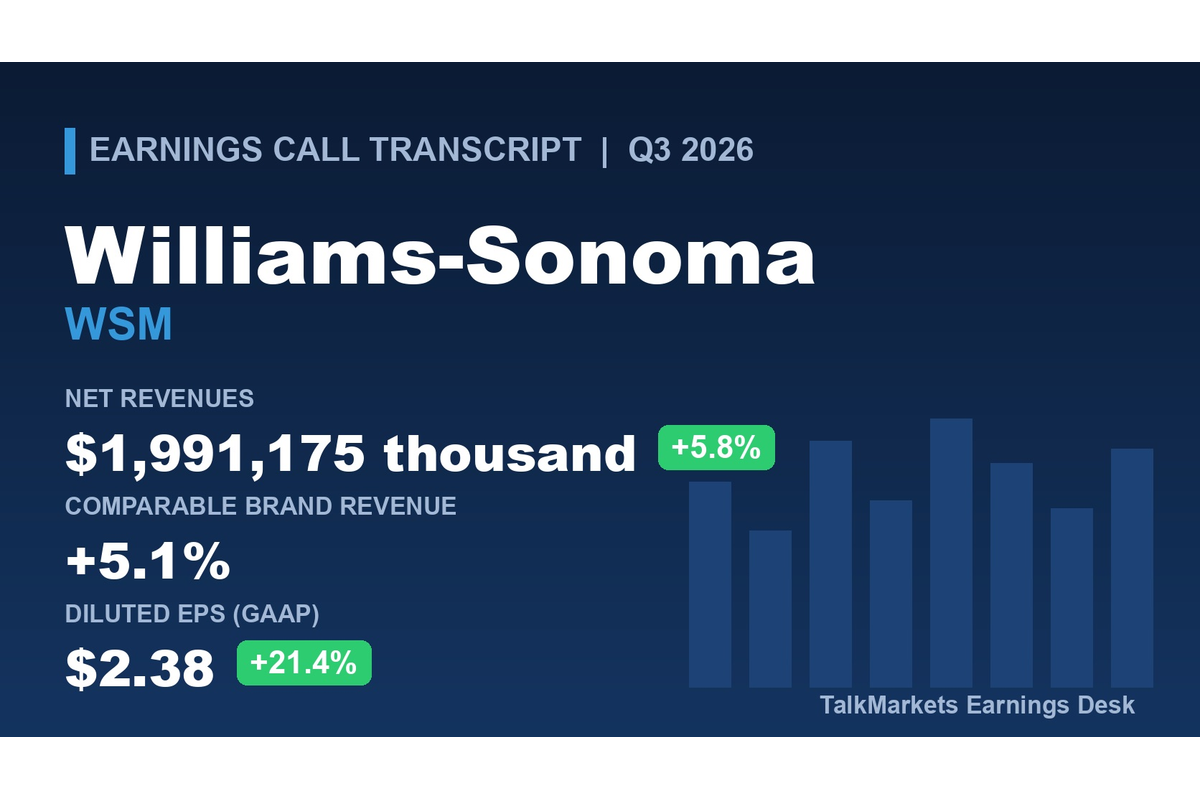
Williams-Sonoma's Q3 2026 net revenues rose 5.8% to $1,991,175 thousand with comparable brand revenue up 5.1%, while GAAP diluted EPS rose 21.4% to $2.38 and non-GAAP diluted EPS rose 11.7% to $2.19.
Ticker: WSM
Williams-Sonoma, Inc. (WSM) reported results on 19 November 2026 for its third quarter of fiscal 2026, ended 1 November 2026. The home retailer, whose brands include Pottery Barn, West Elm and Williams Sonoma, said every brand and channel delivered a positive comparable brand revenue figure. GAAP results benefited from income on previously refunded International Emergency Economic Powers Act (IEEPA) tariffs, which the company removes in its non-GAAP figures.
The key numbers (thirteen weeks ended 1 November 2026)
Metric | This year | Last year | Change |
|---|---|---|---|
Net revenues | $1,991,175 thousand | $1,882,814 thousand | +5.8% |
Comparable brand revenue | +5.1% | +4.0% | |
Gross margin (GAAP) | 47.6% | 46.1% | +150 bps |
Operating income | $376,932 thousand | $319,143 thousand | |
Operating margin (GAAP) | 18.9% | 17.0% | +190 bps |
Net earnings | $283,146 thousand | $241,592 thousand | |
Diluted EPS (GAAP) | $2.38 | $1.96 | +21.4% |
Diluted EPS (non-GAAP) | $2.19 | +11.7% |
On a non-GAAP basis, operating income was $347 million with an operating margin of 17.4%, and gross margin was 46.2%. The GAAP gross margin included a 140 basis point benefit from IEEPA tariff refunds, while higher oil prices raised supply chain costs. Merchandise inventories rose 7.3% to $1.64 billion.
Results by brand (net revenues and comparable brand revenue growth)
Pottery Barn: $762,743 thousand against $741,526 thousand, comparable brand revenue up 1.8%.
West Elm: $499,578 thousand against $468,243 thousand, comparable brand revenue up 7.0%.
Williams Sonoma: $296,018 thousand against $276,417 thousand, comparable brand revenue up 6.8%.
Pottery Barn Kids and Teen: $300,962 thousand against $291,382 thousand, comparable brand revenue up 2.9%.
Cash and shareholder returns
The company ended the quarter with $992 million in cash and generated $279 million in operating cash flow. It returned $253 million to stockholders through $163 million in stock repurchases and $90 million in dividends.
President and Chief Executive Officer Laura Alber said: "Every brand and channel delivered a positive comp."
Year to date
For the thirty-nine weeks ended 1 November 2026, net revenues were $5,756,388 thousand against $5,449,687 thousand, and net earnings were $852,617 thousand against $720,417 thousand. Diluted EPS was $7.15 against $5.82.
Source: SEC Form 8-K Exhibit 99.1
Full call transcript
Operator:
Welcome to the Williams-Sonoma, Inc. 3rd Quarter Fiscal, 2026 Earnings Conference Call. At this time, all participants are in a listen-only mode. A question and answer session will follow the conclusion of the prepared remarks. I would now like to turn the call over to Jeremy Brooks, Chief Accounting Officer and Head of Investor Relations. Please go ahead.
Jeremy Brooks (Chief Accounting Officer and Head of Investor Relations):
Good morning and thank you for joining our 3rd Quarter Earnings Call. Before we get started, I'd like to remind you that during this call, we will make forward-looking statements. With respect to future events and financial performance, including our annual guidance for Fiscal 26 and our long-term outlook, we believe these statements reflect our best estimates. However, we cannot make any assurances that these statements will materialize. And actual results may differ significantly from our expectations.
The company undertakes no obligation to publicly update or revise any of these statements to reflect events or circumstances that may arise after today's call. Additionally, we will refer to our Q3 results on a non-GAAP basis, which excludes the recognition of income from tariff refunds and other tariff-related adjustments. The amounts and details of these adjustments, along with the reconciliation of our GAAP to non-GAAP results, appears in Exhibit 1 to the press release we issued earlier this morning.
Our non-GAAP results should not be considered replacements for and should be read together with our GAAP results. This call should also be considered in conjunction with our filings with the SEC. Finally, a replay of this call will be available on our Investor Relations website. Now, I'd like to turn the call of the Laura Alber, our President and Chief Executive Officer.
Laura Alber (President and Chief Executive Officer):
Thank you, Jeremy, and good morning, everyone. We appreciate you joining us today. We delivered another strong quarter in Q3 with a 5.1% comp, a positive 5.8% total revenue growth, an operating margin of 17.4% and earnings per share growth of 12% to $2.19. Our operating margin expanded 40 basis points over last year, our largest year-over-year rate expansion since the current tariff cycle began, and operating margin dollars grew almost 9%.
Every brand and channel delivered a positive comp, and we delivered 70 basis points of non-comp growth. Our design advantages and direct sourcing model translate into superior economics, allowing us to increase full price selling while continuing to give our customers grade quality and value. We are making choices that strengthen our brands over time, while delivering significant value on a consistent basis. Our 10 great brands and compelling product drive demand, and our integrated operating platform converts that demand into profitable growth.
We are proud of our results, particularly given the external backdrop. During the quarter, cost pressures increased, including higher oil, gas, and diesel costs, impacting both raw material and transportation costs. And we delivered these results, even with higher than last year tariffs, elevated interest rates, geopolitical uncertainty, and a housing market that has gotten worse. Now I'd like to talk about two key strategies contributing to these strong results.
First, our ability to command higher levels of full price selling, and second, the operational excellence of our teams. I'll start with full price selling. We continue to increase full price selling with fewer promotions and shallower markdowns. We've been able to do this because of the strength of our brands, our differentiated product, and our operating model. In our furniture business, we continue to introduce a record number of successful new high quality programs that are innovative and differentiated, allowing us to increase full price selling, and deliver healthy furniture growth in Q3.
In non-furniture, we pulled back even further on markdowns in all brands, but particularly in our Pottery Barn brands, where we increased full price sell-throughs in seasonal, Halloween, and back to school. We knew this change would have an impact on the near-term comp in the Pottery Barn brands, but we believe it is the right strategy for long-term profitability. Now let's talk about our operational improvements. We continue to be in an environment where costs are increasing in the global supply chain,
and we continue to experience longer transit times due to the Middle East conflict coupled with port and rail congestion. Our teams have been trying to find better ways to operate the business and offset these costs increases. Some examples include that our team has negotiated favorable ocean freight costs despite market volatility. Also, we are continuing to optimize our distribution network, and we are modernizing our warehouse operations. These efforts might sound individually incremental, but at our scale, they are important contributors to both the customer experience and profitability.
As we look to Q4, we continue to experience increased costs and delays in overseas shipments, and again, our team is working to mitigate the impact. We are prioritizing key deliveries, exploiting shipping, and improving communications with our customers. AI is also driving operational improvements with broader adoption translating into measurable business results. Our AI assistants are now available across our brands, bringing our product knowledge and service expertise to customers when they need it.
These experiences have supported more than 1 million customer chat visits since launch, helping customers discover products, evaluate their choices, and shop with greater confidence. Digital experience personalization is also driving stronger results. Through Q3, revenue per visit for customers engaging with personalized experiences was up substantially versus the site average and versus last year. We are expanding these personalized experiences across our websites and email, making recommendations more relevant to each customer's shopping journey.
Our digital design platform now uses proprietary AI tools to turn a 3D plan of a customer's own room into a photorealistic image in seconds. Customers and designers can see their selected furniture and decor from our brands together in their actual space with its accurate layout and dimensions before making a purchase. Unlike generic AI design tools that may place furniture without its exact product specifications,
our platform uses the actual products a customer selects with their real dimensions so they can see precisely how those pieces fit and work together in their own room. By combining our assortment with the customer's own space, we bring the entire design to life, giving customers a clearer view of how their choices work together and greater confidence in their finished project. Across our corporate teams, AI is helping associates work more efficiently and amplify the impact of their expertise.
Our in-house AI tools enable creative teams to showcase our products in a wider range of inspiring settings, scaling our brands distinctive design perspective. AI is also giving business teams faster access to insights and automating repetitive analysis and reporting, freeing associates to focus on decisions and work that moves the business forward. Now let's review our brands, starting with Pottery Barn. Pottery Barn delivered a 1.8% comp in Q3.
Customers responded to the refreshed Pottery Barn heritage aesthetic with healthy growth and furniture. We are showcasing what Pottery Barn does best, offering beautifully designed, high quality product at a great value. We are increasing the pipeline of product in this refreshed aesthetic. We are also chasing back orders of our best sellers and designing more into what is working, both in a collection expansion, but also in brand new collections in the same aesthetic.
The moderation in Pottery Barn's comp was primarily driven by non-furniture. And as I discussed earlier, we planned the quarter with higher levels of regular price, especially in these categories. We've also planned Q4 similarly with less markdowns and higher full price selling, especially in the seasonal layer. We will absolutely offer our customers great value over Black Friday and Cyber Week. But in total, we are positioning the brand at a much higher level of regular price sell-through, and we are positioning both core and furniture as great holiday gifts.
Also, we're really excited that in early December, we'll be launching what we believe will be one of Pottery Barn's biggest and most exciting non-comp collaborations. We have never had a flow at this time of the year in Pottery Barn. You may have seen the press release yesterday, announcing Pottery Barn's partnership with a four-sixes ranch. We are so proud to be working with Taylor Sheridan and his team, and have developed a collection of beautiful furniture, textiles, and decorative accessories that brings the magic of the American West into our customers' homes.
Now let's turn to our Pottery Barn children's businesses, which ran a 2.9 comp in Q3. In the quarter, furniture was an important driver, particularly at Pottery Barn Teen. Customers responded to our expanded assortment of well-designed furniture at compelling values. Dorm was a particular highlight, delivering another record season. Customers responded strongly to our differentiated furniture, our innovative storage solutions, and washable rocks reinforcing our position as a destination for high-quality, functional, and stylish dorm-room solutions.
Together with Dormify, we continue to expand our reach. Collaborations remain an important growth engine across these children's brands. Love Shack Fancy, Chris Love-Julia, and Erin perform well, along with newer partnerships, including Pink Palm Puff, and our exclusive Nuna Love Shack Fancy Baby collection. Also in our children's business, we ran fewer markdowns and back to school in Halloween, increasing our margin rates. As we look to Q4, we believe we have a strong lineup of holiday gifting for children of all ages.
And as the largest specialty retailer home furnishings for children, we're excited about the growth opportunities ahead across these life stage businesses. Our pipeline of new product and collaborations is strong, and we continue to expand our reach with the next generation of customers. Now let's talk about West Elm. West Elm delivered a seven comp in Q3. The strength in the quarter was broad-based across both furniture and non-furniture.
Collaborations continue to be a powerful sales driver for the brand. During Q3, West Elm launched a powerful, successful collaboration with Rustin Daughters, which I think many of you know is an iconic New York brand and third-generation family business. Also, the brand introduced an expanded second collection of their very successful collaboration with Pearson Ward. And we opened two new West Elm stores in Q3, Annapolis, a new market for the brand and Williamsburg in Brooklyn.
Looking to Q4, West Elm has a compelling new layer of furniture core and holiday that builds on the successful programs we have introduced all year. Now let's talk about Williams Sonoma. Williams Sonoma ran a 6.8 comp in Q3. Performance was broad-based with every division across our kitchen and home businesses delivering positive comps. Our Q3 performance reflects the strength of this combination. Differentiated products, compelling partnerships and customer experiences supported by continued investments in our stores and our marketing and innovation pipeline.
During the quarter, we brought new product to life through influential partnerships. Maria Sharapova helped introduce our exclusive All-Cloud Graphite cookware and Coffee Expert, Morgan Accra, showcased the new Rebel Autopore over coffee machine available only at Williams Sonoma. And if you haven't seen yet or you're looking for a great gift, please go check it out. It really is the gift of the season. In Williams Sonoma Home, we introduced new collections with artists and designer Josh Young and kitchen designer Christopher Peacock, both of which extended our assortment across more of the home.
Our stores continue to be a major point of differentiation. During Q3, we hosted cookbook signings around the country with culinary leaders and we continued our popular skills series. The skills series was even featured nationally on NBC's Today Show. These experiences bring together product, expertise, community and inspiration in a way that is very difficult to replicate. As we enter Q4, we have a holiday assortment from our iconic peppermint bark to my new favorite pistachio bark to everything our customers need or wants for Thanksgiving, gifting and cooking and entertaining.
Our stores, our websites and our associates are ready for holiday. Now let's move to B2B. B2B grew 15% in Q3, delivering another record quarter with strength across both contract and trade. What is particularly exciting is how broad the opportunity has become. Hospitality remains an important driver with projects across companies including Hilton, Marriott, Rosewood and under Canvas and we are also winning business across food, beverage, gaming, education and sports and entertainment.
Our portfolio allows us to serve a broad range of commercial customers with the design, product, quality and service both on closing large contract projects and on corporate gifting where our broad assortment and personalization capabilities give us another way to serve existing and new customers during the holiday season. We continue to see significant runway in B2B as we expand our customer base and the industries we serve. Now let's turn to our exciting emerging brands which once again delivered double digit growth.
Rejuvenation had an excellent quarter with double digit growth across both DTC and retail. Customers continue to invest in renovation projects and rejuvenation is benefiting from its authority in quality, cabinet hardware, bath and lighting. Product innovation is expanding that opportunity. The brand introduced new bath vanities, decorative lighting, expanded hardware collections and proprietary switches and dimmers. These are highly considered categories for design, quality, craftsmanship and customization matter and that is where rejuvenation really stands out.
Looking ahead we see continued opportunity to expand rejuvenation across project led categories and bring more differentiated product to customers who are renovating their homes. Mark and Graham also delivered another quarter of double digit growth. The brand continues to expand beyond traditional gifting occasions with strength in personalized gifts and corporate gifting and now we are entering Mark and Graham's most important quarter. The brand's assortment is built for holiday with personalized gifts for everyone on the list complemented by decor and tabletop and GreenRow also delivered another quarter of very healthy growth.
During Q3 the brand launched a handcrafted upcycled holiday collection that showcases its distinctive approach to design and craftsmanship. GreenRow was also recognized by House Beautiful as one of the best stores in America and tomorrow we'll open GreenRow's second store in Palo Alto. Another important step as we thoughtfully build this young brand. Finally our global business continued to grow in Q3 led by Mexico, Canada and the UK.
We saw healthy DTC performance, continued expansion of our brands in the UK and further growth in our international design and trade businesses. We continue to see opportunity to extend the brands in these priority markets. In closing Q3 was a strong quarter on both the top and bottom lines. We delivered a 5.1% comp and a 5.8% total revenue growth with every brand and channel delivering a positive comp.
We achieved a third quarter operating margin of 17.4% and earnings per share through 12% to $2.19. We delivered it in an operating environment with higher costs and a housing market that has gotten worse. We continue to offer high quality innovative products, open beautiful new stores and expand our technological capabilities and we made choices that we believe strengthen the long-term health of the business. We ran at higher levels of full price selling,
we continued to strengthen our core business and at the same time our teams are delivering operational excellence across the company from transportation and warehouse operations to vendor partnerships, technology, AI and customer service. To our teams thank you for your extraordinary efforts as we work to finish the year is strong and to our vendor partners and shareholders we appreciate your continued partnership and to our customers thank you for choosing our brands and inviting us into your homes.
And now I will turn over to Jeff to take you through the numbers in more detail.
Jeff Howie (EVP, Chief Financial Officer):
Thank you Laura and good morning everyone. Our Q3 performance demonstrates the power of our operating model to deliver compounding results. We grew both the top and bottom lines despite a challenging environment marked by elevated tariffs, rising interest rates, a weak housing market, high oil prices and geopolitical uncertainty. We continue to take market share in the fragmented home furnishings industry while increasing our penetration of full price selling and delivering strong earnings growth.
I'll cover three things this morning. First, the IEEPA tariff refunds. Second, our Q3 results. And third, our fiscal 26 guidance. I'll start with the IEEPA tariff refunds. During the quarter we recognize the remaining 29 million of IEEPA tariff refunds in cost of goods sold as a related inventory sold through. With a small amount of interest and adjustments, the net benefit to Q3 GAAP Free Tax Results was approximately 30 million with a 19 cent impact to diluted earnings per share, including the IEEPA refunds.
Q3 our free margin was 18.9 percent and diluted earnings per share were $2.38 on a GAAP basis. We have now received substantially all our refunds and have recognized the full benefit in our income statement. We expect no Terra Free Fund adjustments in Q4. As we did in Q2, we have excluded the IEEPA tariff refunds from our non-GAAP results in Q3. This gives investors a clean, comparable view of the operating business across fiscal 25, 26, and 27.
The full GAAP to non-GAAP reconciliation is an Exhibit 1 of this morning's press release. The operating results and guidance I discussed from here are all on a non-GAAP basis. 29 are our third quarter results. Q3 net revenue was 1.99 billion, of 5.8 percent year over year, with comparable brand revenue of 5.1 percent. All brands posted positive comps. By category, both furniture and non-furniture delivered positive comps with their growth primarily driven by strength in our furniture business.
By channel, e-commerce led with a 6.8 percent comp, its fourth straight quarter of acceleration. Retail comped 1.5 percent on top of an 8.5 percent comp last year for a 10 percent two-year stack. Moving down the income statement, Q3 rose margin was 46.2 percent, up approximately 10 basis points year over year, despite higher oil and tariff costs. Merchandise margin expanded 20 basis points, driven by higher full price selling, even as tariff costs remained a headwind and cost of goods sold.
Supply chain deleveraged approximately 50 basis points, as higher oil costs flowed directly through the domestic transportation expense. USD's prices were up more than 60 percent year over year in Q3, and up 20 percent since our last column August. Occupancy leverage approximately 40 basis points. As top line growth of nearly 6 percent, outpaced a less than 2 percent increase in occupancy dollars. Turning to SG&A, our Q3 SG&A rate was 28.8 percent of revenue for approximately 30 basis points better than last year.
Employment leverage 30 basis points as top line growth of nearly 6 percent, outpaced a 3 percent increase in employment dollars. Advertising remained flat at 7.5 percent of revenue. Our in-house marketing team continued to deliver strong returns on spend, allowing us to invest with discipline in high performing areas. This focus on marketing efficiency contributed to our strong e-commerce revenue growth. On the bottom line, operating income was 347 million, up 9 percent year over year, with operating margin at 17.4 percent of 40 basis points.
Deluded earnings per share grew 12 percent to 2.19 cents this year from 1.96 cents last year. Turning out of the balance sheet, we ended the quarter with 992 million in cash and no debt. Virginized inventories for 1.6 billion, up 7 percent year over year, essentially in line with total revenue growth of nearly 6 percent. We continue to chase best sellers across both core and newness and we are working to mitigate the delays in overseas shipments.
During the quarter, we invested 64 million in capital expenditures on our retail stores, e-commerce and supply chain to support our long-term growth. We also returned 250 million to shareholders, demonstrating our commitment to return excess cash over time. We paid 90 million in dividends with our dividend per share of 15 percent year over year. And we repurchased 163 million of stock, bringing our year-to-date stunt share repurchases to approximately 2 percent of shares outstanding.
Summing up our third quarter results, revenue grew 5.8 percent and EPS grew 12 percent. I want to thank our team for those results. They did the work, they deserve the credit. Turning out our outlook, we are reiterating our full year guidance, comparable brand revenue growth of 4 to 6.5 percent, total net revenue growth of 4.7 to 7.2 percent, and our pretty margin of 17.8 to 18.2 percent.
I will focus on three guidance topics in more detail. First, IEEPA tariff refunds. Second, oil. And third, the Q4 dynamics around shrink and tariffs. Starting with the IEEPA tariff refunds, to be clear, our guidance is non-GAAP and excludes the IEEPA tariff refunds and related interests recognized in Q2 and Q3. We do not anticipate any additional IEEPA tariff refunds in Q4. Next, oil. Our oil prices continue to pressure transportation and raw material costs.
Our guidance embeds oil prices at today's levels. That is our best estimate of the impact as the direction of oil prices is difficult to predict. Finally, two Q4 dynamics to keep in mind, shrink and tariffs. As a reminder, in Q4 last year, we realized a shrink benefit of approximately 160 basis points from favorable physical inventory results. We will lap that benefit in Q4 this year. However, we expect lower tariff costs resulting from reduced tariff rates to largely offset the headwind from that comparison.
Below our putting income, we expect full-year interest income of approximately 30 million and a full-year effective tax rate of approximately 26 percent. Our capital expenditure guidance is unchanged at approximately 275 million for the year, with about 95 percent going to retail, e-commerce and supply chain. We continue to expect year-end store count to be essentially flat to last year. As a reminder, most of our leases terminate at fiscal year-end, so closures land in Q4.
Our fiscal 26 guidance continues to embed approximately 70 basis points of non-comp growth. In fiscal 27, we anticipate 1 to 3 percent store count growth. Of returning cash to shareholders, in Q4, we will continue to pay our quarterly dividend of 76 cents per share, a 15 percent increase year over year. We are proud to say this marks our 17th consecutive year of increased dividend payouts. Regarding share repurchases, we have approximately 900 million remaining under our authorization, and we will continue to repurchase shares opportunistically.
Looking beyond 26, we remain confident in our growth strategies and operational execution, and will provide guidance for fiscal 27 in March per usual cadence. Wrapping up, the five reasons we are confident we will continue to outperform our peers remain the same, and Q3 added another proof point to each. One, our ability to gain share in the fragmented industry. In Q3, we continue to outperform the industry with revenue growth of 5.8 percent.
Two, the strength of our in-house proprietary design. Both price selling expanded merchandise margin while we grew our top line. Three, the advantage of our digital first, but not digital only channel strategy. E-commerce accelerated to a 6.8 percent comp and retail comp 1.5 percent for a 10 percent two-year staff. Four, the ongoing strength of our growth initiatives. Business to business, emerging brands, and our retail investment are driving growth.
And five, the resiliency of our inventory in line with sales and approximately 900 million of share repurchased capacity in reserve. When you put those five reasons together, it's clear how the power of 10 brands on one integrated platform produces compounding results. With that, I'll open the call for questions.
Operator:
Thank you. We will now begin the question and answer section. Please limit yourself to one question and one follow up. If you would like to ask a question, please press star one to raise your hand. To withdraw your question, press star one again. We ask that you pick up your handset when asking a question to allow for optimum sound quality. If you are muted locally, please remember to unmute your device.
Your first question comes from the line of Peter Benedict with Baird. Peter, your line is open. Please go ahead.
Peter Benedict (Baird):
Well, thanks, guys. Good quarter and thanks for taking the question. My first question, I'm just curious if you've had any past experience with kind of limiting the non-furniture markdowns within Pottery Barn and just maybe how you expect that to impact kind of the fourth quarter and within that kind of any early reads in terms of holiday demand kind of across the banners.
Company Executive:
Yeah, thanks, Peter. We're excited about holiday. We're seeing our customers all year respond to differentiated product and great quality and great value. And we've been very focused on our whole business taking into higher levels of regular price. And I think you've been on the journey with us as we remove the, you know, site-wide promos. And now we are seeing the opportunity to reduce the amount of markdowns that we take and particularly in seasonal goods where we were more promotional last year.
Now, in the marketplace, our peers are very promotional. They're earlier and they're running site-wide and some of them have, you know, 70% of they're sorting on markdown right now. And, you know, we also have seen that the customer is shopping later towards the seasonal holidays as they are interested in being, you know, shopping for what's relevant. And we're also seeing strength in our foundational core. And when I say that,
I also mean new core that we've just introduced that we know based on the sales is going to be around for many, many years because the strength of the furniture business. And so you're watching them, you know, spend their money on these longer-term purchases, less discretionary purchases. And it's great to see that they really like our new refreshed aesthetic in Pottery Barn and are responding to furniture across the board.
And so in terms of the strategy that, you know, we executed in Q3 and Q4, it's really a continuation of what we've been doing, which is to continue to build our strength in our core brands and grow our emerging brands and B2B and improve the product pipeline and bring in brand heat with great collaborators. And at the same time, just deliver great customer services. There's really no big difference in what you're seeing, except that it's, you know,
it's still one of the biggest opportunities of the year is to reduce the amount of promotions in Q4.
Peter Benedict:
That's helpful. Thank you. My fault is just around the lead times that seem to be picking up your little bit given some of the supply chain dynamics. Can you maybe frame what that means for customers? And are you seeing any signs of, you know, cancellations or anything along those lines that are stemming from some of these longer lead times? Thank you.
Company Executive:
Yeah, we're working very hard. I think, you know, you know, this, we have size and scale and our supply chain and we have great partnerships that are vendors, not just being our product vendors, but also, you know, the shipping companies. And we are working really hard to expedite, you know, key goods. And also, you know, just like we've seen before, you get best sellers and it takes a while to get back in stock.
So, you know, it takes a couple quarters, actually. But clearly, there's, you know, support congestion. Here in the United States, there's, you know, containers, not making it out. You know, there's all sorts of disruptions at, at country of origin. All those dynamics are in play and we're dealing with them like everybody else. And we're also trying to be as transparent as possible with our customer. We actually keep, you know, changing the dates and the quote lead times on, you know,
even orders not placed so that when you go to the site now, you're getting a more realistic quote of time. But it's certainly, you know, not an easy dynamic and the whole industry is dealing with it. And we're going to deal with it better than most. But it is, it is a real dynamic.
Operator:
Your next question comes from the line of Michael Lasser with UBS. Michael, your line is open. Please go ahead.
Michael Lasser (UBS):
Good morning. Thank you so much for taking my question. This might be connecting to unrelated topics. But just in case, the decision to more strategically pull back on some of the coming at a time where you did not include the reiteration of the long term algorithm within your press release. Just want to make sure that we should not interpret this as a signal moving into next year that if you continue this strategy and may even expand it to the other banners,
it would result in at least a temporary suppression of either the top line growth or the thank you.
Jeff Howie:
Good morning, Michael. I think you may be reading too much into that. Every time this time of year, as we look at and turn into Q4 and 27s right around the corner, we debate how to handle the question because we're not issuing guidance today for fiscal year 27. We'll issue guidance for fiscal year 27 in March per usual cadence. And we want to be careful that we don't imply or have people read through that we're actually issuing guidance for 27 when we talk for long term guidance.
So I think you're reading too much into it. It's simply a function that we're not issuing fiscal year 27 guidance at this time. As Laura talked about, we're very focused on executing in a very challenging environment in Q4 and that's what our focus is on.
Michael Lasser:
Thank you very much for that. Jeff, my wife tells me I read into things too deeply as well, so I appreciate that. My follow up question is on the tariff benefit that Williams-Sonoma might get into the early half of next year. You quantified that the lower tariff rate in the fourth quarter is going to largely offset the more difficult shrink comparison during this time. Should we extend that to 2027?
At least the first half until you lap some of the more normalized tariff rates, or given the upholstery increase in tariff rate that might kick in the first part of 2027, we shouldn't extend that math to the first half of next year. Thank you so much.
Company Executive:
I know everyone's chomping at the bit to talk about fiscal year 27, but again we're not issuing guidance for 27 until March. We're really focused on Q4. Michael, you touched on one of the big dynamics in Q4 is we are going to see tariff favorability as we start to come up against lower tariff costs flowing in your income statement. That'll help us offset the one time benefit we had last Q4 from a favorable shrink result.
But as we take a look at next year, there's a lot of puts and takes and you saw at earnings release. There's tariff noise out there. There's also higher oil prices. We're spending more expediting. It's a little early to talk about 27. And one thing I will say is you mentioned the higher upholstery and the increase in the tariff rates for this section 232 tariffs. That will not have a substantial impact on us.
I'll just clarify that for everyone right now. But right now we're really focused on Q4 and we'll get to fiscal year 27 in March.
Operator:
In the interest of time, we now ask that you limit yourself to one question. Your next question comes from the line of Mike Montani with Stifel. Mike, your line is open. Please go ahead.
Mike Montani (Stifel):
Great. Good morning. Thanks for taking the question. I just wanted to ask if we assume that the home furnishing industry remains flatish into 2027. Can you just underscore some of the key drivers that would allow Williams-Sonoma to continue taking share at this kind of mid single-digit revenue growth pace?
Company Executive:
Sure. First of all, thank you, Mike, for your coverage and the question. So we are a company that has always built for the long term. We're so proud of our strong 10 brands and we have great core brands and we have these emerging brands that are growing and are profitable and have a lot of headroom to grow both short term and long term. And when you look at the reason why we are differentiated both in our brands but also in our profit model, there's a few key aspects to it.
First, I think you know that we design our own products and we have a lot of exclusives and we have a direct sourcing model and that gives us great pricing power. The second thing is we have strong digital expertise, technological expertise in terms of the new technology AI and how we're deploying it and you know it's no surprise that we're close to 70% DTC which drives our profitability.
And you know when you think about those couple things on an integrated platform, the scale and the best practice sharing really allows us to produce more profit. We leverage our supply chain, our tech stack, our house file, our performance marketing and then when you add to that our growth levers we have the growth of our core brands and strategy execution to clean part of our in West Elm, our merging brands and B2B and all those things are what we're really confident about.
And then of course there's the unknown that what happens in the macro and clearly as you know it's been really tough for a lot of people including our industry where housing is worse you know believe it or not it's worse and so imagine when we get that acceleration who knows when that's going to happen I wish I knew but when that happens that certainly will be a growth rather.
Operator:
Your next question comes from the line of Jonathan Matuszewski from Jefferies. Jonathan your line is open please go ahead.
Jonathan Matuszewski (Jefferies):
Oh thanks good morning and thanks for taking my question. In the past couple of weeks there's been some new distractions popping up for the consumer we've had some travel disruption, site outages, some retailers calling out panic buying you know curious if any of these distractions have impacted early 4Q trends relative to the 5 comp from 3Q. Thanks so much.
Company Executive:
Yeah I wish I knew the answer that but certainly there's plenty going on out there you know it's definitely interesting times and yet there's a lot of good news out there as well so you know we're very focused as I said on our execution and there's not much I can do about these distractions so we're focused on what we can control in our stores with our great service and how our brands look and you know I haven't mentioned it yet but I've mentioned it in my prepared remarks
we have some exciting stuff coming through you know I think as I think about you know the end of this year and to next we have some collaborations that are game-changing I think that will really drive new customers and new aesthetics across all of our brands some of which most of which we haven't announced yet we did announce the four sixes yesterday and that's a really fun one I don't know if you guys are seeing the early user campaign on that but getting a lot of looks
and the products great and you know we're going to watch that December you know like beginning of December I think we've said December 9th so there's a lot of fun stuff that we're going to create our own distraction with and remind our customers you know how much they love their homes and that we have the best design and quality out there so that's how we're thinking about it so we're not immune to them I'm not ignoring them but I also we can only focus on what we call
Operator:
your next question comes from the line of Christina Fernandez with Telsey Advisory Group Christina your line is open please go ahead
Christina Fernandez (Telsey Advisory Group):
hi good morning I wanted to follow up on the decision to lower promos at Pottery Barn why was now the right time and if you looked at these strategies that you've adopted and other brands in the past how long does it take for the consumer to normalize and get used to the higher pricing we would say it's like three months six months you know couple of quarters maybe some time friend you can give us from past experience thank you
Company Executive:
yeah sure we've used strength in our business to make these decisions I think you've seen us do that you know you watched us really change the trajectory of the West Elm comps and they have significantly reduced their markdown and promo activity last holiday for Pottery Barn you know we it wasn't our strongest holiday as you know and we took more markdowns last holiday then we will let this holiday and
so it's not that it's a different strategy it's that the opportunity is greater than Q4 than it was the rest of the year and then for twenty seven there's you know there's still always opportunity but it's less so than it was than it is right now in Q4
Operator:
your next question comes from the line of Simeon Gutman with Morgan Stanley Simeon your line is open please go ahead
Analyst (Morgan Stanley):
good morning this is Pedro Gill on for Simeon I wanted to ask you about AI and agentic commerce you briefly touched on it already you're already told us a bit about all the good work you're doing with your in-house initiatives but could you expand a bit on your approach to collaborating with external horizontal agents and also given your large online business and your presence in social media already how can you leverage your data and use it to accelerate your market your gains
Company Executive:
thank you for the question I'm going to pass the mic over to Samir who is our CTO the CTO
Samir (Chief Technology Officer):
appreciate the question thanks you know Laura spoke earlier about how we're using AI across the business so let me start with that and then I'll address a couple of things and what you had to specifically ask for and what I want to do is add a little bit of color with some specific examples about what we're doing so Laura talked about the room planner tool
and what's really exciting about that one is that with our proprietary tech you can imagine a whole new look in your room from the furniture down to the rugs the lighting the decorative pieces that give each brand its distinct style so this isn't just about seeing the sofa in your space this is a guide AI guided complete design that you're seeing in your space including decor and it's just something that's unparalleled in the industry if you haven't used our tooling before if you're redecorating if you're shopping
I highly encourage you to use it's a game-changing experience for anybody that's looking to redecorate and it's driving real sales for us and that same design expertise is behind the AI imagery Laura talked about earlier the tools that we built drawn years of our own photography so you talked about the data and how we're leveraging it yes customer data is part of it but you have to think about the catalog of photography of imagery of style that we have that nobody else has
and we're leveraging that with AI to show customers the specific color or finish you're considering more settings more combinations with our distinctive look of our brands so again this is data that we have with proprietary tech built on top of AI that's allowing us to deliver the same great inspiration that we've always delivered but just at a much much higher scale and this holiday we're applying that same tech to be able to showcase our products in gif in gifting settings as well which is you know so seasonally appropriate
and you know you also heard about the results from digital personalization in Q3 a holiday season is where we're going to put that to work with gift givers you know if you bought somebody a gift last year we've had that data and again you kind of talked about that we're going to use that history to send a timely reminder suggest gifts from across our brands that the customer might like and then not only that
we make it easier for the customer to go from that reminder to purchase with a simpler checkout it's just like a practical way of how we're using AI at scale to make holiday shopping more personal and just a little bit less stressful
Operator:
your next question comes from the line of Kate McShane with Goldman Sachs Kate your line is open please go ahead
Kate McShane (Goldman Sachs):
hi good morning thanks for taking our question um we wanted to go back to some of the supply chain issues that you mentioned and I think you did say that you would try to expedate sorry expedite shipments to order in order to mitigate some of the delays is there a cost to this that maybe is not being contemplated in guidance as a result or is there any risk guidance on the margin side if there were to be more of an effort to expedite shipments to customers in Q4
Company Executive:
good morning Kate thank you for asking the question I think it's a topic on a lot of people's minds it's not just the expediting costs it's also a higher price of oil you saw that flow through in our Q3 income statement look higher oil prices are a pressure in transportation raw material costs and as you touched on we're incurring higher cost expediting products that meet our customer promise delivery dates lower talk on that let me talk about what we're experiencing and what's baked into the guidance
and how we're working through it you know first is an inbound transportation I think everyone knows is goods going to our distribution center and goes under a cost of good soul this is primarily ocean freight and while we're seeing some pressure here our sizing scales of 14th largest container importer into the United States helps us mitigate this pressure
and I'd really like to recognize or the outstanding work done by our transportation team navigating this challenging environment the second place is on domestic transportation these are shipments leaving our distribution centers going outbound either to a customer's home or to a retail store here we're seeing a lot of pressure first from diesel I think everyone knows diesels up about 60 percent year over year in fact it's up 20 percent since our last earnings call in August and Q3 we absorbed about 75 basis points of pressure from diesel prices
and on the full year we estimated it could be as high as 60 million dollars of incremental diesel expense that we're absorbing in Europe P&L. Expanding deliveries to customers also has outbound delivery expense in transportation expense we always put the customer experience first and we start there and that is the most important thing to us and here we are absorbing incremental costs is delays from congestion forces in the expediting orders to meet the customer delivery dates and that is what is important to us and
we will incur that expense if necessary and of course finally just to mention raw material prices I think Laura touched on this we're working with our vendors to offset and reduce costs where possible but here's the thing it goes the heart of your question oil prices at today's levels are embedded in our guidance so is some of the explaining costs but it's hard to predict how all this is going to land out
and look if oil prices go up from here that that that may lead us to a different place if we have to explain a lot more in the holidays same thing so that's what we can do it's hard to predict from here our guidance stays are best estimate of how these expenses will come out and where our pretty margin will land for the full year as well with keyboard.
Operator:
Your next question comes from the line of Oliver Wintermantel with Evercore ISI Oliver your line is open please go ahead.
Oliver Wintermantel (Evercore ISI):
Hi thanks my question is about the new stores or remodel stores how are they performing on a total market basis including online sales and how do these investments bring incremental customers and spending to Williams-Sonoma is that more of a channel shift from online to stores or the other way around thank you.
Company Executive:
I'm sorry can you repeat your question
Oliver Wintermantel:
yeah just the new and remodel stores how are they performing on a total market business you know including online sales and then with these new remodel markets do you see incremental sales coming to Williams-Sonoma or is that a channel shift from online to the stores or the other way around.
Company Executive:
Great question it's so wonderful to see that our new stores are performing well and you know we put pretty high expectations on our four walls for our stores and we have been opening more stores we're particularly seeing great results from our new remodeled Pottery Barn and Williams Sonoma stores we haven't done enough west down yet and we haven't rolled out that many more re-juves but in total the total class of stores is outperforming our performer and previous locations which is great and we work really hard on this
and we're always investing money to improve the customer experience in our stores and excited about the future some of the changes we're going to even make next year that we haven't talked about yet with some refresh looks especially not Pottery Barn brands but new stores are doing well Jeff do you want to add anything to the real estate conversation
Jeff Howie:
yeah I think you touched a lot of it you know we've seen big success across all of our initiatives I mean particularly the reposition we're moving stores from some of the older tired indoor malls that are you know all across the US landscape to more vibrant outdoor lifestyle centers and we move these and reposition these stores we're seeing substantial increase in the top lines and better economics in the bottom line and then we're entering new markets as well with some of our brands
and as Laura said you know on average they're beating performer and we have very strict profitability criteria in the four-wall and they're achieving that so it's been a very strong strategy we're you know part of why we're adding 70 basis points of non-comp growth to the year and as we've talked about in prior calls and we talked about our earnings remarks today as we look forward to 27 we've been talking about and one of the 3% store can't grow
Operator:
your next question comes from the line of Brian Nagle with Oppenheimer Brian your line is open please go ahead
Brian Nagle (Oppenheimer):
hi good morning thank you for taking my question nice question the question I want to touch again on just pottery barn and some of the actions you're taking right and I know there's already been a few questions but I guess the question I have is you know as we're thinking about you know what you announced or would you would you discuss say this further pull back in promotions is this is this more of a one-time adjustment or is this something that's going to be ongoing and I think Jeff
I think you maybe you mentioned that you'll still see the impact in fourth quarter but you know is it I guess I had the duration and how far are we into this effort at this point
Company Executive:
that's a great question you know there's always going to be some incremental movement we've been after this you know since before COVID it's how we've been improving our margin and if you look at the improvements in margin and our scripts you'll see that a lot of it is directly related to changing our pricing strategy from what was very promotional and still is in the marketplace to a regular price business that does not mean that the customer is not getting great value because we are
so focused on giving the best first price so we can sell through at regular price okay so that is not changed the Q4 is a more acute situation as was Q3 because of the seasonal holidays versus Q1 which is more foundational now in terms of Pottery Barn I just want to touch on a few things that we haven't talked about yet so we launched as you know a refreshed aesthetic it's always been known for its casual comfortable style that feels timeless collected and lived in
but the new aesthetic refresh aesthetic is even more authentic inspired by architecture antiques auctions has a sense of history it's approachable and it's about high design and a great value we have really elevated our materials we're focused on our wood finishes and our multi-step finishes that really make the product look a lot more expensive than it is and the look is really working and we really rolled it out most dominantly in furniture as I said
we are chasing the best sellers from the fall launches it's going to take us a while to get back in stock and some of the key best sellers and then because we now have confidence in this aesthetic you're going to see us next year you're going to see more and more of this line of newness and Pottery Barn throughout next year and as I said the collaboration lineup is much stronger than this year
Operator:
your next question comes from the line of Steve Zaccone with Citi Steve your line is open please go ahead
Steven Zaccone (Citi):
great thanks so much for taking that question I wanted to follow up on Michael's question it is our job to kind of read into the details here for the investment community so I understand it's standard practice to guide for 27 in March but you've always had this long-term comment it was in the three to the last the release last year
so it is a reflection is it a reflection of the near-term being tough to read do you have a change in some sort of longer-term view of the margin framework for the business any details would be would be helpful
Company Executive:
let's see I appreciate the question you're correct we have put that in the past there is no change in the fundamental proposition of Williams-Sonoma, Inc. both in terms of getting market share in terms of our long-term algorithm particularly in normalize environment this is simply and you know this is some of our inside baseballs we debate every time this year as we release Q3 earnings about what are we saying when
we say that that at this time of year when we're when 27 of the next year is right around the corner um and if you go back and look we have massaged that phrase every year in the script and said it slightly differently um and that's just simply trying not to give 27 guidance and you're all reading it one way we were trying to you know have you not read it another way in trying to imply that
we were guiding 27 a certain way because we're not going to do that till March so again I think I think you're reading too much into it's simply we're just trying not to guide 27 until March and our long-term guidance algorithm has not changed
Operator:
we have reached the end of the Q&A session I will now turn the call back to Laura Alber CEO for closing remarks
Laura Alber:
okay well thank you all for your support and your questions and listening today and again I want to thank our teams um who've done such a great job and we have peek right around us and I hope you're shopping you guys I hope you go out and see our stores and check out um all the great products there's a lot of good stuff to buy and we look forward to talking to you after the new year
Operator:
this concludes today's call thank you for attending you may now disconnect
Comments
Log in or sign up to join the conversation.