

The Federal Reserve left its target interest rate steady yesterday, confirming widespread expectations for no change in monetary policy. The decision was likely driven, at least in part, by a desire to steer clear of even the appearance of influencing next week’s midterm elections. While that may be a politically savvy move, it could make the central bank’s job of taming inflation that much harder.
Using Warsh’s comments from yesterday’s press conference as a guide suggests there’s a case for following through on September’s rate hike with another round of tightening. In his opening statement at Wednesday’s press conference, he said that “economic activity is expanding at a strong pace” and has “strengthened,” while “job gains have kept pace with the workforce.” He also noted that “the jobless rate is lower than a year ago, and payroll growth is noticeably above last year’s pace.”
At the same time, “inflation remains elevated” and is still “too high.” He added that “Americans, of course, are still dealing with inflation that has been running above the Committee’s objective for close to six years.” Lest there be any doubt, he asserted that “it’s our responsibility to get inflation down.”
It all adds up to a persuasive case for another rate hike. Warsh’s explanation for why the Fed punted ultimately boils down to a vague rationale that was neither persuasive nor satisfying: “The Committee believes that the accumulation of more information will help it determine the policy stance appropriate to ensure a timely return of inflation to the 2 percent goal. The Committee will deliver price stability.”
The question is whether the gap between now and the next FOMC meeting on Dec. 9 will give inflation more room to run, forcing the Fed into a stronger policy response to play catch-up.
“Waiting is not costless,” notes Claudia Sahm, a former economist at the Fed who is now the chief economist at New Century Advisors. Speaking with The New York Times she observes: “If they wait and find out that those upside risks to inflation they were worried about are not risks but reality, then the Fed will have to do more.”
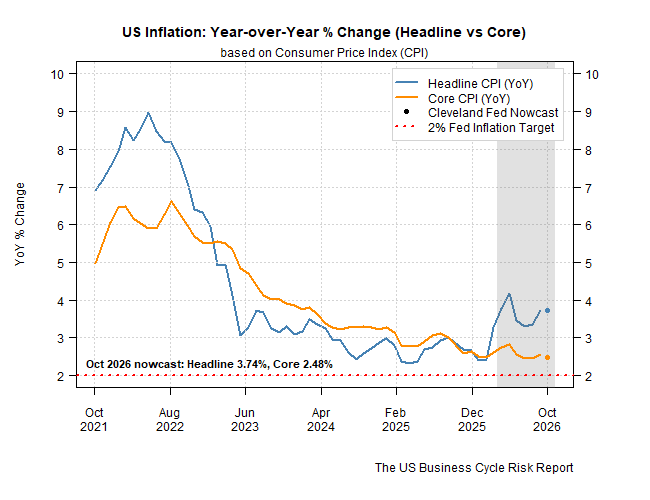
The market is pricing in high odds of a quarter-point rate hike in six weeks, based on Fed funds futures. Meanwhile, the Cleveland Fed’s nowcast for the upcoming October consumer inflation report points to year-over-year change in headline CPI holding steady at 3.7%, while core CPI is projected to edge down to 2.5% from 2.6%.
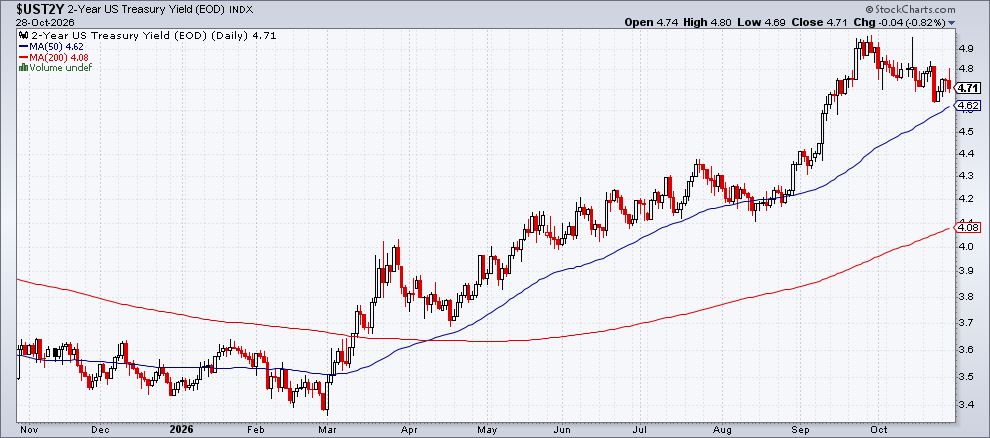
The bond market still appears willing to give the Fed the benefit of the doubt for pausing rate hikes. The policy-sensitive 2-year Treasury yield edged lower yesterday, although at 4.71% it continues to signal that investors expect additional tightening in the near future.
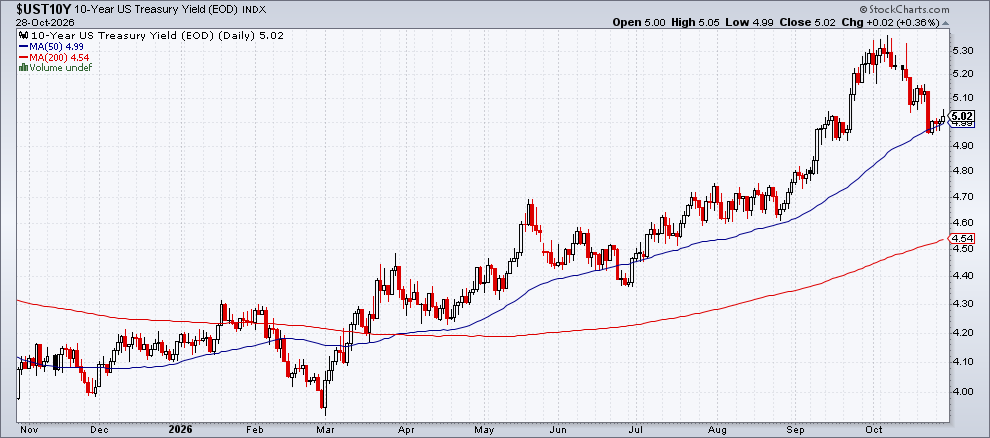
By contrast, the 10-year Treasury yield was somewhat less forgiving, posting a modest increase. The benchmark rate’s recent firming following a sharp retreat from its peak suggests the market may be preparing to resume a less tolerant view of dovish leanings within the Fed.
The case for additional rate hikes remains credible, but several wild cards continue to cloud the outlook, most notably the Iran war. The conflict remains a key driver of this year’s reflationary pressure through the energy-supply shock it unleashed. It’s widely understood that if the war ended tomorrow, much of the uncertainty surrounding monetary policy would quickly fade as inflation risk fell. But the odds still appear low for even a durable stalemate, much less a lasting peace.
As The Economist reports, the turmoil stemming from the Iran war is being compounded by the escalating rivalry between Saudi Arabia and the United Arab Emirates, fueling instability across the Red Sea corridor and the Horn of Africa. Taken together, these developments continue to undermine the prospects for near-term normalization in regional energy exports by leaving critical maritime chokepoints vulnerable to attack.
A gray zone of uncertainty is likely to keep markets on edge while complicating the central bank’s next moves. Until the fog of war lifts, the Fed’s inflation fight will remain hostage to forces beyond its control.

Comments
Log in or sign up to join the conversation.