

The recent slide in the U.S. stock market has sparked debate about what’s driving the downturn in sentiment. The unwinding of the AI bubble? Fears of inflation and higher interest rates? Expectations of a downturn in corporate earnings? One factor that doesn’t make the cut at the moment: recession risk.
The stock market can decline for many reasons, and sometimes a downturn in economic activity is a factor. But the numbers published to date downplay this threat. That could change, of course, and perhaps quickly. But the current profile of U.S. economic activity suggests that the acceleration in growth from the sluggish first half of the year is still in play.
One source of optimism: relatively upbeat data on consumers in October. Since the consumer sector is the main engine of economic activity, continued strength in spending reduces the immediate risk of a meaningful slowdown.
Headline retail spending growth slowed in October following two strong months, but the control group (which corresponds with the consumer spending input for the calculation of GDP) rose 0.6%, topping expectations and suggesting that consumer spending entered the fourth quarter with solid momentum. The stronger-than-expected gain prompted economists to revise growth forecasts higher, reinforcing the view that household spending remains strong enough to keep the economy expanding and the Federal Reserve focused on combating inflation.
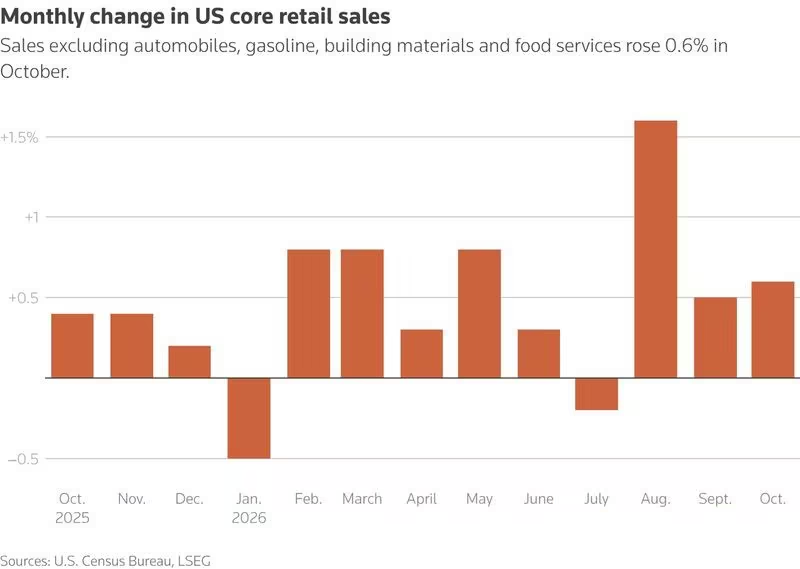
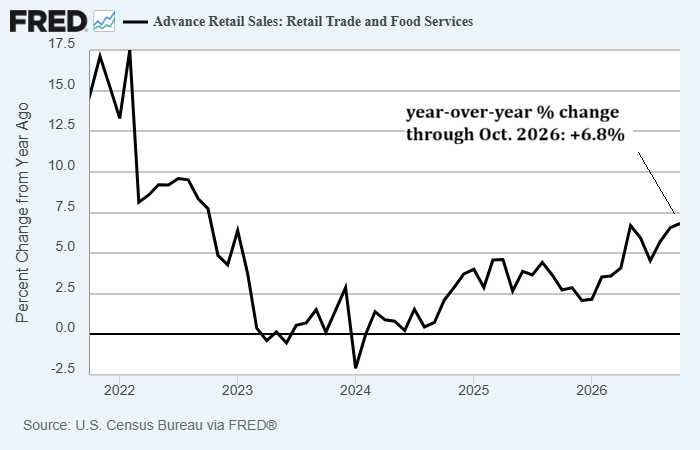
Skeptics might argue that the control group doesn’t offer a complete picture of retail activity and therefore provides a somewhat narrow view of consumer spending. But zooming out and looking at overall retail sales on a year-over-year basis, which helps filter out monthly volatility, still points to a healthy trend. Sales rose 6.8% in October from a year earlier, accelerating to the strongest pace in four years.
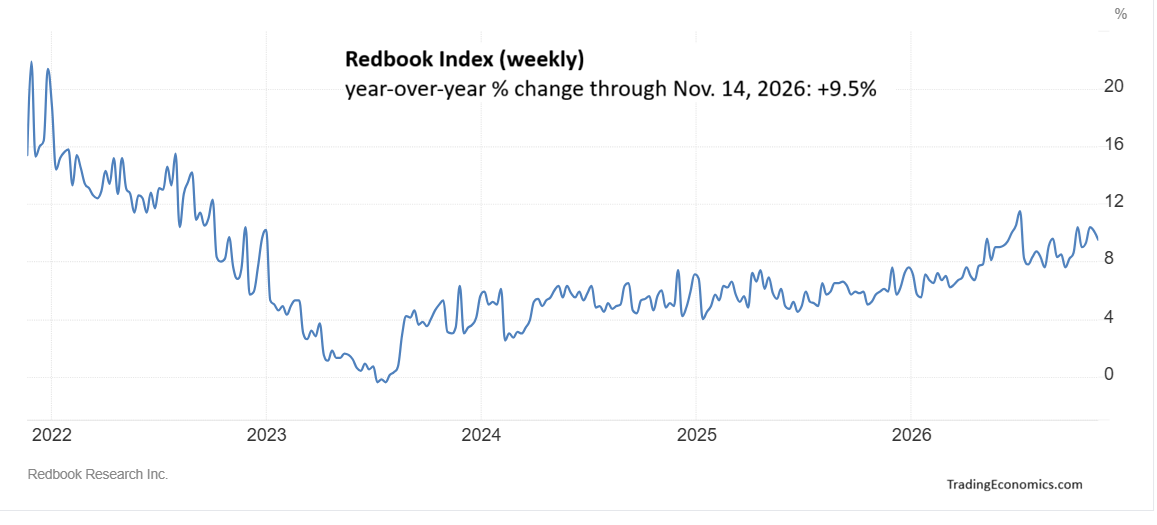
Another measure of spending activity in the retail sector confirms that the recent resilience remains intact. The Redbook Index, a weekly measure of same-store sales at major U.S. retailers, continues to signal solid consumer spending. Strong year-over-year sales growth suggests household demand remains firm despite higher prices and elevated interest rates. Spending on this front rose 9.5% for the week through Nov. 16 versus the same period a year earlier, near the strongest pace in several years.
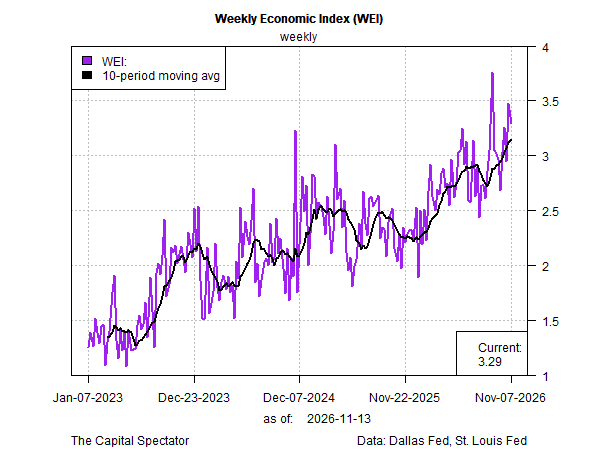
Shifting to a broader measure of U.S. economic activity also indicates a solid trend through early November. The Dallas Fed’s Weekly Economic Index (WEI) reflects 3.3% year-over-year GDP growth through Nov. 7. The data suggest that the economy’s recent acceleration is continuing through the midpoint of the fourth quarter.
Solid growth is also the message in the latest Q4 GDP nowcast from the Atlanta Fed’s GDPNow model. Output is tracking at a 3.4% annualized increase for the current quarter, matching Q3’s gain and marking a sharp pickup from Q2.
The latest numbers for the labor market also paint an encouraging picture. Payrolls picked up last month, posting a strong rebound from a sluggish September while jobless claims remain near multi-decade lows.
There are several caveats, of course, starting with inflation. The Federal Reserve is still expected to raise interest rates again at next month’s FOMC meeting to tame pricing pressure. There are also growing concerns that the AI boom is losing momentum, which could weigh on economic growth if businesses pull back on spending for data centers, chips, and related infrastructure. A prolonged slowdown could reduce investment, weaken confidence, and eventually spill over into consumer spending.
The uncertainty extends well beyond the economy. The ongoing conflict with Iran, the war in Ukraine, and unanswered questions about how a Democratic-controlled Congress may reshape fiscal, regulatory, and energy policy, and the outlook becomes considerably more clouded.
Perhaps the stock market is starting to price in these risks and and prolonged correction is brewing. Or maybe it’s just noise. For now, the jury is still out. What is clear is that the published economic data continue to point to a growth bias. Whether that resilience endures, and whether it ultimately puts a floor under the recent stock-market slide, remains an open question.



Comments
Log in or sign up to join the conversation.