

The bond market rebound over the past month has fueled hopes that the worst may be over for fixed-income investors. With yields rising to more attractive levels, bonds have become increasingly appealing. Whether this renewed interest marks a timely shift back into the asset class remains to be seen, but the broader trend profile still argues for caution. The bond market, in short, has more work to do before making a compelling case that the bearish sentiment weighing on the asset class has run its course and is giving way to a sustained recovery.
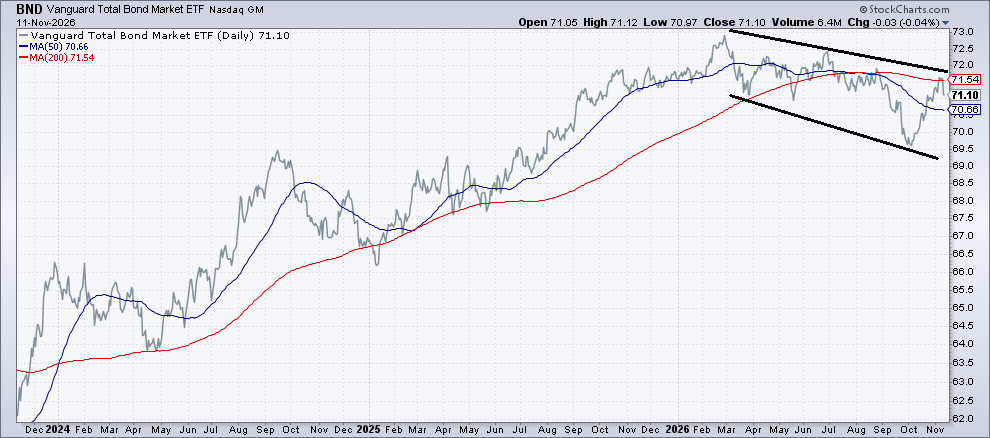
Consider the Vanguard Total Bond Market ETF (BND), a widely used proxy for U.S. investment-grade bonds. The fund’s sharp rebound over the past month has inspired forecasts that the correction has ended. But that call still looks premature. The rally stalled this week after encountering resistance at a key technical level. Until BND breaks above its recent peak, the downtrend that has defined much of this year appears intact.
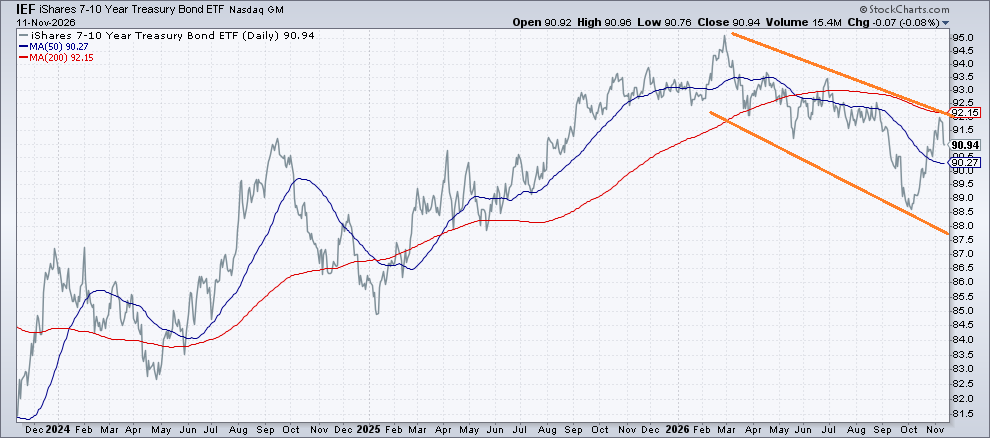
A similar profile applies to U.S. Treasuries, represented here by the iShares 7-10 Year Treasury ETF (IEF). The fund’s trend remains bearish, suggesting investors should stay cautious until price action provides stronger evidence of a reversal.
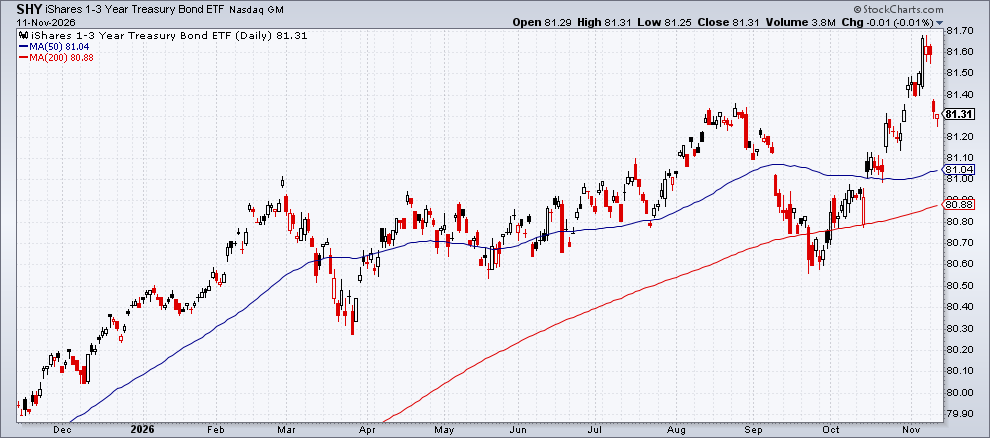
The market is still signaling weak demand for duration, with investors continuing to favor shorter maturities. As an example, the iShares 1-3 Year Treasury Bond ETF (SHY) presents a bullish contrast to its longer-duration counterparts.
Beneath the price trends, investors are grappling with a complex mix of macroeconomic forces. The ongoing tug-of-war between inflationary and the potential for a return of near-term disinflationary pressures could limit the bond market’s ability to establish a clear direction in the weeks ahead.
October’s consumer inflation report reinforced the view that inflation remains stubborn enough to pressure bond prices and push interest rates higher. The Consumer Price Index rose more than expected last month, strengthening expectations that the Federal Reserve will continue tightening monetary policy. Although the report omitted year-over-year figures due to last year’s government shutdown, available data suggest headline CPI rose to a roughly 4.0% annual pace, the highest reading since May, while core CPI climbed to an estimated 2.9%, a 13-month high. Inflation, in other words, is still moving in the wrong direction and widening the gap over the Federal Reserve’s 2% target.
A key question for investors is whether the recent inflation surge proves temporary or more durable. The initial catalyst was the energy shock tied to the Iran war, which suggests inflation could cool if the conflict continues to wind down. But emerging signs of firmer inflation expectations raise the risk that price pressures are becoming embedded in the broader economy, potentially keeping inflation elevated well after the Middle East supply shock fades.
The University of Michigan recently highlighted this concern in a report, noting that “after five years of above-target inflation, both short- and long-term inflation expectations have ticked up in recent months, exposing risks that elevated inflation expectations could become entrenched.” The New York Fed’s Survey of Consumer Expectations similarly found that October inflation expectations remained elevated at 3.9% over the next year, or nearly double the Fed’s 2% target. The risk is that even if the energy shock tied to the Iran conflict fades, inflation could remain persistent if households continue to anticipate higher prices.
Yet markets and consumers eventually adapt. If inflation expectations continue to rise, they can reinforce actual inflation, keeping bond yields elevated and monetary policy restrictive. Over time, however, higher borrowing costs and tighter financial conditions tend to restrain spending, investment, and economic growth. If that process succeeds in cooling demand and easing inflation pressures, bond yields could eventually peak as investors begin pricing in slower growth and a less hawkish Fed.
At that point, the case for a durable bond-market rally would become significantly stronger. Predicting such turning points is notoriously difficult, but when conditions are ripe for a bullish shift, the market’s trend profile will be among the first indicators to reflect the changing outlook. For now, however, such a pivot appears to be a low-probability scenario based on the bond market’s current trend signals.

Comments
Log in or sign up to join the conversation.