

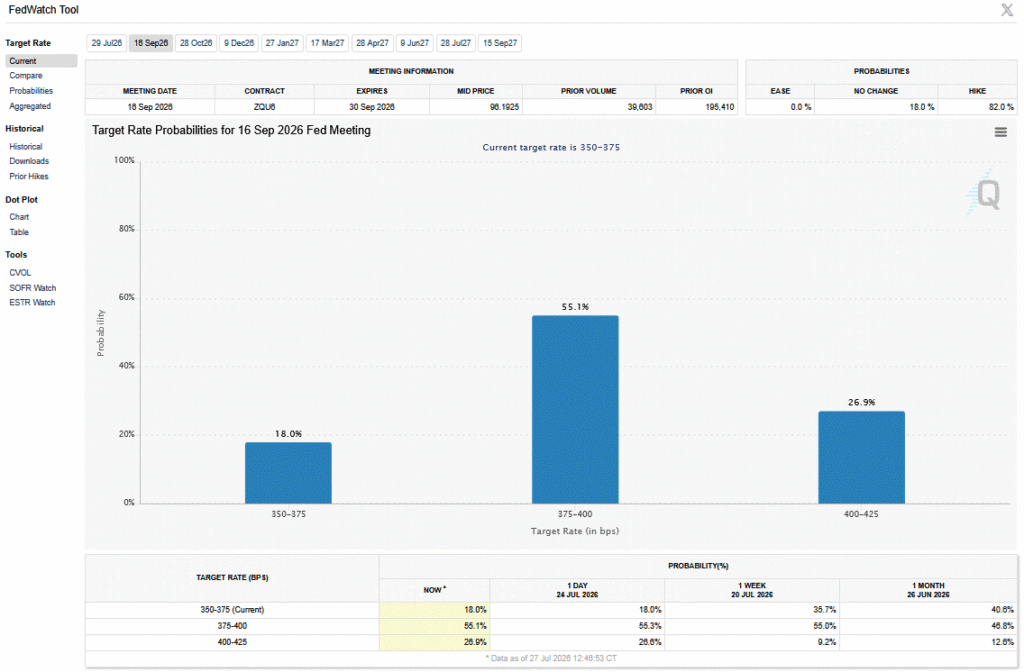
The FOMC meeting concludes today with the rate decision at 2:00 PM ET, followed by Warsh’s press conference at 2:30 PM. Heading into today’s announcement, the market is placing 62% odds the Fed holds rates at the current 3.50% to 3.75% range. However, as we share below, market expectations for a September rate hike are running at 82%. Will high oil prices and their impact on inflation force the Fed’s hand today and/or in September?
The FOMC dot plot from June showed the committee split evenly: nine of eighteen officials forecasted at least one hike before year-end, the other half favored holding or even cutting rates. Chair Warsh didn’t submit a projection. There are no new dot plots until September, assuming the Fed continues to release them. Thus, the FOMC statement language and the tone of Warsh’s press conference will be the best signals for investors trying to understand what the Fed’s next move is.
Policy timing is difficult for the Fed. June CPI cooled from 4.1% to 3.5%, giving the FOMC cover to hold. However, oil prices have gained over 20% in the last two weeks, and Houthi tanker attacks in the Red Sea may mean high oil prices become sticky. Thus, will the Fed hike rates primarily due to high oil prices? While inflation stability is their mandate, oil prices are high solely because of the Iranian conflict. Higher rates will slow the economy, but it will have negligible impact on oil prices.
Assuming they don’t hike rates, the vote count in favor of a hike today and Warsh’s tone are key barometers of Fed policy. In particular, will Warsh treat high oil prices as noise, or will he use it to take a more hawkish case?
What To Watch Today
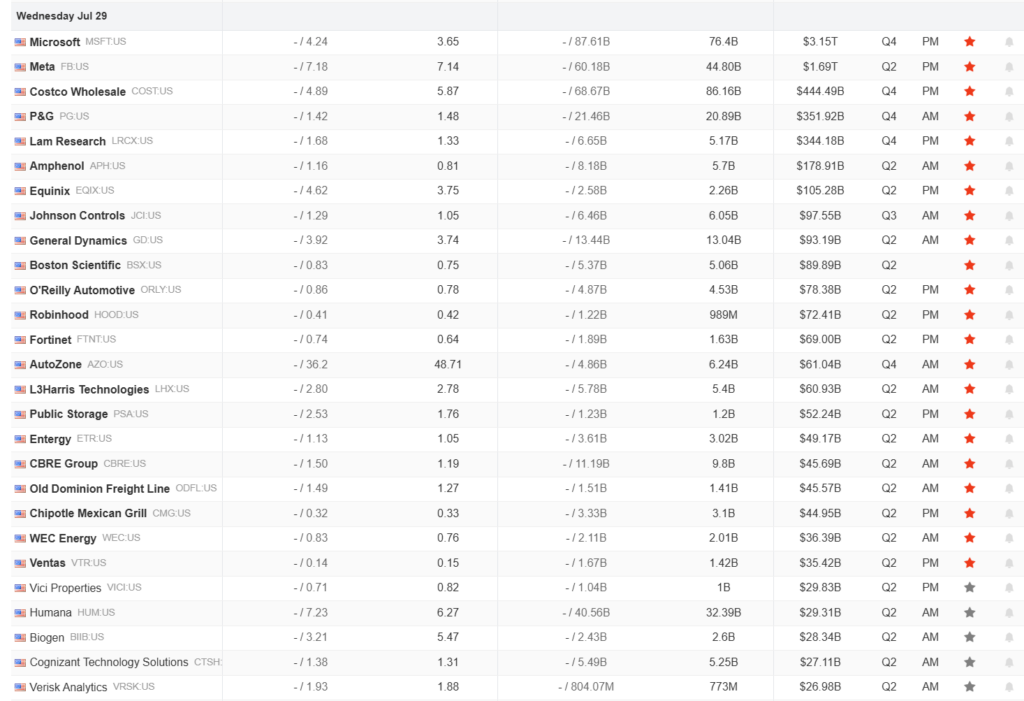
Earnings
Economy

Market Trading Update
In yesterday’s report, we discussed how small caps have quietly won all year while the mega-caps wobbled. Today, I want to answer the question filling my inbox: the leveraged AI trade is unwinding, so has anything actually broken inside these companies, and is this the entry point patient investors have waited for?
In short, the fundamentals have not changed, and that matters far less than you think. The opportunity is real, just not where everyone is digging.
Start with the businesses. Lam Research (LRCX) reports tonight, and the Street is looking for 29% revenue growth and 27% earnings growth. Arm (ARM) just finished its third straight year of revenue growth above 20%. Memory remains tight enough that it capped Qualcomm (QCOM)’s handset revenue last quarter. Nothing in that is deteriorating.
Now look at what July did to them anyway.
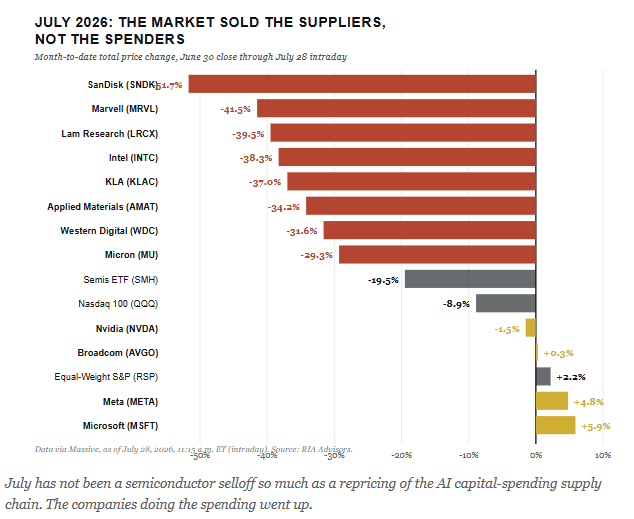
That is not a liquidation, as liquidations are indiscriminate. This one is very surgical, and investors who took on leverage to chase a trade are being liquidated. The market dumped everything, selling picks and shovels and moved to the hyperscalers. Microsoft (MSFT) is up 5.9% this month, and Meta (META) is up 4.8%, both while their own supply chains have surrendered a third of their value. Nvidia (NVDA) is off just 1.5%.
What changed is the sign on capital spending. When Alphabet (GOOGL) guided 2026 capex toward $205 billion last Thursday, the stock shed 7%, and roughly $300 billion of market value, and free cash flow turned negative for the first time ever. Two years ago, that identical sentence was a buy signal. As I warned last Friday, the capex depreciation bill ultimately hits the income statement, but the market will eventually fully price it in. That process has started.
Follow the logic. If capex is cresting, spenders’ free cash flow inflects upward, and suppliers’ revenue inflects downward. Same thesis, opposite signs. That is why the equal-weight index closed at a record yesterday, while the Nasdaq 100 sits down 8.9% for July, and why energy, staples, financials, and healthcare all gained between 5.7% and 10.3% this month.
So focus where the cash flow is going, NOT where the drawdown is deepest. The names off 40% are commodity cyclicals rolling over at a capacity peak, and “cheap” is not a level you can locate three weeks into a capex top.
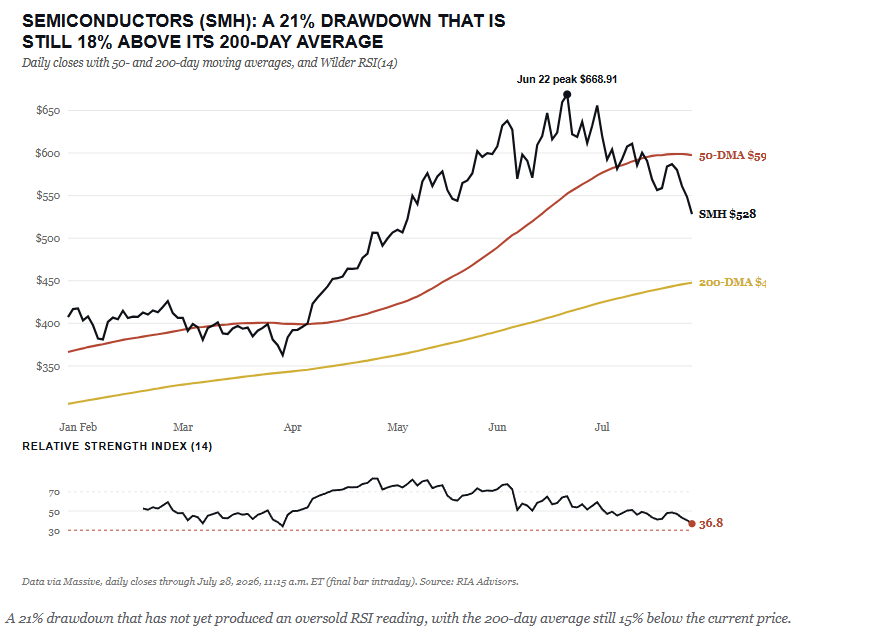
Semis have already handed back 21% from the June high, yet RSI sits at 36.8, which is not oversold, and the 200-DMA waits another 15% lower. The VIX is 18.77. Nobody has been forced to sell yet.
Now, I can be wrong in one specific way. If Microsoft and Meta both guide 2027 capex sharply higher tonight, my framing inverts, the suppliers catch a bid, and the platforms take Alphabet’s punishment. We will see what happens and react accordingly.
Trade accordingly.
High Margins Draw Competition For Chipmakers
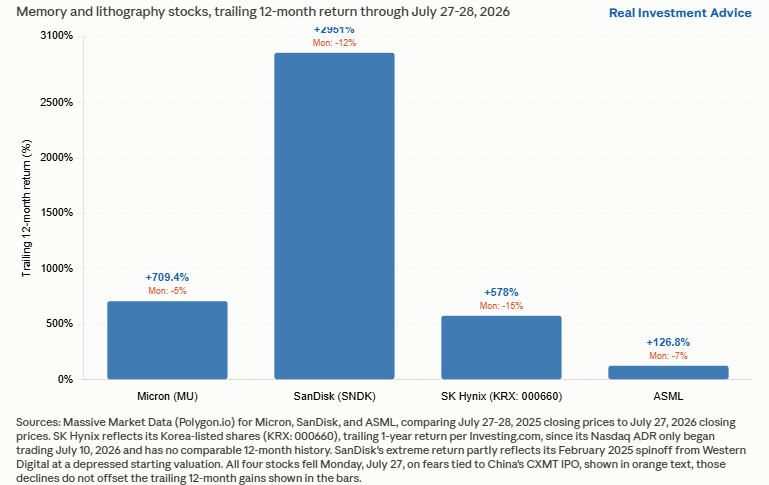
China’s ChangXin Memory Technologies (CXMT) surged 466% on its Shanghai IPO Monday. That price action briefly made CXMT China’s most valuable listed company, with a market cap of nearly $500 billion. In reaction, CXMT’s competitors Micron (MU) fell 5%, SanDisk (WDC) dropped 12%, SK Hynix (HXSCL)’s ADRs slid 9%, and ASML (ASML) lost more than 7%.
The news is not as bad as the market reaction appears for the chip makers. CXMT earns almost all of its revenue from commodity DRAM (dynamic random access memory), with little HBM (high-bandwidth memory) production, a product heavily relied upon by AI hardware and with the highest margins. It’s worth adding that CXMT lacks access to ASML’s extreme ultraviolet lithography systems, the tool required to manufacture AI-grade HBM. Nomura (NMR) projects CXMT’s global DRAM share will increase from roughly 10% today to about 18% by 2028. Micron has been demphasizing DRAM production as it’s a low-margin commodity.
Monday’s sell-off in chip companies on news of the CXMT IPO looks like continued profit-taking, coupled with momentum traders exiting the sector. The moat around AI-grade HBM remains intact. What changed is that DRAM has more competition.
The graph below shows that the one-year returns for the stocks mentioned in the opening paragraph remain incredibly high but, in most cases, are 20-40% of the peaks.
Tweet of the Day


Comments
Log in or sign up to join the conversation.