Why TSMC Fell After A 77% Profit Surge

Taiwan Semiconductor posted record Q2 results but hiked capital spending to $64 billion, fueling margin concerns.

For months, the only question that mattered for semiconductor stocks was whether artificial intelligence demand could hold up. Today, the foundry that actually prints the chips confirmed that demand remains exceptionally strong and that leading edge capacity is still tight. But the early market reaction tells a more complicated story. Wall Street is looking past the sheer volume of orders and weighing a lower near term margin outlook, a much larger capital budget and expectations that had already climbed extremely high. The setup is shifting from whether TSMC can grow to whether it can preserve its unusually high returns while spending far more to stay ahead.

Main Note

The Cost of Maintaining a Monopoly

Taiwan Semiconductor (TSM) Quote

Verdict: TSMC proved that infrastructure demand remains incredibly strong. But the larger capital budget, the 2 nanometer ramp and the growing cost of overseas manufacturing are forcing the market to look more closely at how much of that growth turns into free cash flow.

What happened

The company reported second quarter net income of NT$706.56 billion, which is a 77.4% surge compared to last year. Revenue hit a record $40.2 billion in US dollars and operating income rose 65.4%. The profit number also included NT$63.20 billion of disposal and mark to market gains on Vanguard International Semiconductor shares. Management raised its full year revenue growth outlook to slightly above 40% and guided for third quarter revenue of $44.6 billion to $45.8 billion.

But the massive growth requires an equally massive check. Management raised the 2026 capital expenditure budget to $60 billion to $64 billion from prior guidance that called for spending near the high end of a $52 billion to $56 billion range. That annual budget will support advanced process technology, packaging and manufacturing capacity around the world. Separately, TSMC pledged another $100 billion for its US expansion, bringing its total announced US commitment to $265 billion. That is a multi year commitment, not another $100 billion of spending this year, and it could add about four more plants depending on market conditions.

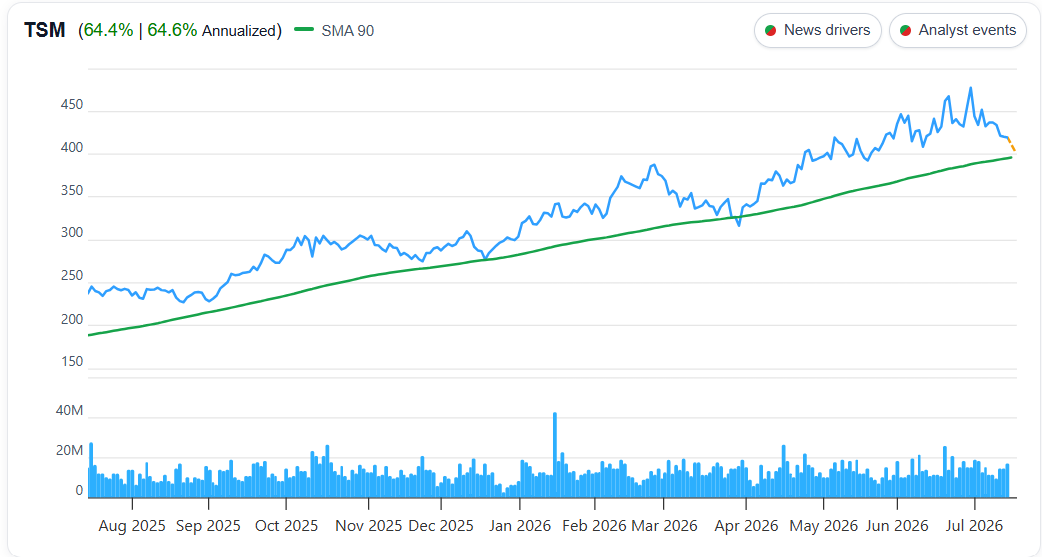
Taiwan Semiconductor (TSM) Price Chart

Taiwan Semiconductor (TSM) Price Chart

Why it matters

Foundry work is incredibly capital intensive. The cash flow and income statement effects do not arrive at the same time. Capital spending reduces free cash flow when the money is spent, while much of the investment reaches the income statement as depreciation over several years after the assets enter service. New factories can also pressure margins sooner through ramp costs, lower early utilization and higher costs at overseas fabs. Even after NT$496 billion of capital spending in the quarter, TSMC still generated NT$287.36 billion of free cash flow.

What changed in the thesis

TSMC was never a simple revenue growth story because the foundry business has always required enormous capital spending. What changed this morning is the size and duration of the commitment. Management raised this year’s budget, said spending over the next three years will be significantly higher than the last three and added another $100 billion to its US expansion plan. Investors now have to decide whether demand, pricing and utilization can stay strong enough to preserve the company’s unusually high returns through that buildout.

What the market may be missing

The near term margin dilution from the 2 nanometer ramp might be masking the underlying pricing power TSMC commands. The company is not literally the only advanced chip manufacturer, but it remains the dominant independent foundry at the leading edge and its manufacturing ecosystem is difficult to replace. That gives TSMC room to offset some of the higher factory costs through pricing, product mix, cost improvements and higher utilization, although none of those offsets are guaranteed.

Valuation and expectations

The early selloff shows how high expectations had become. Management guided third quarter gross margin to 65% to 67%, down from 67.7% in the second quarter, but its third quarter revenue outlook came in above market forecasts. The real question is not whether one quarter lands at the low end of the margin range. It is whether the 2 nanometer ramp, overseas expansion and higher capital spending keep free cash flow under pressure for longer than investors currently expect.

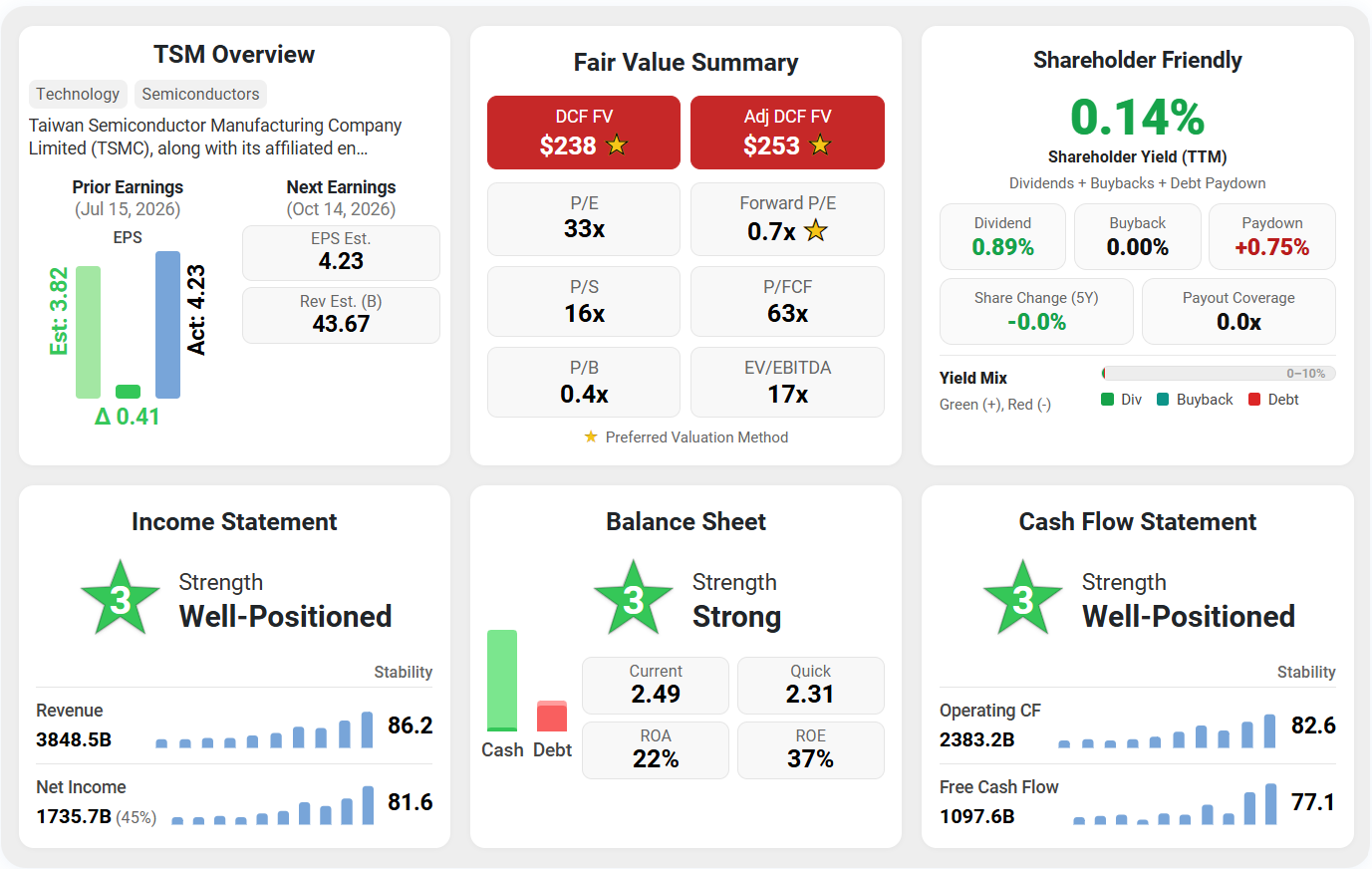
Taiwan Semiconductor (TSM) Summary Scores

Taiwan Semiconductor (TSM) Summary Scores

Bottom line

The infrastructure boom is very much alive, but the easy money phase of the hardware trade appears over. From here on out, the market will demand proof that these massive capital bets actually generate profitable returns, rather than just higher revenue numbers.

Pre Market Pulse

  • TSM shares were down roughly 5% in pre market trading as of 8:05 a.m. Eastern, hovering near $399.

  • Nvidia was down roughly 2% and Advanced Micro Devices was down roughly 3% to 4%. The weakness was part of a broader semiconductor selloff, not a clean reaction to TSMC alone.

Why it matters this morning

A massive earnings beat followed by an immediate stock drop breaks a familiar pattern. It suggests that beating revenue expectations is no longer enough to support premium multiples if that growth comes attached to massive future capital commitments.

Peer Read Through

ASML Holding (ASML)

The Dutch equipment giant raised its 2026 sales outlook to a range of €43 billion to €45 billion on Wednesday. This aligns perfectly with the TSMC spending hike, as ASML supplies the extreme ultraviolet lithography machines needed for those new factories.

Nvidia (NVDA)

The results from TSMC confirm that demand for Nvidia hardware remains massive. Recent reports suggest Chinese tech companies alone have ordered 2 million H200 chips for 2026 delivery, which explains why Nvidia is demanding more capacity.

Advanced Micro Devices (AMD)

Shares fell roughly 3% early Thursday. If TSMC is spending this much to build new capacity, those expenses will eventually trickle down as higher wafer prices for chip designers like AMD.

Group takeaway

The entire semiconductor supply chain is locked in a massive spending cycle. Equipment makers benefit first, foundries take on the capital risk, and designers have to hope end customer demand stays strong enough to absorb the eventual price hikes.

What to Watch

  • Third quarter gross margin results from TSMC to gauge the exact dilution impact of the 2 nanometer ramp.

  • Capital expenditure plans from major cloud providers during the upcoming mega cap technology earnings season.

  • Third quarter order bookings from ASML to verify how quickly the new budget translates into firm equipment purchases.

  • Any signs of a slowdown in data center spending, which would leave TSMC with high fixed costs and idle capacity.

Bottom line

The primary risk going forward is cyclicality. If major technology companies pull back on their infrastructure budgets next year, the massive factories TSMC is building right now will become a severe drag on profitability.


STOCKS IN THIS ARTICLE

Comments