Palantir Proves AI Software Can Actually Monetize

Palantir shares surged as U.S. commercial revenue jumped 149%, proving enterprise AI delivers massive cash flow.

For the past year, the market has debated whether enterprise artificial intelligence was just a series of experimental pilot programs or the beginning of a real software upgrade cycle. Much of the early spending and investor attention went toward chips and data center infrastructure, while software companies struggled to prove they could monetize the trend. Palantir (PLTR) just delivered some of the strongest evidence yet that at least part of the enterprise market is moving from testing to deployment. Its United States commercial revenue grew 149% year over year and the company generated $1.22 billion in adjusted free cash flow. That does not prove every software vendor will benefit, but it does show that customers are willing to pay for artificial intelligence software that produces measurable results. The remaining question is whether any software stock can grow fast enough to justify the extreme premium investors are willing to pay for the early winners.

Main Note

Palantir Answers the Software Monetization Question

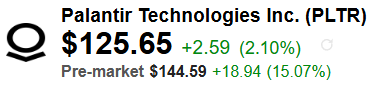
Palantir Technologies (PLTR) Quote

Verdict: Palantir’s quarter strengthens the case that enterprise artificial intelligence is moving from testing toward deployment. The company posted a 149% year over year increase in United States commercial revenue and raised full year revenue guidance by nearly $500 million, from a previous range of $7.65 billion to $7.662 billion to a new range of $8.15 billion to $8.158 billion. That is a major thesis change for Palantir, even if one company cannot settle the question for the entire software industry.

What happened

Second quarter total revenue reached $1.94 billion, easily beating consensus estimates near $1.81 billion. The real story was the composition of that growth. United States commercial revenue grew 149% year over year to $764 million, while United States commercial total contract value reached a record $2.13 billion, up 153%. The United States commercial customer count also increased 35% to 653. Across both government and commercial customers, Palantir closed 220 deals worth at least $1 million.

This is not just a top line growth story. The company generated $1.22 billion in adjusted free cash flow, representing a 63% margin. Management also raised full year revenue guidance to a range of $8.15 billion to $8.158 billion.

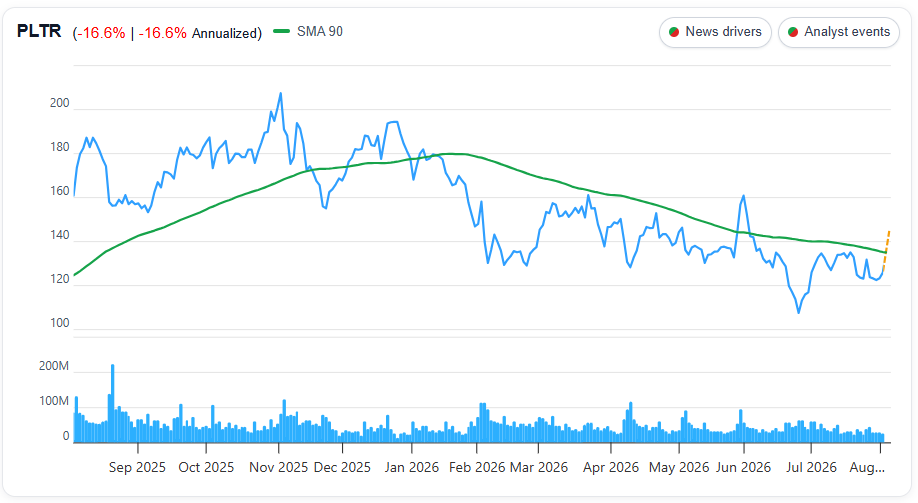
Palantir Technologies (PLTR) 1 Year Chart

Palantir Technologies (PLTR) 1 Year Chart

Why it matters

Investors have worried that corporations were just testing new software without committing real budget. Palantir’s bookings and backlog now provide much stronger evidence that customers are making real commitments, although they do not prove the software is a mandatory upgrade across the entire enterprise market. Total revenue grew 93% while adjusted operating margin reached 62%. GAAP operating margin was also exceptionally strong at 47%, showing that the operating leverage remains impressive even after stock based compensation and other operating costs are included.

What changed in the thesis

The previous setup relied heavily on government contracts to fund growth. The United States commercial business is now the fastest growing part of the company and is becoming a much larger part of the story, but it has not replaced government as the core of the business. Total government revenue still reached $990 million in the quarter, slightly more than total commercial revenue of $945 million, and United States government revenue grew 90%. To buy the stock here, investors must believe Palantir can sustain rapid growth in both markets while building a structural moat around its data architecture, security, and sovereign artificial intelligence strategy.

What the market may be missing

It is easy to look at the massive top line growth and assume it is just a one time pull forward of deals. But remaining performance obligations jumped 103% year over year to $4.9 billion. This metric represents noncancelable contracted revenue that has not yet been recognized, giving investors better visibility into future revenue than total contract value. It is also weighted toward the commercial business because many government agreements are excluded. That supports the idea that momentum extends beyond one quarter, although remaining performance obligations can be lumpy and do not tell investors exactly when the revenue will be recognized.

Valuation and expectations

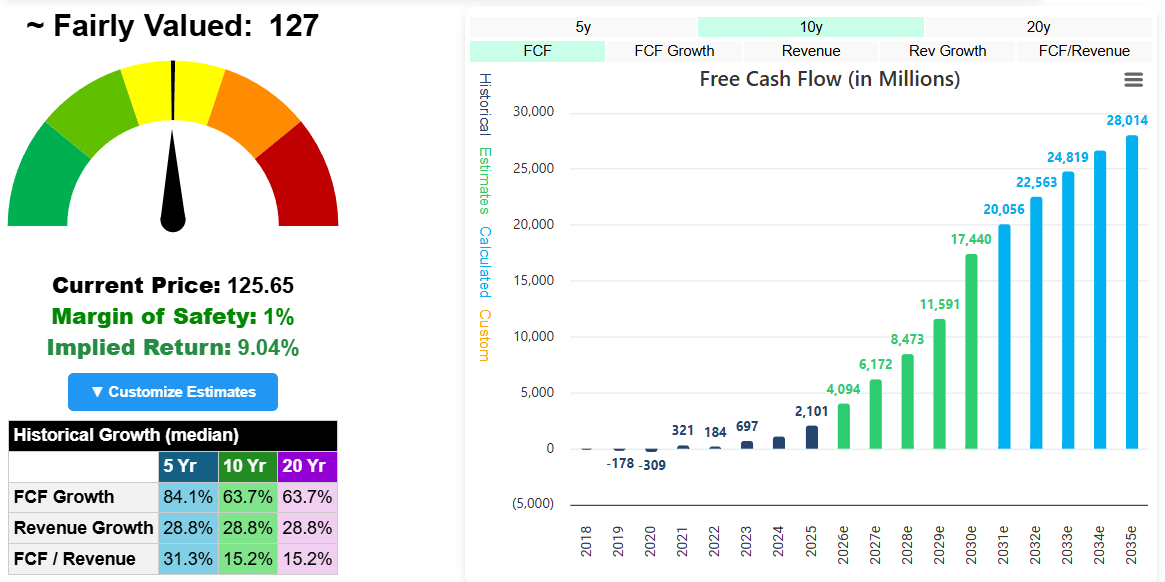
The equity trades at a highly demanding 72x forward earnings multiple and roughly 70x its future free cash flow. This premium implies near flawless execution. If the domestic commercial segment experiences any delayed deal cycles in the back half of the year, this extreme valuation leaves the stock vulnerable to multiple compression. Although, using analyst estimates for free cash flow and extending DCF for a full 10 years, the stock looks much closer to fair value.

Palantir Technologies (PLTR) DCF Fair Value

Palantir Technologies (PLTR) DCF Fair Value

Bottom line

The company successfully proved that artificial intelligence software can generate massive cash flow today. The challenge moves from proving the business model to defending a valuation that prices in years of uninterrupted hyper growth.

Pre Market Pulse

  • S&P 500 futures point to a modestly positive open, while Nasdaq 100 futures rise roughly 0.5% to 0.7% as technology shares respond to strong artificial intelligence forecasts.

  • Palantir shares were up roughly 15% in pre market trading, recently changing hands around $143 to $145 per share.

  • The 10 year Treasury yield moved modestly higher to around 4.70% as oil prices rebounded and inflation concerns returned.

Why it matters this morning

Palantir is being rewarded for company specific execution, but the macroeconomic backdrop is not entirely calm. Higher oil prices and rising Treasury yields can still pressure expensive growth stocks, while job openings, factory orders, and trade data later this morning could move expectations for interest rates.

Peer Read Through

Snowflake (SNOW)

Product revenue grew 34% and net revenue retention was 126% in its latest quarter, but the company still reported a GAAP operating loss. Snowflake is benefiting from artificial intelligence related demand, although its growth and profitability profile is much less extreme than Palantir’s.

Salesforce (CRM)

Revenue grew 13%, including a contribution from Informatica (INFA), current remaining performance obligations grew 14%, and Agentforce annual recurring revenue reached $1.2 billion, up 205%. Salesforce is growing much more slowly than Palantir, but its artificial intelligence transition is not being rejected by customers.

C3.ai (AI)

Revenue fell 52.5% to $51.6 million and GAAP gross margin dropped to 22% during a major restructuring. C3.ai is a much smaller enterprise artificial intelligence vendor, not a clean direct comparable, and its results are better viewed as a company specific execution warning.

Group takeaway

The peer results support a narrower conclusion. Corporate budget exists for artificial intelligence software, but it is not flowing only to pure play vendors or only to Palantir. Snowflake and Salesforce are both showing artificial intelligence related traction, while C3.ai shows that weak execution can overwhelm a favorable industry trend. Palantir’s advantage is that it is currently combining much faster growth with unusually high margins, and the market is charging a much higher price for that combination.


What to Watch

  • Third quarter deal duration and contract sizing to confirm the momentum in large enterprise commitments is sustainable.

  • Net dollar retention rates, which hit 157% this quarter, to see if initial pilot customers continue expanding their spending.

  • International commercial revenue growth, which lagged at a relatively soft 26% year over year pace.

  • Gross margin stability as the company takes on more cloud hosting duties for large government clients.

Bottom line

The current share price assumes the domestic commercial segment will continue to double its revenue base. Any sequential slowdown in remaining performance obligations next quarter will be the first signal that the law of large numbers is taking effect.

STOCKS IN THIS ARTICLE

Also Mentions:

Comments