

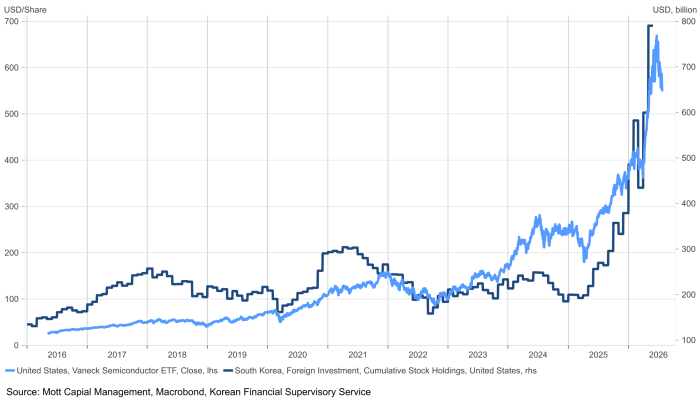
Semiconductors were hit hard again today, and it is probably no surprise that the Korean won continued to strengthen. The won appears to have become an important part of the semiconductor story we’ve witnessed over the past several months. Korean investment flows into the U.S. equity market have been extraordinary since April 2025, with cumulative holdings rising from around $200 billion to roughly $800 billion by June.
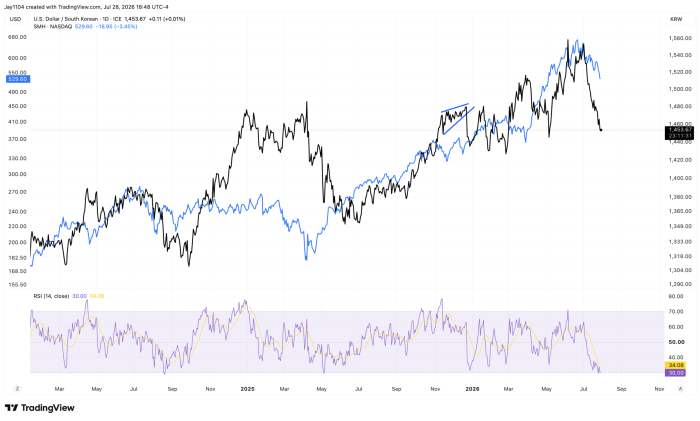
Since June 2025, the won has weakened considerably. During that same period, the semiconductor sector experienced a powerful rally. The inverse relationship has been striking, with a weaker won coinciding with increasingly strong gains in semiconductor stocks.
Rising Rates
One reason the semiconductor trade may be starting to unwind is that USD/KRW has declined to a less favorable level, reducing one of the tailwinds that coincided with the sector’s rally. At the same time, Korean policymakers appear increasingly uncomfortable with the won’s previous weakness. Unlike the Bank of Japan, the Bank of Korea has already begun tightening policy, raising its benchmark rate by 25 basis points on July 15. Markets expect another 25-basis-point hike in August and possibly one more before year-end, bringing the policy rate to around 3.25%.
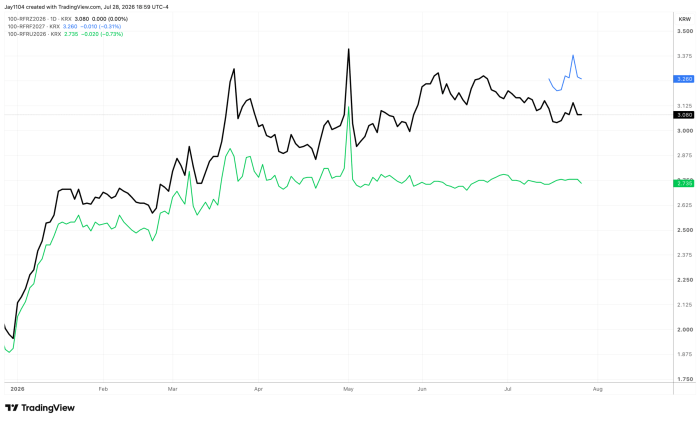
Korea’s two-year government bond yield has risen to roughly 3.71%, while the 10-year yield has climbed above 4.3%. At the same time, the interest rate differential between the U.S. and Korea has narrowed significantly. As with any currency trade, when an interest-rate advantage that once heavily favored the dollar begins to disappear—and markets expect the Bank of Korea to continue raising rates aggressively over the next six months—the currency tends to adjust. In this case, the Korean won has strengthened against the dollar.
Korean Won Impacts
That creates a difficult environment for Korean investors who purchased U.S. assets on an unhedged basis. Not only are they facing losses from the dollar’s depreciation versus the won, but many of the same investments—particularly in the AI and semiconductor space—are also coming under pressure. The combination of adverse currency translation and declining asset prices can quickly turn what had been a highly profitable trade into a painful one.
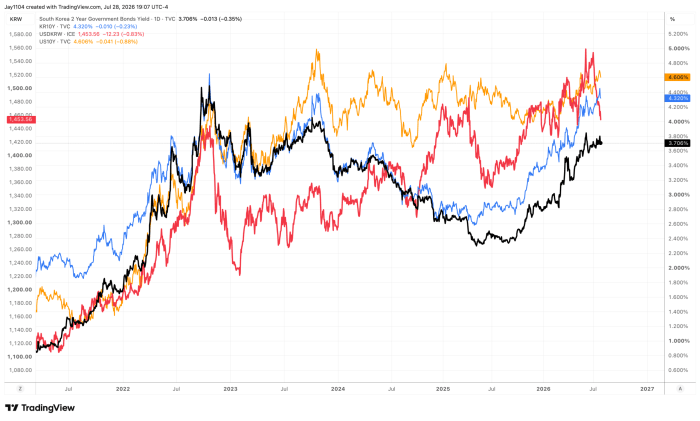
In my view, if the Korean won continues to strengthen against the dollar, the AI trade is likely to continue unraveling. The currency tailwind that supported Korean investment in U.S. AI and semiconductor stocks has reversed, leaving investors exposed to both a stronger won and weakening equity prices.



Comments
Log in or sign up to join the conversation.