

Even prior to the collapse in oil prices in 2014, the Canadian economy started to stall and now is stuck in neutral. National output actually declined in the second quarter as retail sales, business investments and, most importantly, merchandise exports all recorded disappointing results. Although expectations are for a return to growth for the balance of the year, the economy will likely grow at below potential yet again. For a nation that derives about a quarter of its income from international trade, the policymakers must continuously focus on improving the balance of trade.
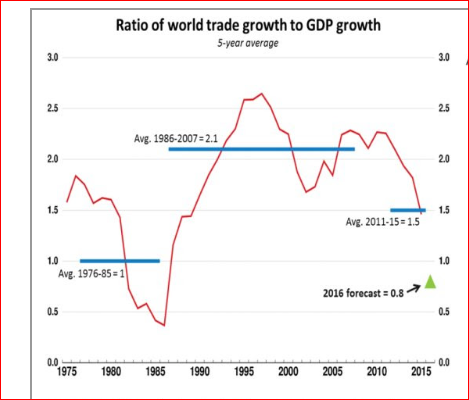
In a recent article, we looked at the decline in the growth of world trade. The World Trade Organization (WTO) now predicts that global trade will expand only at a rate of 1.7 per cent, down considerably from an earlier (April) forecast of 2.8 per cent. This dramatic revision signals a serious and disturbing change in the flow of international trade. World trade will now grow slower than the growth in world GDP, for the first time since 1980 (Figure 1).
Figure 1 The Growth in World Trade and GDP
Source: OECD
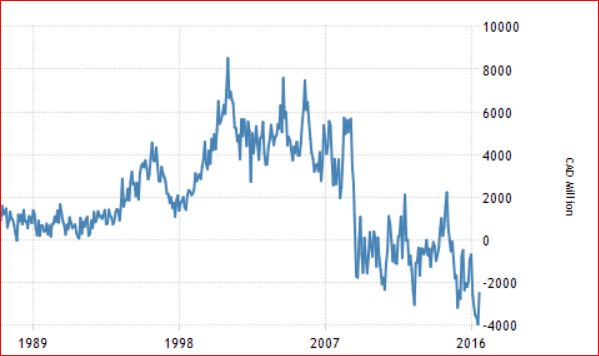
The WTO points out that much of the downgrade is attributed to a sharp decline in merchandise trade volumes. The WTO cites slowdowns in economic growth and trade in major emerging markets, e.g. China and Brazil, as well as a fall off in imports within the North American continent. Canada’s balance of trade was positive throughout the 1990s and continued that way into the first decade of this century (Figure 2). Since 2008, the balance of trade has fallen into a deficit position and the deficit has taken its toll on GDP. Granted, much of this declines lies at the doorstep of the commodities’ sector. However, Canadian manufacturing exports have failed to pick up this slack, something many analysts predicted would take place as domestic resources shift into non-energy industries. To be fair, the BOC had made it clear it believes that this shift will require another 3 to 5 years to complete.
Figure 2 Canada's Balance of Trade
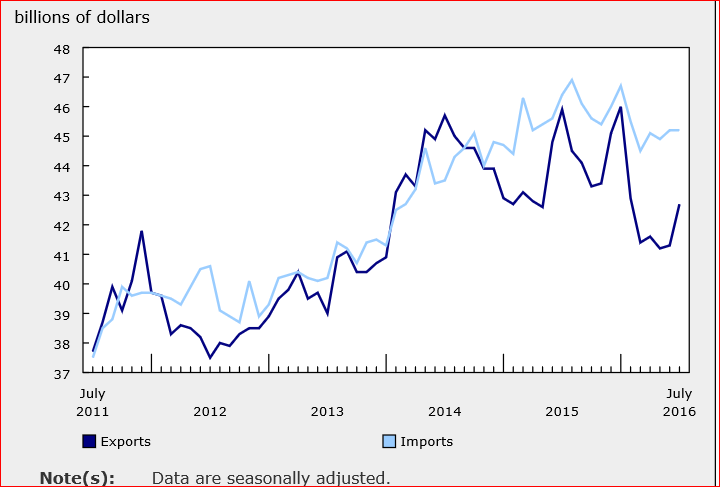
As a result of the decline in the balance of trade, the Canadian dollar, once trading above par against the USD, fell dramatically and now trades at USD 77 cents. The Bank of Canada (BOC) pins much of its hopes on the dollar devaluation to reduce the trade deficit and boost overall output. So far, these hopes have failed to materialize (Figure 3). While imports remain constant, exports have fallen dramatically so far in 2016. Even in cases where exports have grown, a recent report by CIBC points that although manufacturing exports have risen since 2012, there has not been much impact on GDP or employment . [1]
Figure 3 Canada's Merchandise Trade
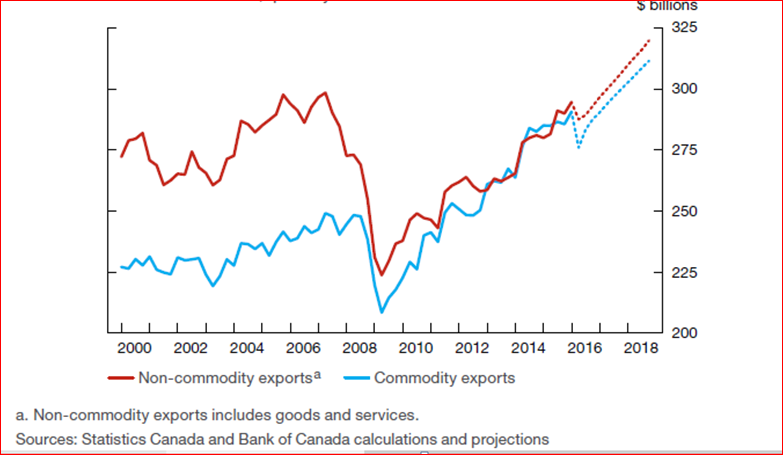
This recent poor trade performance has not dented the BOC optimism. In its July, 2016 Monetary Policy Report, the Bank maintains “solid foreign demand and the depreciation of the Canadian dollar will continue to support non-commodity exports.” Where exactly does this optimism originate is not spelled out in the report, other than to say that “the projected growth profile for non-commodity exports relies on historical relationships between non-commodity exports, foreign demand and the value of the Canadian dollar”(Figure 4).
Figure 4 The BOC Projected Export Growth
The BOC needs to provide more analysis than just to say that the ‘past is prologue’ in order to convince many that the existing policy measures are up to the task. Holding the line on the bank rate and keeping the Canadian dollar in the 75-80 cent range does not appear to reverse the recent trend in the trade balance. Holding policy steady only ensures that the economy remains in neutral.
_________________________
Footnotes
- Waiting for the Export Multiplier, by Benjamin Tal with Katherine Judge, Sept 28,2016


Comments
Log in or sign up to join the conversation.