

For a country that was already slowing down and had more than three million people unemployed before the coronavirus crisis hit, Spain's economy is acutely sensitive to the fallout. We explain why.
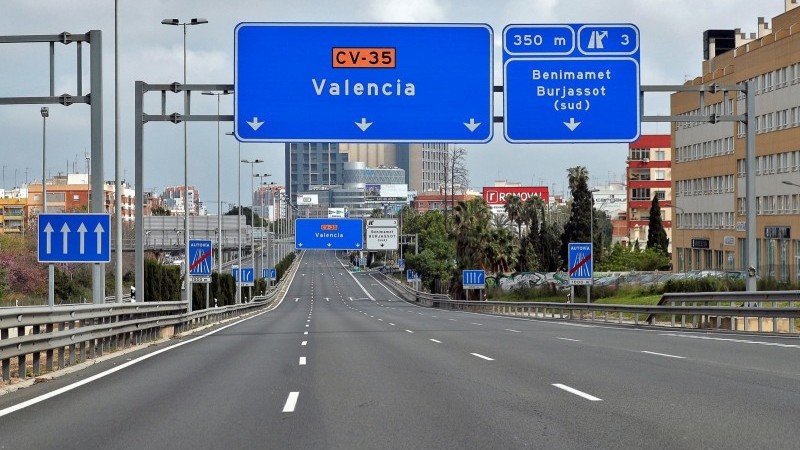
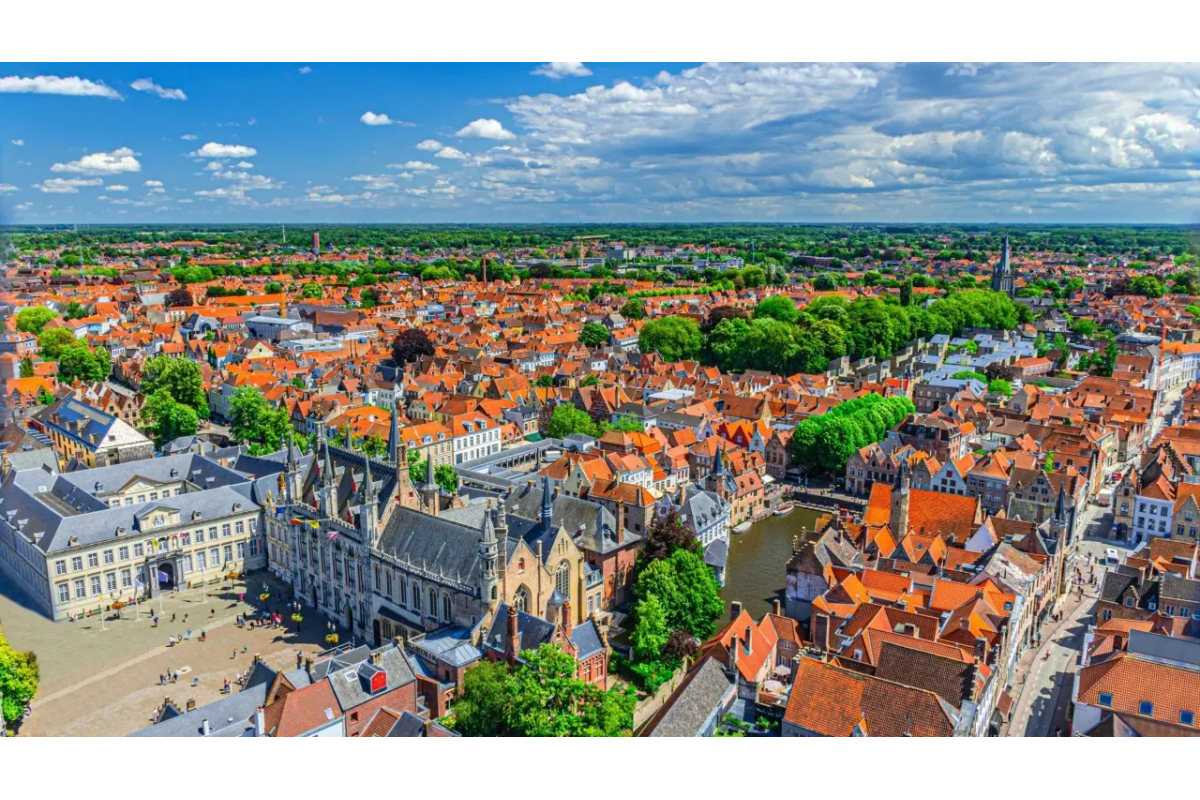
A view of the completely empty CV-35 road in Valencia, eastern Spain, 19 March, 2020/ Source: Shutterstock
Spain hit hard by Covid-19
In Spain, the first case of coronavirus was confirmed on 1 February, but the number of new infections started to accelerate in early March.
The country went into lockdown on 14 March. Only essential shops and pharmacies are open while schools, museums, libraries, hotels and restaurants have been closed and sporting and cultural events are prohibited. Initially, these measures were taken for 15 days, but have now been extended to at least until 12 April.
The longer a lockdown is necessary to combat the spreading of the virus, the harsher the economic downturn will be.
The economy is sensitive to the Covid-19 shock
For the duration of the lockdown, the Spanish economy is more sensitive to its effects compared to other countries as it has a number of vulnerabilities:
- The economy slowed already in 2019 and was expected to slow further
- A high unemployment rate (13.8%) High government debt (close to 100% of GDP)
- A high structural deficit
- A minority central government and regional tensions.
But some other structural characteristics make it even more sensitive.
Tourism will be hit hard
Tourism and travel account for 15% of Spain's GDPand it looks like this sector will be hard hit. We already see that prices for flights to Spain and hotel prices for the Easter period have dropped significantly, implying a sharp fall in demand.
(Click on image to enlarge)
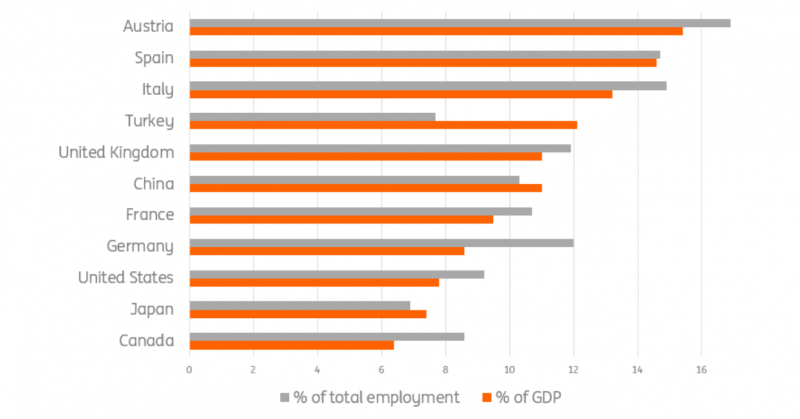
Source: World travel and tourism council, 2018
SME’s are important and more vulnerable
Academic research shows that small and informal enterprises are more vulnerable to exogenous shocks.
They have limited financial, managerial and technological resources. This is why, for example, it is more difficult for small firms to respond to the crisis with technological solutions such as telework.
(Click on image to enlarge)
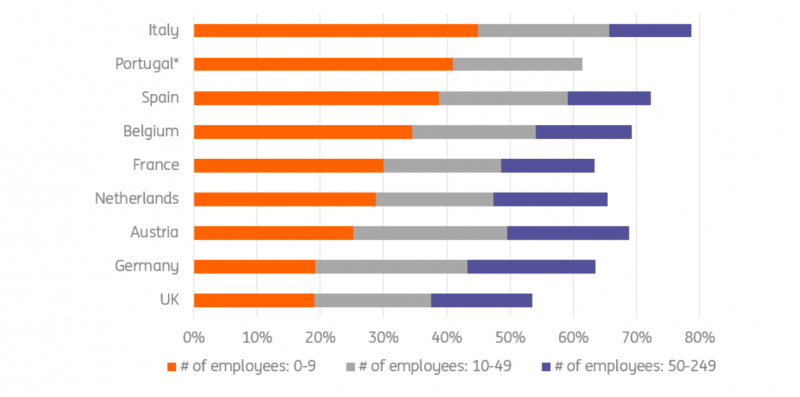
Source: Eurostat 2016 * Figures for companies with 50-249 employees are not available
Relatively high share of vulnerable workers
Workers in the informal sector have no social protection and are more difficult to reach with targeted measures while self-employed workers generally have lower social protection too.
(Click on image to enlarge)
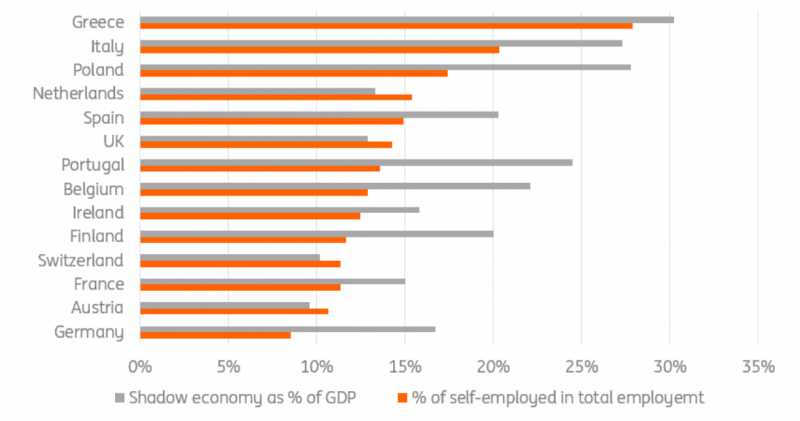
Source: Data on informal economy are from Kelmanson et al. (2019). Data on self-employment are ING calculations based on Eurostat data for the year 2019.

Comments
Log in or sign up to join the conversation.