


Seriously, what are we supposed to do when an AI chatbot breaks down?
Who’s going to tell me I’ve made a “really insightful point” after a seven-word prompt, with three words spelled incorrectly? Who’s going to suggest a clickbait headline, like “Unpacking a world without Copilot: James Smith’s THINK Ahead at a crossroads”? And, most importantly, who’s going to ask whether I’d like the answer turned into a table?
After briefly confronting the terrifying prospect of thinking for ourselves, I thought I’d have a go at doing AI’s job. So, after today’s outage, here’s a timely prompt: Can the global economy survive without AI in 2027?
Connecting the dots… Piecing it all together… Pretending to think deeply… That’s a fascinating question! (Predictable.)
Let’s break it down into four key areas. Because everything has to be broken down into four key areas…
The resilience question
If today’s Microsoft (MSFT) outage tells us anything, it’s that we probably underestimate the economic risks of critical infrastructure failing. At our Global Outlook webinar this week, just 2% of the audience picked new supply shocks, including cyberattacks, as the biggest risk for 2027. A rather larger 34% chose an AI bubble bursting and stock markets crashing. More on that shortly.
Now, one chatbot crashing out for a few hours isn’t going to move global GDP. Spain’s huge blackout in 2025 barely registered in the growth figures. But as we argued in our outlook, the damage from electricity, payments or communications outages could rise disproportionately if they become more frequent or widespread. It starts to hit confidence. And businesses are forced to spend more insulating themselves.
One data centre owner told me this week that they keep 48 hours’ worth of diesel on site in case the power conks out. That sort of contingency doesn’t come cheap. But the flipside is that businesses are building up resilience against supply shocks like the Iran war – or a ‘moat’, as our AI overlords like to say.
Greater preparedness, including more hedging, is one leading explanation for why European core inflation has remained remarkably subdued so far.
What is the biggest risk in 2027? (Our webinar poll)
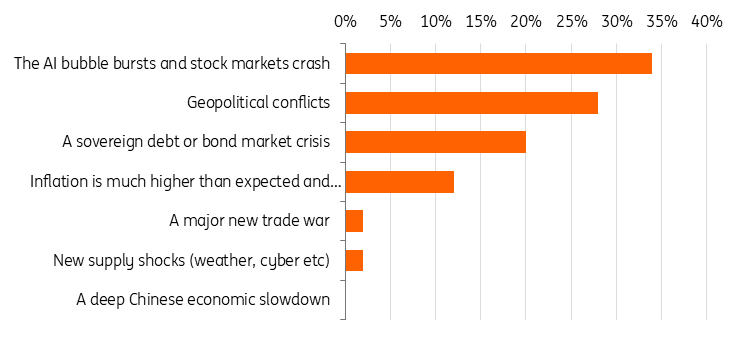
Based on 202 votes
Source: ING
‘Unpacking’ (sorry) the growth impact
Everyone talks about the boost AI investment has given the US economy. And my colleague James Knightley wrote in our outlook this week that this is likely to continue into 2027.
What gets talked about less is the impact it’s having on Europe. Partly, that’s because the story is mixed. As a nice chart from my colleague Pablo Muylle showed this week, not everyone is enjoying a Netherlands/ASML-style boost to manufacturing.
It’s a similar story for data centres, which are contributing around 0.1-0.2pp to year-on-year eurozone growth if you take the IT sector as a proxy. By contrast, as we saw in this week's GDP data, the data centre rollout in the UK is adding around 0.4pps to the roughly 2% annual growth we’re seeing. That should remain a tailwind next year and there’s clearly scope for a positive surprise.
The more intriguing question is what’s happening outside the server farms. UK output across parts of professional services, from law to accountancy, has shot up remarkably quickly this year and in apparent unison. Is that AI productivity coming through? I suspect that is some, though not all, of what’s going on.
Or as AI would put it, “The answer is nuanced.” Thanks for that…
Is this the first sign of AI productivity showing up?
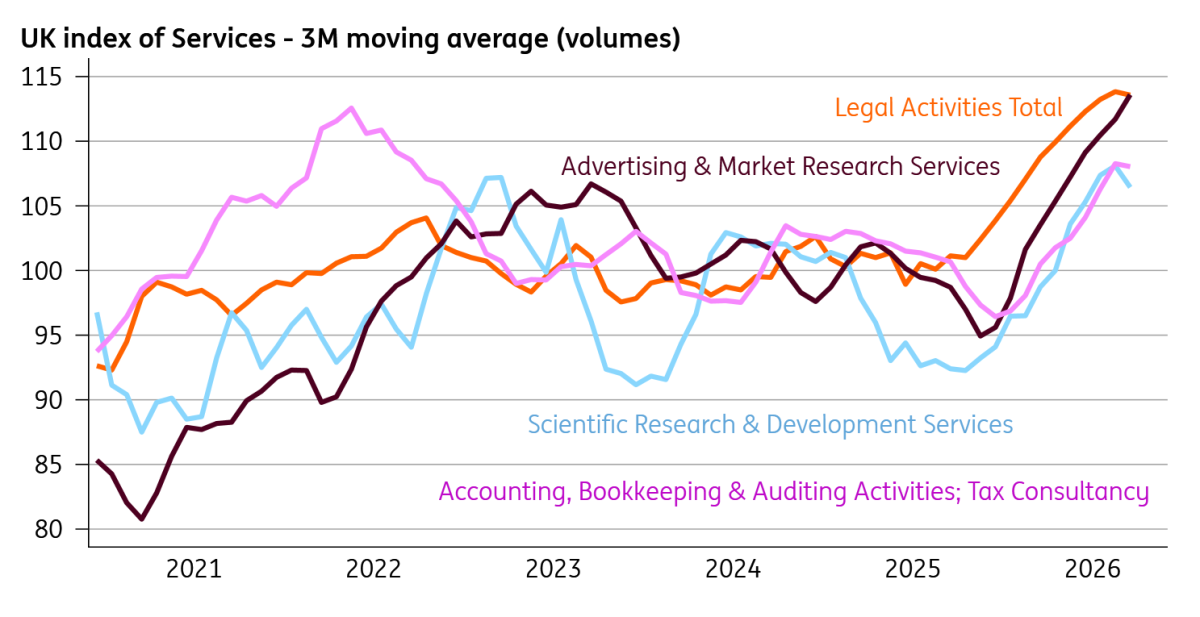
Source: Macrobond, ING
What if the AI bubble bursts?
Never ask an AI chatbot if AI is a bubble. It hurts our feelings.
But… if we did get a proper bear market in US equities, the problems are likely to extend well beyond tech. We wrote about this in our Outlook report this week. Remember what happened after the dotcom bust, when non-tech investment fell harder than tech itself, on account of wider credit spreads and tighter lending standards. And were it to happen – not our base case – then it would have big ramifications for the Fed, which has built a rate hike rationale linked heavily to the solid equity market.
My FX colleagues reckon the impact on the dollar would depend not only on that interest rate story, but whether an equity correction threatens financial stability. If it does, the dollar could still attract some safe haven flows, though in general they reckon JPY and CHF are the more obvious beneficiaries of a serious sell-off. Read more in their FX Outlook hot off the press this week – and sign up for the team's webinar on Monday.
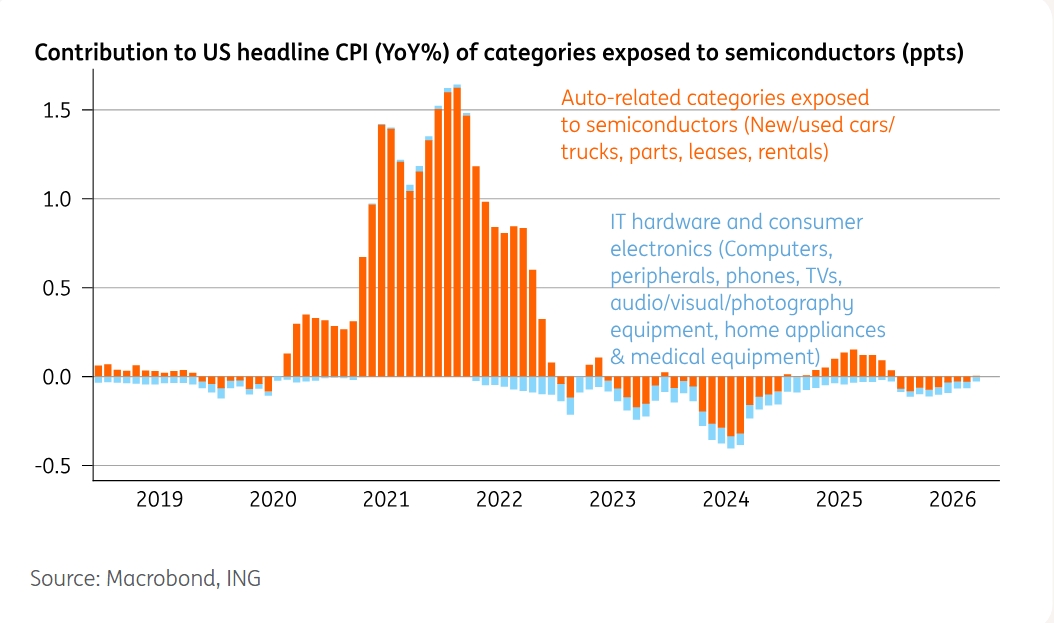
'Chipflation' is not a big thing right now
And what about inflation?
Fed Governor Chris Waller suggested this week that AI is putting upward pressure on inflation. It helped form the basis of his suggestion that rates could rise by 50bp in December, and contributed to the 32bp rise in short-dated US rates this week.
But is it true? There are admittedly many ways AI could be influencing inflation, but the evidence of “chipflation” is pretty flimsy so far.
Even using a generous definition of electronics and IT hardware, those categories are still dragging US inflation down, not up. So are cars, despite being stuffed with semiconductors. The inflation figures are undoubtedly problematic; a 0.4pp rise in the Fed’s preferred metric of core inflation can’t be ruled out for October. But AI really isn’t the main event here.
So there you have it. Now, would you like me to summarise that in five bullet points, adopt a more professional tone, or turn it into a PowerPoint presentation featuring an alarming amount of purple?
James Smith
THINK Ahead in developed markets
United States (James Knightley)
Financial markets have aggressively repriced the outlook for Federal Reserve policy in the wake of hawkish comments from officials and a hotter-than-anticipated core CPI print. There are several Fed officials scheduled to speak over the coming week, despite Chair Kevin Warsh's desire for less forward guidance, and they will retain a hawkish bias. We fully expect a 25bp rate hike at the December FOMC meeting, but the Fed will have a pre-release copy of the November inflation report, and that should look very benign given steep declines in gasoline prices. Hence, we don't see much likelihood of a mooted 50bp hike.
Retail Sales/Industrial Output (Tue): In terms of data, we will have October retail sales, which will be held down by weak auto sales. Gasoline sales are likely to be close to flat. In real terms, we could see total sales fall. Manufacturing output should continue growing, boosted by a strong performance from advanced manufacturing tied to the tech/AI rollout. Some traditional, heavy energy usage sectors, such as steel and glass, should also perform well given their comparative advantage over European and Asian producers, who are having to deal with sharply higher energy costs.
United Kingdom (James Smith)
Inflation (Wed): We expect headline inflation to nudge higher on a small rise in the quarterly energy price cap and a further 4% rise in fuel costs. It won't be until January that we see the full impact of higher natural gas prices when household energy bills are set to rise by circa 25%, something that's likely to be formally confirmed in the coming days. That's likely to take headline CPI to just shy of 4.5% early next year. However, for now, second-round effects look minimal. We don't expect further signs of that in October's data; food inflation is likely to stay unchanged in year-on-year terms.
UK-EU summit (Fri): A deal is widely expected on 20 November to bring the UK closer to Europe, via agreements to reduce checks/paperwork on agricultural goods, align on emissions trading, and increase youth mobility. We'll be looking for any clues about PM Burnham's willingness to go further, and what these deals tell us about his willingness to compromise on key issues of migration and regulatory alignment. That will hint at how close he might be prepared to go to the single market in future.
Key events in developed markets
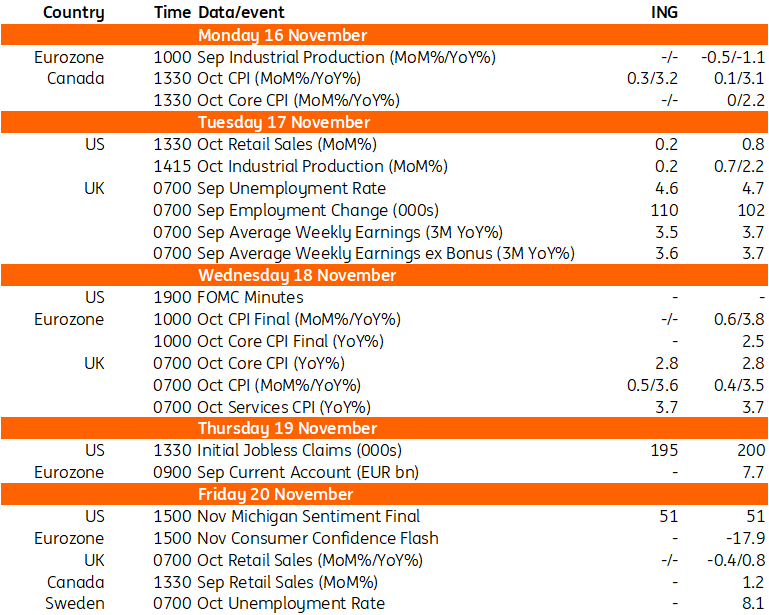
Source: Refinitiv, ING



Comments
Log in or sign up to join the conversation.