

Poland’s economy slowed in the third quarter, while core inflation fell below 3% YoY. There is still little evidence of second-round effects. The MPC has nevertheless turned more hawkish with staff projecting high inflation next year, supporting our base case of 50bp of rate hikes in early 2027.
Poland’s economy slowed in the third quarter.
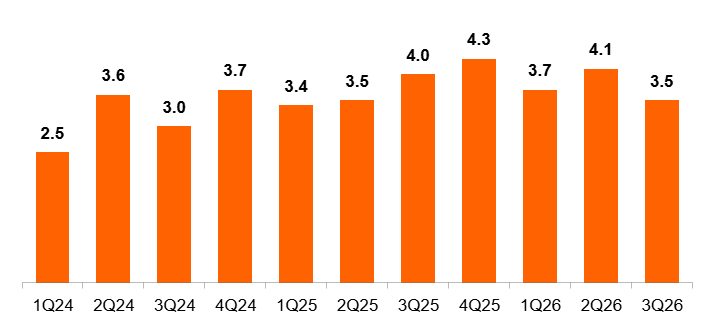
GDP growth slowed in 3Q26, similar to other economies in the region
According to the preliminary estimate, GDP growth slowed to 3.5% YoY in 3Q26 from 4.1% YoY in 2Q26. Seasonally adjusted data point to a slowdown in growth to 0.8% QoQ from 1.1% QoQ in the previous quarter. We will learn the breakdown of GDP growth for 3Q26 on 30 November, but the available data suggests that growth in industrial gross value added slowed, while construction activity declined in annual terms. Continued solid growth in services was not enough to offset weaker performance in these areas.
On the expenditure side, the main reason for slower growth last quarter compared with 2Q26 was a deterioration in net exports, ie, the foreign trade balance. Net exports added 0.5ppt to annual GDP growth in 2Q26, while we estimate that the contribution turned slightly negative in 3Q26. Private consumption growth probably slowed further as well. With nominal wage growth normalising and inflation rising, household incomes came under pressure. Higher spending on fuel is limiting households’ ability to increase consumption elsewhere. Geopolitical uncertainty also remains elevated, resulting in a persistently high propensity to save.
Slower GDP growth, including weaker consumer demand, is an important factor limiting inflationary pressure. This marks a significant difference from the previous energy shock in 2022, which was accompanied by strong income growth and a consumption boom. Under current conditions, it is more difficult for companies to raise prices and pass higher energy costs on to consumers. Price competition in retail also remains intense, while Poland continues to face strong competitive pressure from Chinese imports.
GDP growth moderated in 3Q26
GDP, %YoY, NSA
October CPI inflation confirmed at 3.5% YoY, with core inflation falling below 3% YoY
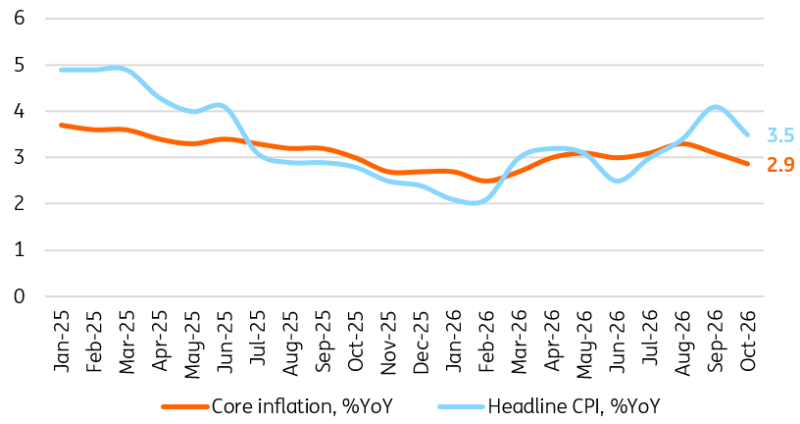
According to the final estimate, CPI inflation fell to 3.5% YoY in October from 4.1% YoY in September. This was mainly due to a decline in fuel prices (-9.7% MoM), related to cuts to excise duty and VAT on petrol and diesel. Growth in food and non-alcoholic beverage prices also remained low at 0.4% MoM, although we are approaching the end of the period of annual deflation in this category that began in June this year. The impact of the energy crisis was, however, visible in housing energy prices, which rose by 1.7% MoM, mainly because of higher prices for solid fuels (7.4% MoM, including an 11.2% MoM rise in coal) and liquid fuels (2.9% MoM). Goods prices rose by 2.9% YoY and services prices by 4.9% YoY, compared with 3.6% YoY and 5.3% YoY, respectively, in September.
The biggest surprise in the October inflation breakdown, however, was the decline in core inflation excluding food and energy prices. According to our current estimates, it fell to 2.9% YoY from 3.1% YoY in September, dropping below 3% YoY for the first time since March. Annual inflation in the recreation, sport and culture category fell markedly, from 5.5% YoY to 4.0% YoY, mainly due to more favourable tourism prices. Price pressure from transport services also eased. Air fares fell by 10% MoM, although they remain 10% higher than a year ago.
The higher energy commodity prices are not translating into broader price pressures in the Polish economy, while the risk of second-round effects, ie, wage increases in response to inflation, remains low.
Both headline CPI and core inflation down in October
CPI and core inflation, %YoY
The MPC has recently turned more hawkish
The National Bank of Poland’s (NBP) November inflation projection points to a high inflation path in 2027, prompting a significant hawkish shift in the Monetary Policy Council (MPC) rhetoric. Recent comments from Council members indicate a willingness to raise interest rates in early 2027. This is consistent with our baseline monetary policy scenario, which assumes a 50bp increase in the cost of money in 1Q27.
The NBP remains more dovish than other central banks in the region and core market policymakers, including the Fed and ECB, and in our view could postpone rate hikes until early 2027. Data on the October CPI composition confirm that there is still no evidence of second-round effects. It's worth noting that monetary policy was also more restrictive at the starting point than in other countries. We believe the Council is waiting for information on the scale of government measures to cushion electricity, gas and fuel prices at the beginning of 2027.
The inflation scenario presented by NBP economic staff is, however, subject to considerable uncertainty. This applies to fuel prices on global and Polish markets, as well as the scale of changes in regulated energy prices, including electricity and gas bills, from the beginning of 2027. Oil prices have moderated again, while the government is preparing measures to freeze gas prices for households.

Comments
Log in or sign up to join the conversation.