


As expected, inflation has started to increase again in Hungary. While the overall picture remains positive, the number of upside risks is growing rapidly. If the external situation remains volatile until the next interest rate decision is made, a rate cut will have to be put on hold
Disinflation came to an end
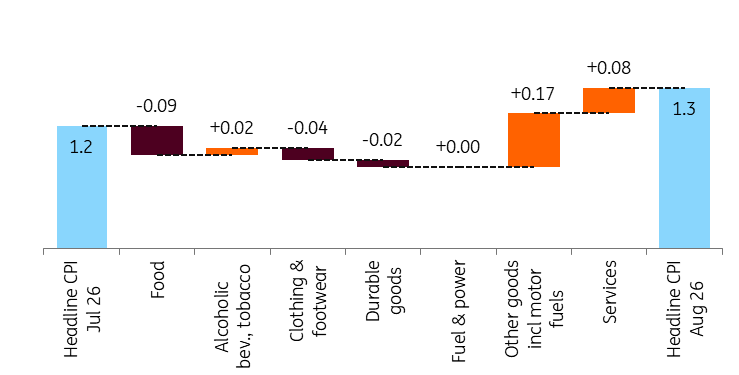
The price level in Hungary rose by 0.2% in August 2026 compared to the previous month, in line with market consensus, according to the latest data released by the Hungarian Central Statistical Office (HCSO). This marked a resumption of inflation accelerating after three months of deceleration. While the increase was minimal, the headline indicator stood at 1.3% year-on-year in August, following an acceleration of 0.1ppt.
The latest inflation data paints a more favourable picture than the National Bank of Hungary's June forecast. However, the acceleration in services inflation, the vulnerability of the forint, the yield environment, and the significant rise in energy prices compared to June already cast a shadow over this. If the external environment does not substantially improve in the coming weeks, the Monetary Council may delay a rate cut until October. Nevertheless, we anticipate some positive changes in the geopolitical situation by the end of the year, which could create an opportunity to reconsider rate cuts. We forecast the base rate to reach 5.00% by the end of the year.
Main drivers of the change in headline CPI (%)
The details
For the fourth consecutive month, food prices have fallen compared to previous months. Strong seasonal price changes were seen among unprocessed foods, resulting in a 1.3% month-on-month deflation in that category
The weakening of the forint and rising energy prices have led to higher fuel prices. However, a monthly price increase of 0.6% is surprisingly low compared to preliminary estimates
The change in service prices continues to push inflation upwards. Within the services sector, we have seen more significant price increases, particularly for services that are sensitive to rising energy prices and the weakening of the forint. Travel to long-distance destinations, taxi fares, holidays abroad, and the transport of goods have all become more expensive
The impact of the previously announced price increases was also felt in the other services sector. This primarily refers to financial and insurance services
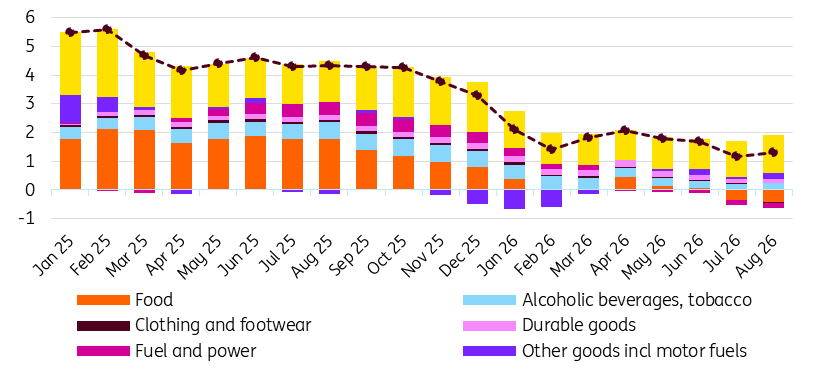
The composition of headline inflation (ppt)
Core inflation still shows a favourable picture
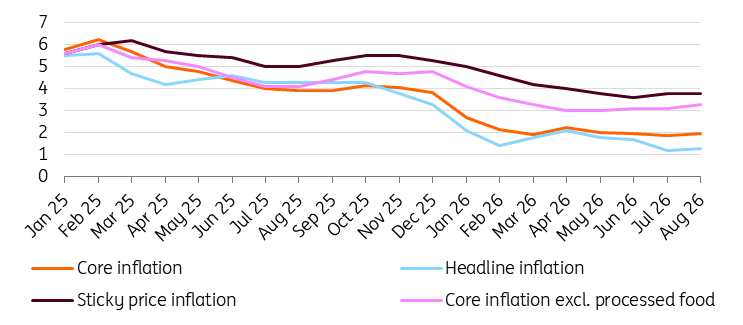
The slight year-on-year increase in inflation was mainly caused by changes in fuel and service prices. Inflation in services has now reached 5% on a yearly basis. As inflationary pressure is currently coming primarily from services, it is not surprising that core inflation continues to exceed the headline rate. Nevertheless, the 2% YoY core figure is favourable overall. The central bank’s underlying inflation measures also paint a fairly solid picture, with sticky price inflation remaining unchanged at 3.8% year-on-year in August.
Headline and underlying inflation measures (% YoY)
The inflation expected to stay under the target in the coming months
Looking ahead to the coming months, service inflation is likely to remain strong due to seasonal factors, wage pressures, and rising energy prices. The latter, combined with the weakness of the forint, could lead to higher inflation for durable goods, which may also be reflected in processed food prices sooner or later. The impact of the drought is more likely to cause an increase in the prices of raw and processed foods early next year. More importantly, despite all the supply-side shocks, both households and retailers are showing moderated price expectations, which indicates strong anchoring of underlying price movements.
According to our latest flash estimate, inflation may rise slowly until the end of the year, potentially climbing slightly above 2% YoY by December. Meanwhile, we expect only incremental acceleration in core inflation, fluctuating around 2%. We are projecting an average inflation rate of just 1.7-1.8% for the headline figure this year. In 2027, we expect the average price to increase to around 2.8%.



Comments
Log in or sign up to join the conversation.