

China's State Council pledged to accelerate policy support and bond issuance, stabilise investment and the property market, promote employment and income growth, and stimulate domestic demand. This signals greater policy urgency after months of soft economic data
Further policy support could help shore up growth
A readout from China's State Council meeting on 28 September noted that countercyclical adjustments will be intensified in response to current problems in the economy.
It marks a bit of a shift in tone. Policymakers have thus far appeared relatively unconcerned, despite the weak data we’ve seen over the last few months. This signals that more policy support rollouts are likely to reach both short- and long-term growth targets. These include the 4.5-5.0% GDP growth target for 2026, and the longstanding goal to double GDP from 2020 to 2035.
The readout covers various areas of fiscal and monetary policy. We've highlighted our three key takeaways below:
Study and introduce policies to stabilise the real estate market and promote employment and income growth. As we’ve argued many times over the past few years, falling property prices and slowing wage growth are the biggest impediments to household confidence in China. While these issues aren't new and have been mentioned in previous policy communications, a fresh wave of support could help shore up the weakest parts of the economy.
Adopt and adjust monetary policy tools. In 2026, policymakers have opted for more targeted tools rather than blunt instruments, given that commercial bank net interest margins are already at record lows. The readout noted that policymakers will continue to expand consumer loan interest subsidies, and increase re-lending quotas for tech. On benchmark rates, we’ve argued that there’s room domestically to cut rates given low inflation, weak borrowing demand, and slowing growth. We recently pushed back our People’s Bank of China rate-cut forecast to 2027 after updating our global central bank scenario. But a cut within the year is still possible, especially if monthly data continues to slide.
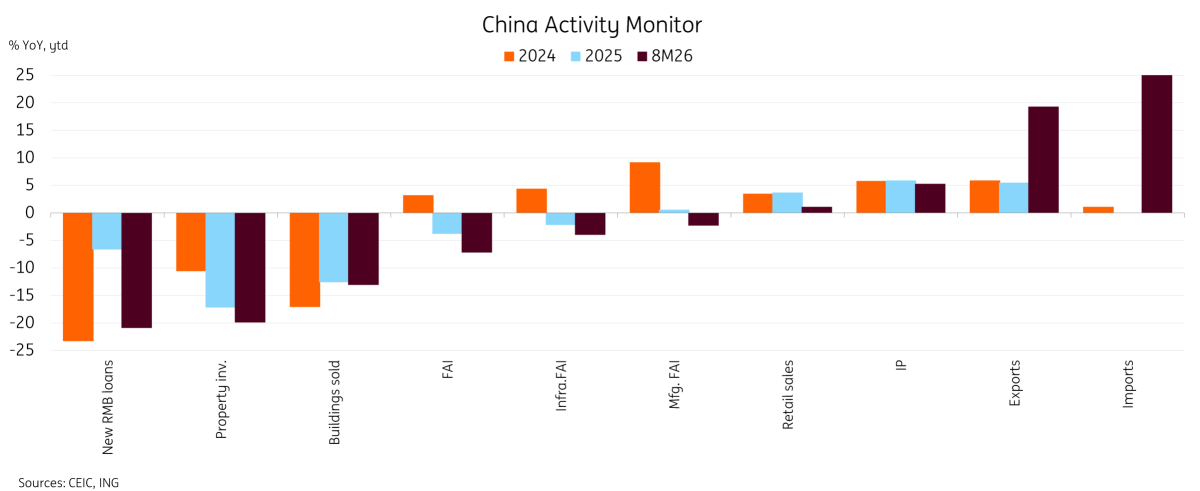
Coordinate efforts at all levels to stabilise investment. The investment picture outside of AI- and tech-related investment has been bleak. Fixed asset investment overall is down -7.2% year-on-year ytd in the first eight months of the year. FDI and ODI are both down on the year. The State Council readout called for preparing high-quality projects, stimulating private investment vitality, strengthening guarantees for investment project elements, and improving investment approval efficiency to help stabilise investment. In more detail, the readout called for advancing the renovation and upgrading of old reservoirs and grain depots.
Officials reiterated calls from July's Politburo meeting to accelerate the issuance and use of various bonds, optimise fiscal expenditure arrangements, and to make good use of local government debt balance limits. This suggests continued efforts to ramp up bond issuance toward year-end.
We've been arguing that risks to China's government bond market look asymmetric right now. Most market participants we spoke to expect yields to grind lower (and indeed it has played out this way so far this year). Yet we think higher levels of bond issuance, an exit from deflation, and a potential turnaround in risk appetite leading to portfolio rebalancing all represent risks for a reversal of a multi-year bond bull market. We expect Chinese government bond (CGB) yields could surprise markets with a move higher in the year ahead.
As for growth, the K-shaped divergence of China's economy has widened in recent months. Exports have remained the main source of strength, while domestic demand has softened further. Overall, growth momentum has slowed, perhaps prompting a more proactive policy response to help shore up the weak spots of China's economy. We continue to look for 4.6% YoY growth for China in 2026.
Policy measures to shore up the weaker parts of China's economy will be welcome



Comments
Log in or sign up to join the conversation.