

Higher mortgage rates are back. Housing affordability is deteriorating. Demand for mortgage loans is weakening. Yet, German house prices continue to edge higher.
At first glance, these developments seem contradictory. In reality, rising prices in thinner markets can easily happen, but they also tell the story of a housing market caught between cyclical headwinds and structural shortages. While financing conditions are once again weighing on demand, the chronic lack of housing supply has prevented a more pronounced correction in prices.
Prices tell only half of the story
Germany's economy has fared better than expected this year. Despite geopolitical tensions, political uncertainty and another jump in energy prices, sentiment indicators continue to point towards resilience. And the housing market once again is reflecting trends in the broader economy.
According to the German Statistical Office’s house price index, house prices rose by 0.3% quarter-on-quarter in the second quarter of 2026, from a downwardly revised 0.1% QoQ in the first quarter. On the year, house prices were up by 0.6% in the second quarter of 2026. While German house prices remain 8.2% below their 2022 peak, they have recovered by more than 5% from the trough reached in 2024.
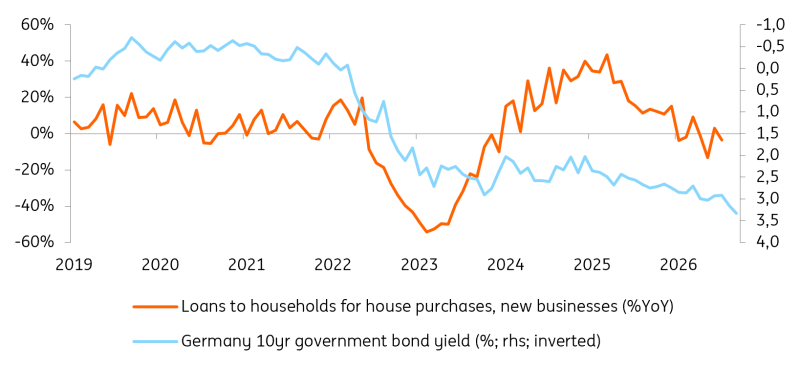
At face value, these figures suggest that the housing market has shrugged off another rise in interest rates. However, it’s not that simple. In fact, recent mortgage lending data suggests that the 100bp surge in mortgage interest rates is leaving its mark on demand. New business volume for mortgage lending was down by more than 1.5% in the first seven months of the year.
Interest rate development & mortgage demand
Source: LSEG Datastream; ING Economic & Financial Analysis
This once again underlines the sensitivity of housing demand to financing conditions. Affordability remains the key cyclical driver of the German housing market, and affordability has deteriorated lately. Prospective buyers now face a challenging combination of higher property prices, higher financing costs and the lingering effects of weaker real purchasing power, driven by the adverse economic effects of the war in the Middle East. Even relatively small increases in mortgage rates can have a disproportionate effect on borrowing capacity, pushing potential buyers out of the market or forcing them to postpone purchase decisions.
The outlook offers little immediate relief. With capital market yields rising further in August and September, mortgage rates are likely to remain elevated throughout the third quarter of 2026. As a result, a meaningful rebound in housing demand appears unlikely in the near term.
Structural shortage versus cyclical weakness
The main reason why prices are still increasing probably lies in the persistent mismatch between supply and demand. Germany still suffers from a structural housing shortage, while residential construction remains subdued. This structural shortage provides an important floor for house prices. It helps explain why mortgage lending and property prices are currently sending different signals. Lending activity is already reacting to a deterioration in affordability and higher borrowing costs. Prices, by contrast, continue to benefit from supply constraints and typically adjust only with a considerable delay. And don’t forget that prices can increase in smaller volumes.
All in all, Germany's housing market is telling an interesting story of a market under substantial pressure from higher interest rates but still seeing increasing house prices.



Comments
Log in or sign up to join the conversation.