

"Educate and inform the whole mass of the people... they are the only sure reliance for the preservation of our liberty."
— Thomas Jefferson
This week we continue our series looking at the big life expenses that have outpaced the rate of inflation over the past several decades. Last week we covered housing. This week, let’s take a look at higher education. There’s a lot to look at.
I’m 58-years old. I earned my bachelor’s degree from the University of Vermont (aka Goovy UV, then considered a Public Ivy). I come from modest means and was the first in my family to earn a college degree. If this is sounding like the American dream, it is.
I covered my room and board expenses by working a part-time job during the school year, slinging pasta and prepping at a downtown Burlington Italian restaurant called Alfredo’s. I’d pick up extra shifts over the Christmas break.
During the summer I worked full time, first in the kitchen and then as a bartender at places like the Lighthouse and Halvorsen’s. I ate as much as I could while at work (free food!). Late at night we’d head to one of the infamous Burlington bars, including Nectar’s, to drink dime drafts and catch Phish before they became the touring sensation they are today. Ironically, right after I hit the send button on this letter, I’m on my way to Boston to catch Phish for two nights at Fenway!
You could describe my financial picture at the time as bleak. I made just enough money to pay the rent, buy books, and cover roughly half my tuition. The balance was made up with a few scholarships, a little help from my parents (thanks Dad!), and loans.
I graduated with $7,000 in student loans. That’s the equivalent to about $17,000 today. My return on investment has been phenomenal. Lots of my friends were in similar situations, and for the most part, it worked out pretty well for us. We made life-long friends and were armed with degrees that let us improve our lots. I went into industrial sales, then operations, and finally into M&A and Business Development. Today I get to be here with all of you. It’s been a good run. I have never once thought, “was my degree worth the cost?” It has been invaluable.
Since those days, the price of college has risen roughly 360% faster than inflation. Not 360% more expensive. 360% faster than everything else that got more expensive.[1] And it's leaving many to wonder if college is a realistic option anymore.
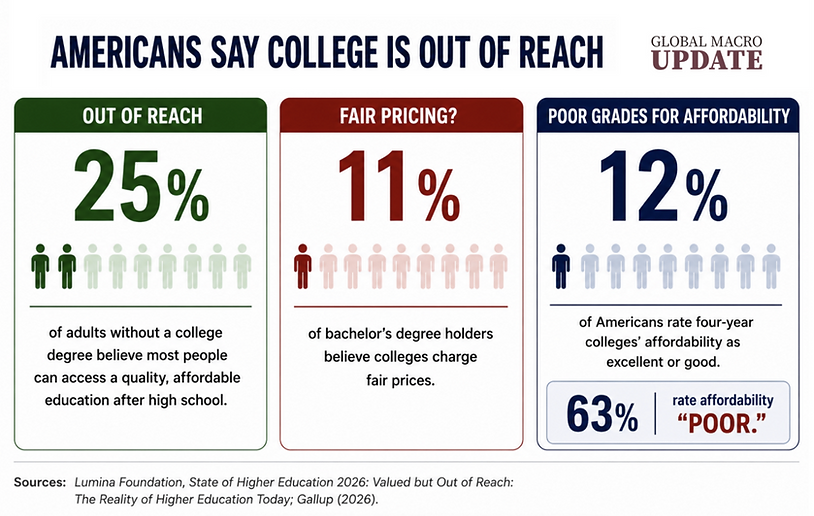
According to the Lumina Foundation's 2026 State of Higher Education study, only 25% of adults without a college degree believe most people in America can access a quality, affordable education after high school. Only 12% of Americans say four-year colleges are doing an excellent or good job on affordability, ranking dead last among the seven attributes. Just 4% rated four-year colleges' affordability as excellent, while 63% rated it poor.[2]
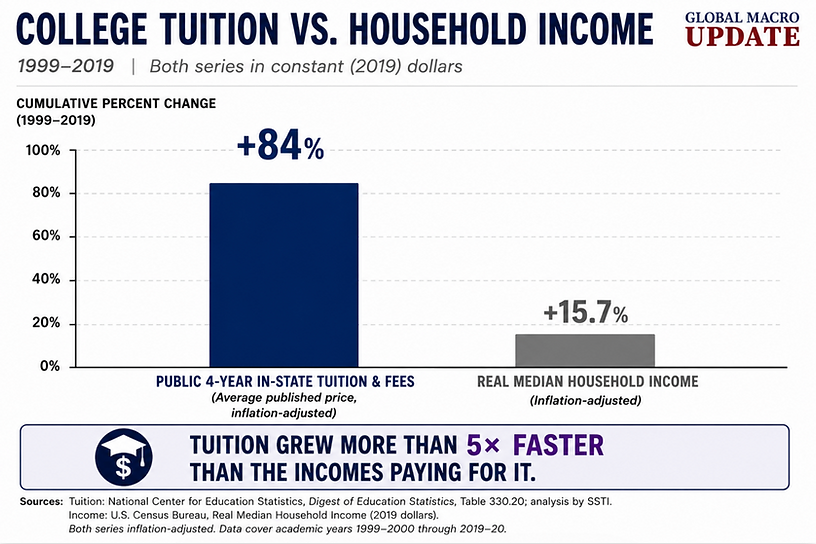
The numbers back up the vibe. In the two decades from 1999 to 2019, public tuition rose 84% while real median household income rose just 15.7%.[3]
Today, average published tuition and fees run about $11,950 a year at public four-year schools for in-state students, $31,880 if you're out-of-state, and $45,000 at private nonprofits. And to be clear, none of that includes room and board.[4]
Which begs the question…
How Did We Get Here?
It wasn't always the students who paid the bill. Many public universities were built to be low-cost or tuition-free, funded by land grants under the 1862 Morrill Act. The University of California charged no tuition until 1970. For roughly a century, the state carried most of the cost, not the student.
That changed after World War II. The GI Bill sent millions of veterans into college at once, demand outpaced what states could fund, and support shifted from directly funding universities to funding students instead, state funding's share of public university revenue fell from about 79% in 1980 to roughly 55% by 2019, while the maximum Pell Grant went from covering close to 80% of a public four-year education to just 29% today.
Enter “financial aid” as we know it. Economists still argue about what easier borrowing did to college prices. Some research says it let colleges raise prices with less resistance, other research says the effect comes and goes. Either way, it's hard to call financial aid the root cause of skyrocketing tuition. It is easier to call it an accelerant. Add an amenities arms race, opaque pricing, demand, and limited local competition, and no single force explains the increase in tuition. Put together, they snowballed, with strong demand for a degree on one side and easier and easier ways to pay for it on the other.
Meanwhile, all that tuition money had to go somewhere.
Where The Money Went
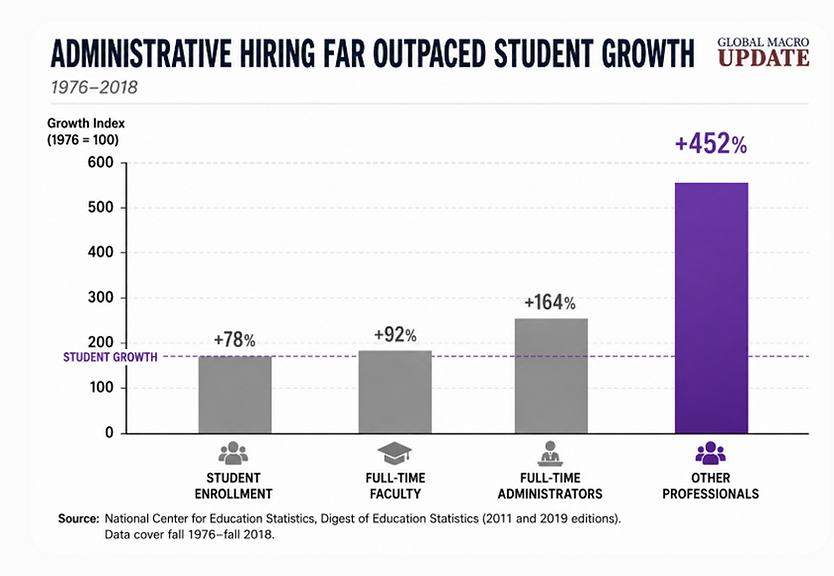
Between 1976 and 2018, total student enrollment at American colleges grew about 78%, and the number of full-time faculty grew roughly in step, at 92%. Full-time administrators grew 164%. Other professional staff, a broader category running from compliance officers to student services, grew 452%. [5] More recently, from 2010 to 2018, spending on student services rose 29% and administrative spending 19%, while instructional spending rose only 17%.[6]
All that additional headcount had to be paid for somehow. With state and federal support shrinking, tuition was where colleges turned. Not that that's automatically a bad thing: Economists Robert Archibald and David Feldman of William & Mary believe much of it is "cost disease". When labor-intensive service industries can't capture the productivity gains manufacturing does, their costs rise faster than inflation almost by default.[7] Even Phillip Magness, no defender of administrative growth, highlighted it didn't come at faculty's expense. Excluding for-profits, U.S. higher education has held a steady ratio of about 25 students per full-time faculty member for four decades. Nobody raided the classroom to fund the bureaucracy.[8]
If there's a single group the numbers point to, it's not faculty and it's not administrators in the traditional sense (to my surprise), it's the broader category of "other professional staff," which grew nearly five times faster than enrollment itself.
Regardless, neither point erases the core numbers. Higher education became a system where loan money, regulation, and cost structure all pushed in the same direction at once.
Whatever the exact mix of causes, the outcome is the same for the person writing the tuition check: a bigger bill. And that has changed the decision matrix for today’s potential students.
Access Hasn’t Disappeared. It Changed.
College hasn't become unavailable, but for many it is unattainable. People aren't being shut out of college. They're paying more, taking on debt, and/or choosing cheaper alternatives. The latter isn’t necessarily bad, but it is a big change from prior generations.
Loans, grants, community colleges, dual enrollment, and certificate programs give millions of students a way through the door. For many students, the question isn't whether they can go to college. It's which version of college. Some borrow more to attend the school of their dreams. Others choose a cheaper option, community college, a shorter certificate program, and living at home instead of on campus.
I know many parents who feel their children deserve the same college experience they had. To be fair, that was my goal for my own children. But when you are taking on debt at the expense of funding your own retirement… yikes. That’s when difficult conversations need to take place. And many don’t.
Things might be changing. The old saying, “the cure for high prices is high prices,” is at work here. College costs are at an all-time high, yet enrollment remains below its 2011 peak[9]. Private four-year colleges lost students this past fall, even as certificate programs grew 28.3% since 2021,[10] and registered apprenticeships climbed to roughly 700,000 active participants.[11]
Americans are becoming more selective about how much they will pay, how long they will study, and how much debt they will accept.
Cost is only half of that calculation. The other half is what the credential delivers once they earn it. A few weeks ago, we wrote about Peter Turchin's research on elite overproduction, the idea that societies eventually produce more credentialed, ambitious people than they have positions to reward. College is where a lot of that credentialing happens.
A degree used to be a reasonably reliable ticket to upward mobility. The more expensive, and the less certain that payoff becomes, the more the entire value proposition starts to change.
Housing was once part of the American Dream. So was a diploma. Two legs of the same stool, and both are looking a little wobblier than they used to. Which raises the bigger question we'll get into next week: in this economy and at today’s cost, is a college degree still worth it?


Comments
Log in or sign up to join the conversation.