

One question we are often asked is, “why bother with international investments?” U.S. multinational companies have revenue generated all over the world, so what if diversification is just a matter of “de-worseifying” and bringing suboptimal outcomes?
I understand this concern, considering that for a long stretch of time, the U.S. has outperformed the rest of the world. Over the past 10 years ending April 30, the MSCI USA Index has outperformed the MSCI EAFE Index by more than 140%.1
However, we believe there are long-run benefits of investing globally.
There are strong parallels to “growth” dominating “value” within the U.S. markets when looking at foreign markets versus the U.S.
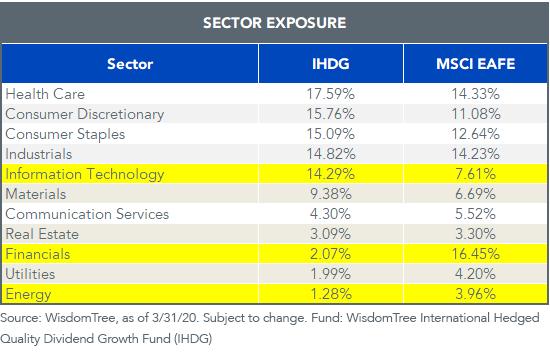
Standard market cap-weighted international indexes have sector exposures akin to U.S. value benchmarks, particularly the lack of technology sector exposure and over-weight position to financials and commodity-dependent sectors.

But not all international strategies have these sector tilts.
The WisdomTree international quality dividend growth strategy has a sector balance closer to the S&P 500, particularly being over-weight in technology versus the MSCI EAFE Index and providing meaningful weights to the health care and consumer sectors. In shifting the weight away from traditional value benchmarks, it also has little exposure to sectors that are typically value heavyweights, such as energy and financials.
We believe screening for profitability, low leverage and earnings growth creates a valuation profile that is more attractive than broader international benchmarks.
Yes, the MSCI EAFE Index is less expensive than the S&P 500 on a price-to-earnings (P/E) ratio basis (by about four points), but the S&P 500 has a return on equity (ROE) that is 50% greater, profit margins that are 40% higher and less leverage. These higher margins and profitability ratios warrant the premium multiple of the S&P 500.
By contrast, when one focuses on these profitability and growth metrics in selecting higher quality companies, the situation is completely reversed.
The WisdomTree International Hedged Quality Dividend Growth Fund (IHDG), which seeks to track, before fees and expenses, the price and yield performance of the WisdomTree International Hedged Quality Dividend Growth Index, currently has a ROE that is 40% greater than the S&P 500, profit margins 3.5% higher than the S&P 500 and a leverage ratio that is one-third that of the MSCI EAFE Index and almost half that of the S&P 500. For these better profitability and growth metrics, you are also not paying a premium multiple to the S&P 500 but getting the market at around a one-point discount instead.
(Click on image to enlarge)
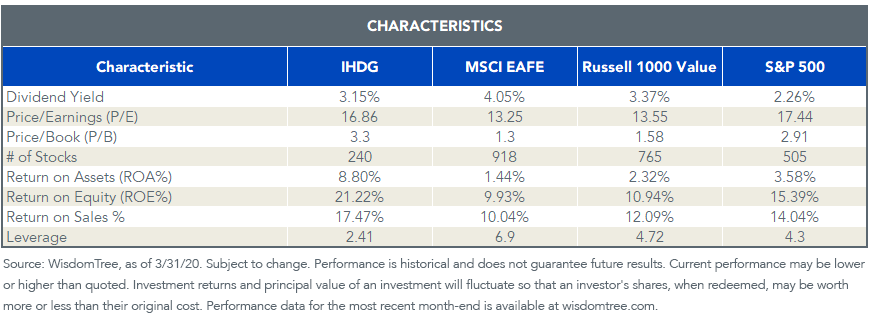
While the characteristics of broad international benchmarks are understandably “less expensive for good reasons,” we believe this basket of international quality stocks looks attractively priced versus the S&P 500 for its improvement in quality and growth characteristics.
1Source is Bloomberg as of 4/30/2020.



Comments
Log in or sign up to join the conversation.