

Key Takeaways
Gold has weakened as rising real yields, a stronger U.S. dollar and higher Fed rate expectations have outweighed safe-haven demand, shifting the focus from higher rates to higher uncertainty.
Despite ETF outflows, central banks remain a key source of demand, with 89% expecting global gold holdings to rise and a record 45% planning to increase their own reserves.
Investors seeking gold exposure without reducing core equity or bond allocations may consider WisdomTree's capital-efficient gold exposure ETFs.
Gold prices are now lower than where they started the year. That is a surprising outcome given the strongest monthly increase in gold prices on record in January 2026 (measured by nominal U.S. dollar gains rather than percentage returns). As a result, gold has experienced its most volatile first half of the year since it became a broadly investable asset.1
Gold has come under pressure from rising interest rate expectations. The war in the Middle East has contributed to this shift in sentiment, as the inflationary effects of disruptions to shipping through the Strait of Hormuz led markets to anticipate a monetary policy response aimed at containing price pressures. For a brief period, gold rallied when the United States and Iran signed a Memorandum of Understanding (MoU), as investors hoped that lower energy prices would ease pressure on central banks.2 However, the rally proved short-lived after the Federal Reserve's June FOMC meeting signaled a more hawkish policy stance.
The first FOMC meeting under Chairman Warsh featured a streamlined policy statement, marking the beginning of a broader reduction in forward guidance.3 As a result, markets are likely placing greater emphasis on the guidance that remains. The so-called "dot plot", which shows where individual policymakers expect interest rates to be at year-end, revealed that nine of the eighteen participants projected at least one rate hike by the end of 2026 (Figure 1).
A growing number of Fed officials have warned they may need to raise rates before the end of 2026 to counter persistent inflation, and traders are now betting on an increase as soon as September, a notable shift from June, when markets had penciled in a move no earlier than October. With the Iran war escalating again and pushing oil prices back toward $100 a barrel4 for the first time in two months, the modest relief American households drew from last month's decline in consumer prices looks likely to prove short-lived.
The U.S. economy appears to be shifting from a higher-for-longer interest rate story to a higher-for-longer uncertainty story, and that could weigh on the Fed and markets more heavily than rates alone.
The personal consumption expenditures price index excluding food and energy is now seen rising 3.4% in the second quarter from a year earlier, up from a 3.3% estimate last month, according to the survey. Even so, respondents expect headline inflation to decelerate more quickly in the second half of the year than previously projected.
Figure 1: Federal Open Market Committee Members' Expectations for End-2026 Interest Rates: March vs. June 2026
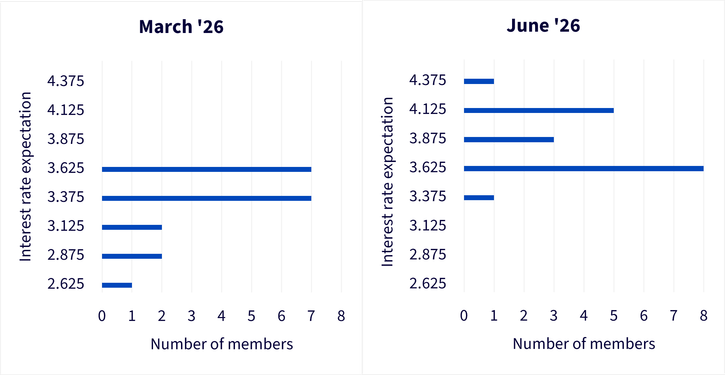
Source: Federal Reserve Summary of Economic Projections, June 17th, March 18th 2026, WisdomTree. Past performance is not indicative of future results.
Gold and Real Rates
Real rates, as measured by Treasury Inflation-Protected Securities (TIPS) yields, have been rising and have therefore exerted downward pressure on gold in recent months. While gold and real yields appeared to decouple for several years, their historically negative relationship seems to have reasserted itself more recently (Figure 2).
Figure 2: Gold vs. Real Rates (Treasury Inflation-Protected Securities Yield)
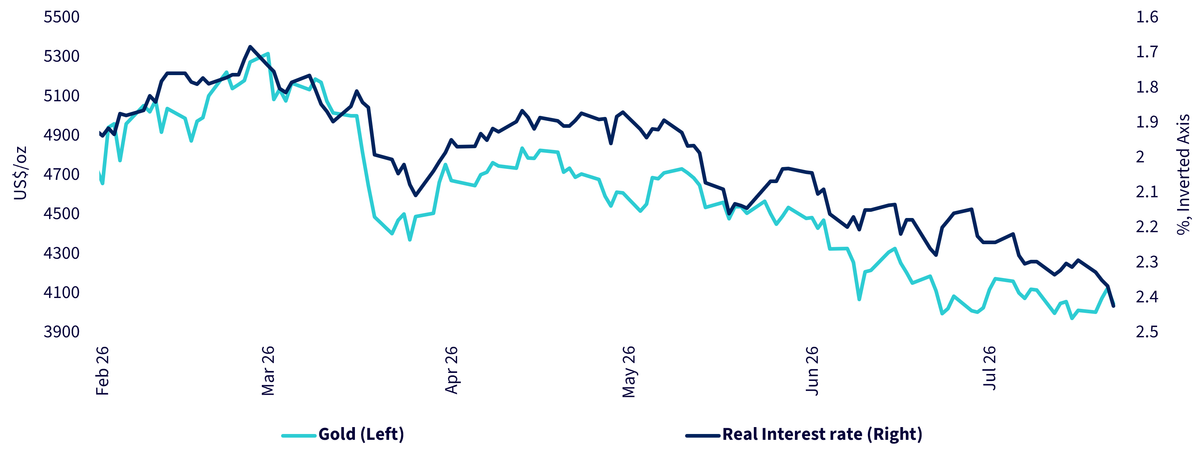
Source: Bloomberg Finance LP. WisdomTree, February 2026 –July 2026. Past performance is not indicative of future results.
Gold and the U.S. Dollar
The U.S. dollar has appreciated to its highest level in more than a year. The greenback benefited from the United States' relative energy security during the Iran conflict, particularly compared with other traditional safe-haven currencies.
Both sides have been dismissive of a near-term return to the negotiating table, even as the risks to energy markets and the world economy mount.
Trump last month cited the risk of a global economic crash as a key reason why he agreed to a truce. But he said on Thursday that Iran is “not ready yet” for a deal and signaled U.S. attacks will continue.
Figure 3: Gold and U.S. Dollar Basket
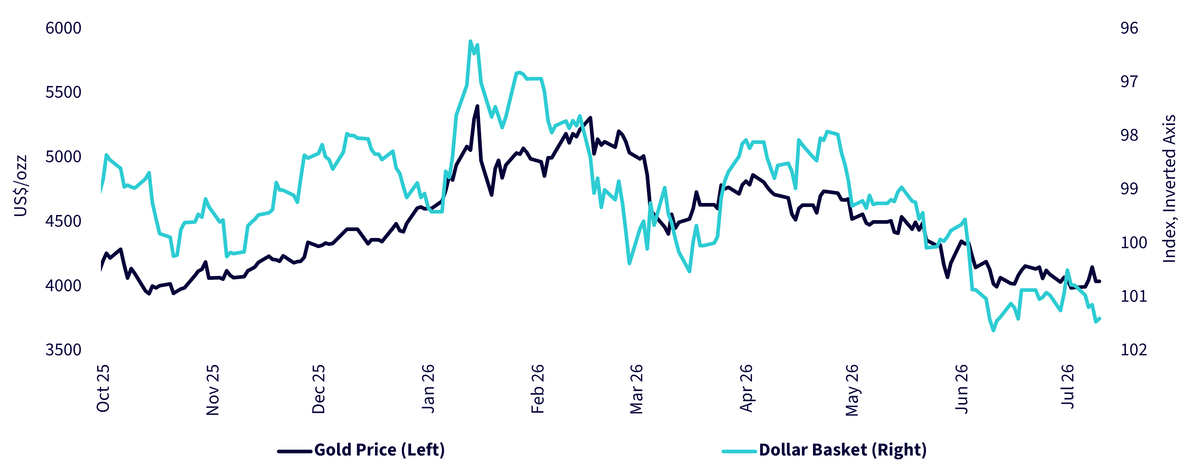
Source: Bloomberg Finance LP. WisdomTree, October 2025 –July 2026. Past performance is not indicative of future results.
Central Banks Remain Constructive on Gold
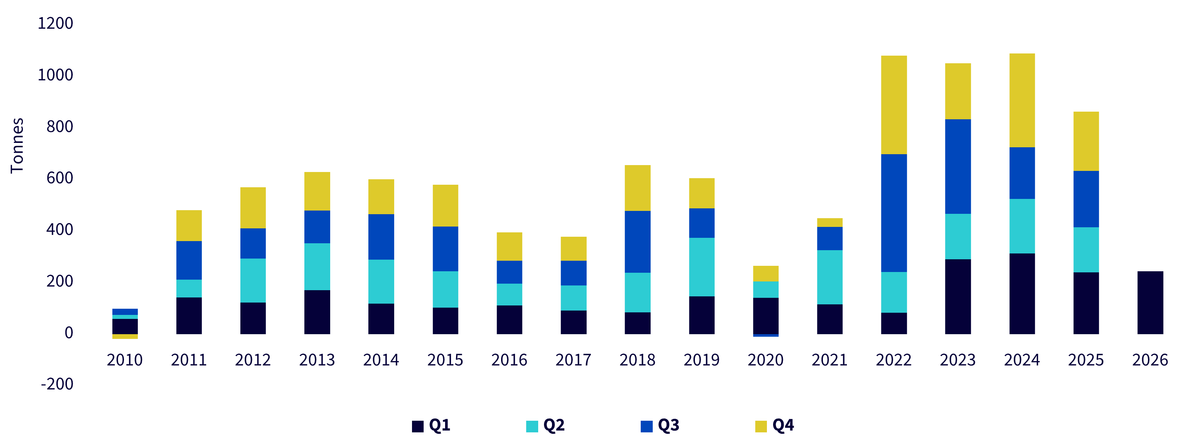
In 2025, central banks purchased less gold by tonnage than in 2024, 2023 and 2022, falling below the 1,000 ton mark for the first time since the Russia-Ukraine war started (Figure 4). However, they spent more than ever on gold purchases because of the higher price environment (we estimate over $95 billion in 2025 vs. $84 billion in 2024).
Figure 4: Central Bank Demand for Gold
Source: WisdomTree, World Gold Council, Q1 2010 to Q1 2026. Past performance is not indicative of future results.
For those concerned that central bank demand may be weakening, the World Gold Council's latest annual central bank survey provides useful perspective.
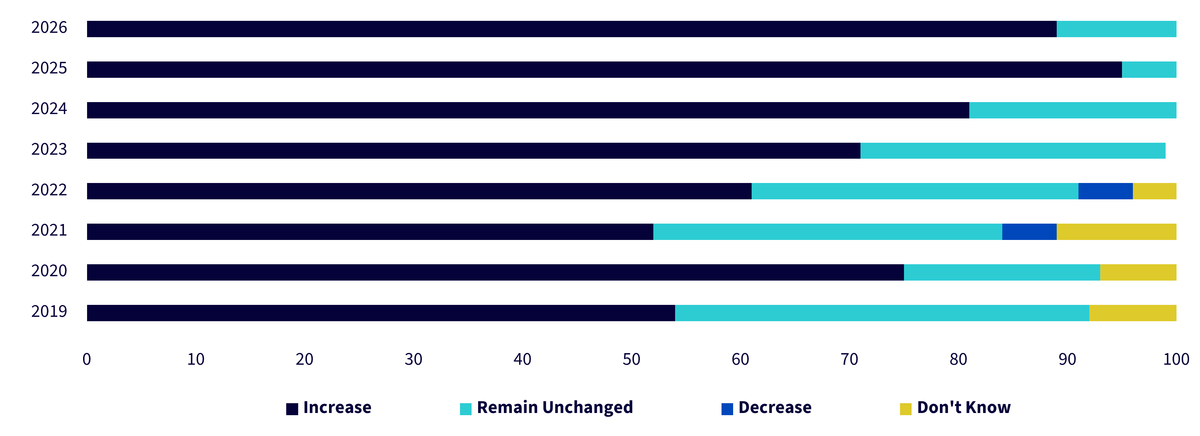
Central banks remain highly constructive on gold. The survey found that 89% of respondents believe central banks as a group will continue to increase their gold holdings over the coming year (Figure 5). None expected aggregate gold holdings to decline. Although a slightly larger proportion than last year expect holdings to remain unchanged (11% in 2026 versus 5% in 2025), this is unsurprising given the substantial increase in gold prices and the larger share of foreign exchange reserves now represented by gold.
Figure 5: Central Bank Expectations on All Central Bank Gold Holdings
Source: WisdomTree, World Gold Council, Central Bank Gold Reserves Survey 2026. Past performance is not indicative of future results.
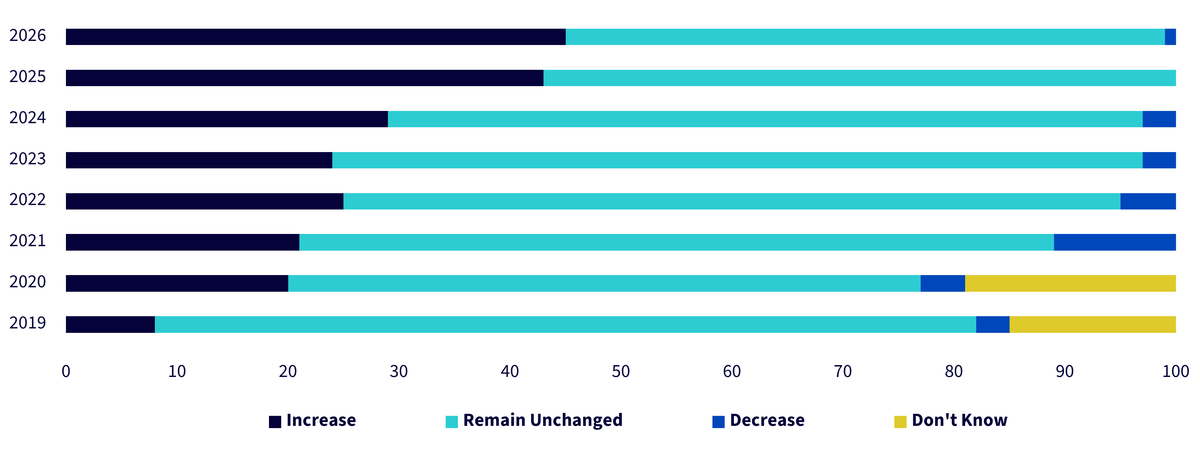
A record 45% of respondents expect their own institution's gold reserves to increase over the next 12 months (Figure 6). Most of the remaining respondents expect no change, while only 1% anticipate a reduction in holdings. Based on the survey sample, this suggests that only a single central bank indicated an intention to sell gold.
Figure 6: Central Bank Expectations on Their Own Gold Holdings
Source: WisdomTree, World Gold Council, Central Bank Gold Reserves Survey 2026. Past performance is not indicative of future results.
Investors Cooling
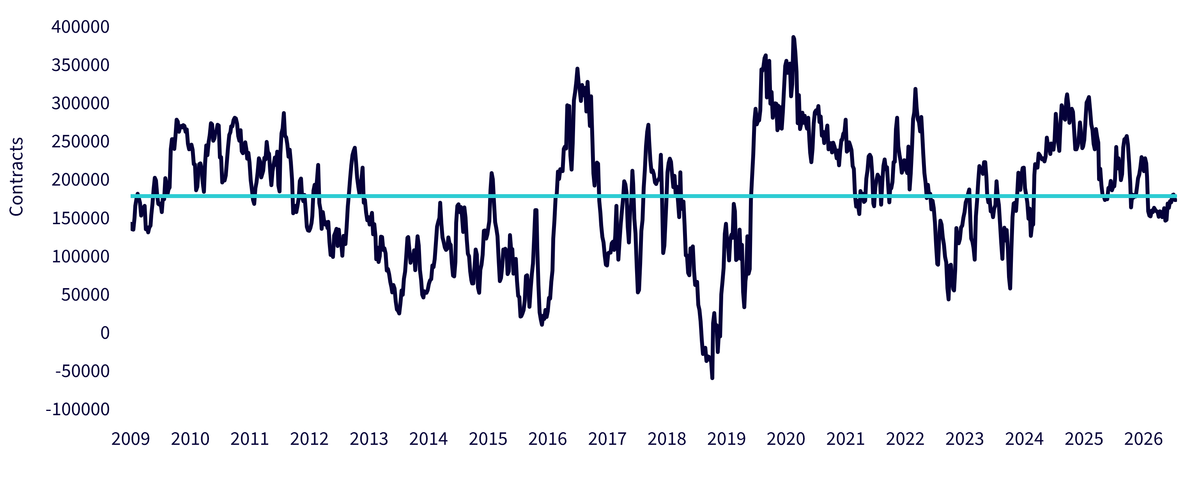
In line with central banks, the investor picture has grown more mixed. Net speculative positioning in gold futures actually rose in July, having fallen the previous month, and has moved back toward its long-term average since 2009 (Figure 7).
Figure 7: Net Speculative Positioning in Gold Futures
Source: Bloomberg Finance LP. WisdomTree, June 2009 –July 2026. Past performance is not indicative of future results.
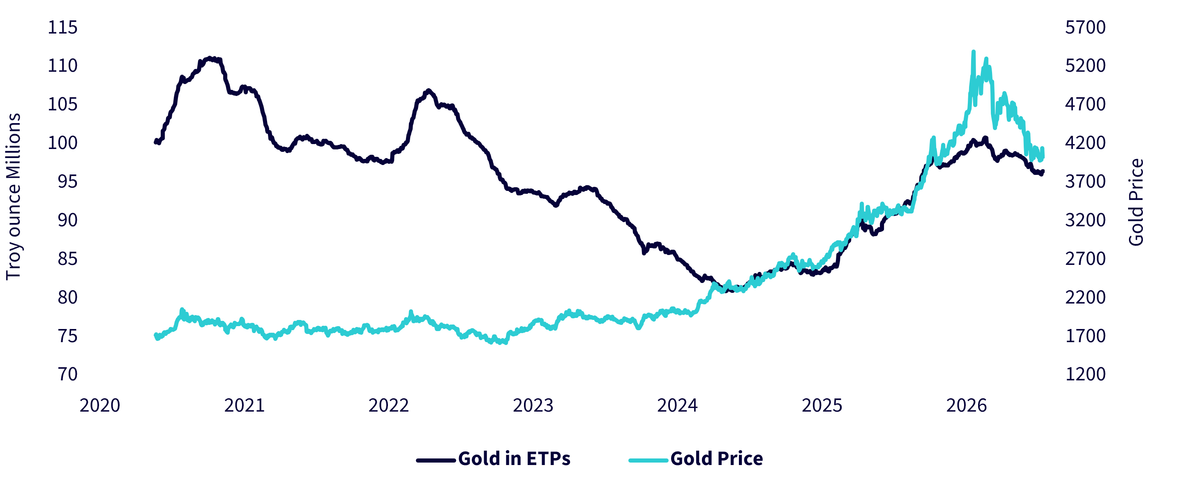
Gold held in exchange-traded products, by contrast, saw further outflows, with holdings declining as prices eased (Figure 8). The divergence suggests that while some tactical investors are re-engaging through the futures market, exchange-traded product holders remain focused on higher real yields and a stronger U.S. dollar, even as structural buyers continue to accumulate gold.
Figure 8: Gold Held in Exchange-Traded Products (ETPs)
Source: Bloomberg Finance LP. WisdomTree, June 2020 –July 2026. Past performance is not indicative of future results.
Long-Term Risks Remain Unresolved
We believe the world remains characterized by elevated geopolitical risks and growing financial vulnerabilities. The renewed escalation of the Iran conflict, following the collapse of last month’s truce, underscores that these risks remain unresolved, and have arguably deepened since our previous outlook.
While central banks may be raising interest rates in response to inflationary pressures, now compounded by a fresh energy-price shock, government indebtedness continues to rise across many major economies.
The tension between tighter monetary policy and deteriorating fiscal positions creates potential fault lines within the global financial system. Although these concerns are not currently being reflected in gold prices, gold is likely to play an important role should these imbalances unwind in a disorderly manner, particularly in a world increasingly defined by uncertainty rather than by the path of interest rates alone.
Conclusion: Expressing the View: Capital-Efficient Gold Solutions
We have written before about how investors who find the setup compelling and are thinking about a potential rally back in gold face a practical question: how to add gold without giving up the exposures already doing work in a portfolio. WisdomTree’s capital-efficient suite is built for adding gold as an overlay to a sleeve in a portfolio and creates more room without having to sell an important asset.
Figure 9: WisdomTree Capital Efficient Gold ETFs
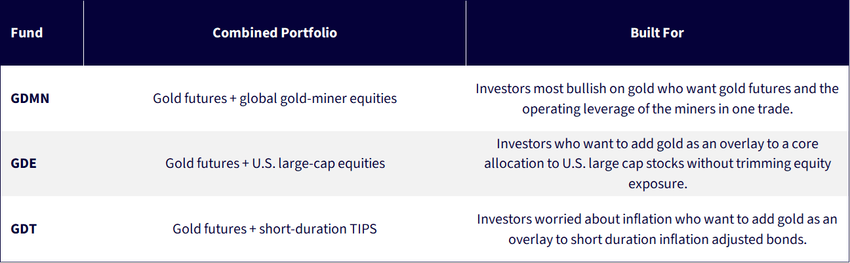
GDMN refers to the WisdomTree Efficient Gold Plus Gold Miners Strategy Fund, which is a strategy designed to provide exposure to 90% equities of gold mining companies, 10% short-term U.S. treasuries to serve as collateral for a position that provides 90% notional exposure to gold futures. For each hypothetical $100 invested, there is $180 of notional exposure. GDE refers to the WisdomTree Efficient Gold Plus Equities Strategy Fund, which is a strategy designed to provide exposure to 90% equities of the 500 largest U.S. companies by market capitalization, 10% short-term U.S. treasuries to serve as collateral for a position that provides 90% notional exposure to gold futures. For each hypothetical $100 invested, there is $180 of notional exposure. GDT refers to the WisdomTree Efficient Gold Plus TIPS Strategy Fund, which is a strategy designed to provide exposure to 90% U.S. Treasury Inflation Protected bonds, 10% short term U.S. treasuries which serve as collateral for 90% notional exposure to gold futures. These ETFs do not hold physical gold.
Each fund uses U.S.-listed gold futures, collateralized by the fund’s core holdings, to layer roughly 90% notional gold exposure on top of an existing ~90% allocation, for about 1.8x total asset exposure per dollar invested.
Because the gold sits on top of the large cap equity, gold miners, or TIPS sleeve rather than replacing it, an investor can introduce a meaningful gold position without selling down the stocks or bonds they already own.
The Case for the Baskets:
One ticker, two return streams. Rather than choosing between gold and a core allocation, each basket delivers both in a single, liquid ETF, freeing the capital that a standalone gold sleeve would otherwise tie up.
Diversification without the drag. Gold’s historically low correlation to both equities and Treasuries means adding it as an overlay can improve a portfolio’s risk-return profile.
1 Sources: World Gold Council. (2026, July 1). Gold mid-year outlook 2026: Point break; World Gold Council. (2026, July 1). Gold faces a pivotal second half as geopolitical risk, rate expectations, and investor positioning collide [Press release].
2 Sources: Gibson, Dunn & Crutcher LLP. (2026, July 7). The U.S.-Iran Memorandum of Understanding: Prospective sanctions relief, commercial opportunities, and legal risks. Gibson Dunn; Forex.com. (2026, June 15). Gold forecast: US-Iran deal optimism lifts metal ahead of central banks.
3 Source: Giangiulio, D., Cox, J., Liesman, S., & Li, Y. (2026, June 17). Chairman Warsh drastically alters Fed rate statement: Here's what's changed. CNBC.
4 Bloomberg Finance L.P. as of 23 July 2026.

Comments
Log in or sign up to join the conversation.