

Key Takeaways
Nvidia (NVDA)’s 2,400% dividend increase makes it the second-largest dividend payer in the U.S., highlighting how technology companies are reshaping the dividend growth landscape.
The WisdomTree U.S. Quality Dividend Growth Fund (DGRW) benefits from exposure to dividend initiators like Nvidia, Alphabet and Meta that many backward-looking dividend growth screens still miss.
By emphasizing quality and future growth potential over dividend history, DGRW aims to capture tomorrow’s dividend leaders before they become widely recognized.
Nvidia’s quarterly earnings reports are usually marquee events for equity markets, and its first-quarter results announcement on May 20 was no different. In addition to reporting record revenue, strong profit margins, and triple-digit year-over-year increases in Generally Accepted Accounting Principles (GAAP) and non-GAAP diluted earnings, it announced one of the greatest dividend growth stories equity markets have ever seen.
The most valuable company in the world, and artificial intelligence (AI) bellwether, announced that it would immediately raise its quarterly cash dividend from $0.01 to $0.25 per share of common stock, a 2,400% increase. With roughly 24 billion common equity shares outstanding, Nvidia will be on track to pay $24 billion in cumulative dividends during its fiscal year, vaulting it into second place among the largest dividend payers in U.S. equity markets.
Figure 1: Top 10 U.S. Dividend Payers by Dividend Stream™ After Nvidia’s Announcement
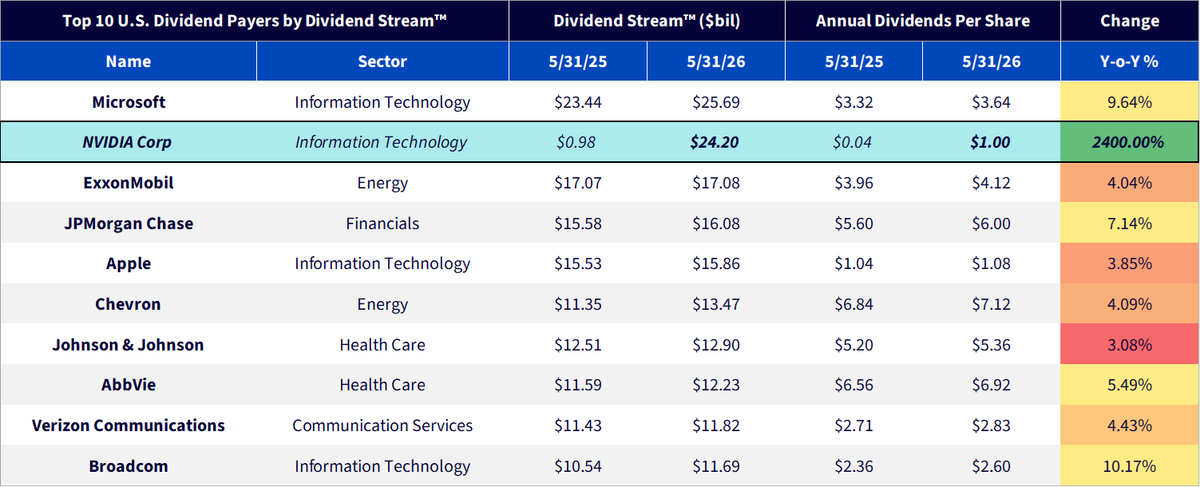
Source: WisdomTree, MSCI, FactSet, as of May 31, 2026. Dividend Stream = Indicated dividends per share x shares outstanding. Universe based on the MSCI USA Index.
Nvidia will now only trail Microsoft (MSFT) among U.S. dividend leaders, as its cumulative annual payout of $25.69 billion narrowly maintains first place. The $17 billion in dividend payouts from ExxonMobil (XOM), now the third-largest dividend payer, was immediately dwarfed by NVIDIA’s historic increase.
Nvidia’s announcement further augments the changing composition of the U.S. dividend landscape, as three of the top five dividend-payers now operate within the Information Technology sector (Apple (AAPL) ranks fifth, at $15.86 billion), with a fourth (Broadcom (AVGO) ($11.69 billion) rounding out the top ten.
Historically, the idea of technology companies paying dividends at the expense of potentially reinvesting in their own growth was antithetical to prevailing wisdom, but that no longer holds.
The 2026 U.S. dividend environment reminds us that dividend-centric investment strategies should not rely on rigid frameworks that are becoming increasingly obsolete. Instead, they should utilize flexible, adaptive approaches that evolve with the market, not in spite of it.
Challenging Mainstream Thinking
Nvidia’s dividend increase reminds us of an important premise for dividend growth investing: Long, consistent histories of dividend growth are not a precondition for further growth, nor protection from a reduction or suspension. More importantly, fixating on yesterday’s leaders ignores today’s initiators and tomorrow’s growers.
The WisdomTree U.S. Quality Dividend Growth Fund (DGRW) debunks the notion that dividend growth history should dictate inclusion investment strategies focused on dividend growth today. Similarly, it counters the idea that a dividend payment is inherently stable simply because of past growth.
No Backward-Looking Growth Requirement
Unlike other dividend growth equity funds, DGRW’s methodology contains no trailing dividend growth requirement that would otherwise ignore Nvidia and recent Information Technology initiators like Alphabet and Meta. Because they are all high-quality companies (based on our measures of return-on-equity (ROE), return-on-assets (ROA), trailing and forward-looking earnings growth and more), DGRW maintains exposure to all three companies, which are all success stories in their own right:
DGRW has owned Alphabet (GOOGL) since it initiated a dividend payment on April 25th, 2024. Since its declaration through June 8, 2026 (its most recent record date), its dividend has grown by $0.02 (or 10%) while its share price climbed 130%.
Ditto for its class C shares (GOOG), which matched the announcement date, dividend amount and dividend growth history through June 8. Those shares climbed 126%.
Meta (META) first declared a dividend on February 1, 2024, which has grown by 5% since. Through June 8, 2026, Meta stock has risen more than 49%.
Nvidia’s announcement is obviously the most recent justification for our decision to reject backwards-looking growth requirements. Competing strategies, such as those that replicate the S&P U.S. Dividend Growers Index, have no exposure to NVIDIA altogether and will not benefit from its growth announcement. The same is true for the Morningstar U.S. Dividend Growth Index, along with the S&P 500 Dividend Aristocrats Index, where NVIDIA and its dividend are conspicuously absent.
Growth History Does Not Equal Growth Potential
As the oft-repeated saying in our industry goes, “past performance is not indicative of future results.” But when it comes to dividends, the past is exactly what conventional dividend growth strategies rely upon to justify the perceived stability of their constituents’ payouts going forward. Put another way, they believe that a historical dividend growth trend should necessarily persist.
DGRW challenges conventional thinking and tries to accomplish dividend growth and stability more intelligently. Rather than assuming that a dividend’s past is prologue, it screens for dividend-paying companies that score highly on a variety of quality and growth metrics to identify companies with ample potential to grow those dividends in the future. Look no further than Nvidia as a validating example.
DGRW relies on quality for its dividend protection because metrics like ROE, ROA and earnings and sales growth across time periods are indications of healthy, resilient, efficient businesses. Stable operations naturally reduce operating uncertainty, which should promote greater consistency in operating results. Since dividends are a discretionary award from management to shareholders, there is no obligation for them to ever be paid, which often puts them under threat when operating results sour.
Quality is therefore our preferred antidote to dividend threats. To the extent we can reduce operating uncertainty within our methodology, we can partially mitigate the uncertainty about the viability of a dividend going forward. That’s how DGRW thrives.
WisdomTree has always sought to deliver more intelligent investment intuition within our products. That’s why we paired ROA along with ROE in our quality framework to counter attractive profitability metrics purely inflated by financial leverage. That’s why we rejected the mainstream thinking that historical dividend growth is a prerequisite for future growth. And that’s why we’ve created a product that adapts to the changing dividend market, rather than resists it. That’s DGRW.



Comments
Log in or sign up to join the conversation.