

Amazon (AMZN) is one of the most followed companies in the market. However, it can be easy to miss the forest for the trees when discussing such a dynamic and controversial business. Let's take a step back and consider the long-term thesis in Amazon stock from a big-picture perspective.
The Business Fundamentals
When evaluating a successful business like Amazon, competitive strength is of utmost importance. Success attracts competition in the business world, so a company needs to have the tools to keep the competition at bay in order to sustain performance over the long term.
Brand value is a key source of competitive advantage for Amazon, and the company also benefits from the network effect. Buyers and sellers attract each other in the search for opportunities to the leading e-commerce platforms. The bigger the platform, the more value it offers to consumers, and the business gets stronger as it gains size over time.
Amazon is expected to generate over $275 billion in sales during 2019, and this massive scale allows the company to distribute its fixed costs on a huge amount of units sold, which reduces fixed costs per unit. In addition to this, Amazon has built a gigantic distribution network that would be prohibitively expensive for smaller competitors to replicate.
Innovative drive is a key driver to consider when evaluating a company's ability to adapt and thrive in an always changing market environment. Under the leadership of Jeff Bezos, Amazon has grown from an online bookstore to the leading online retailer of all kinds of product categories. At the same time, the company has consolidated an undisputed leadership position in cloud computing infrastructure while also built a sizeable position in online advertising.
Nobody knows what the future could bring, so betting on companies with visionary leadership and a strong innovative culture is one of the best ways to make sure that the company will be able to navigate through all kinds of environments. Based on its impressive track record for growth, Amazon comes second to none in this area.
Amazon is a huge business, but it still has a lot of room for growth in the years and even decades ahead. According to Bezos, Amazon still owns only "a low single-digit percentage of the retail market", which is due to the fact that 90% of retail is still happening offline. With online retail gaining share versus brick-and-mortar in the years ahead, Amazon is in the right place to capture most of those growth opportunities.
Not only that, but Amazon is increasingly venturing into physical stores with projects such as Amazon Go, which could be a final step in terms of blurring the lines dividing online retail versus brick-and-mortar retail, opening the door to many growth opportunities for Amazon.
Amazon produced $7.43 billion in revenue from AWS during the fourth quarter of 2018, an impressive growth rate of 46% on an FX-adjusted basis. Chances are that AWS will continue growing at a faster rate than the rest of the company in the future, so AWS should increase its participation in the overall revenue mix and become an increasingly important growth engine for the business.
The Valuation
Since Amazon is aggressively reinvesting for growth, valuation metrics based on variables such as net income can be quite confusing and hard to grasp. However, when looking at ratios such as price to operating cash flow and enterprise value to EBITDA over the last decade, the stock is priced at fairly reasonable levels by historical standards.
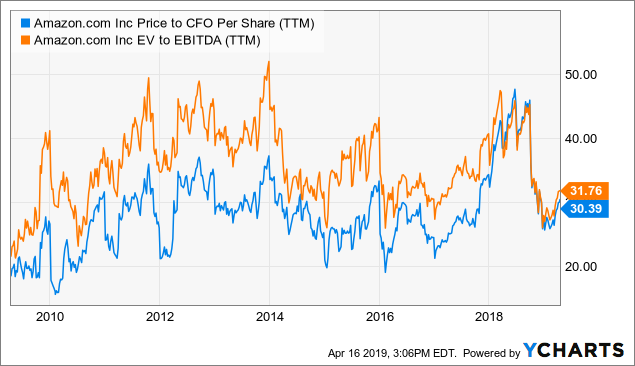
Data by YCharts
Amazon stock is comparatively expensive versus the average stock in the market, but valuation metrics need to be analyzed in their due context, and companies with superior growth rates, obviously, deserve higher valuation levels.
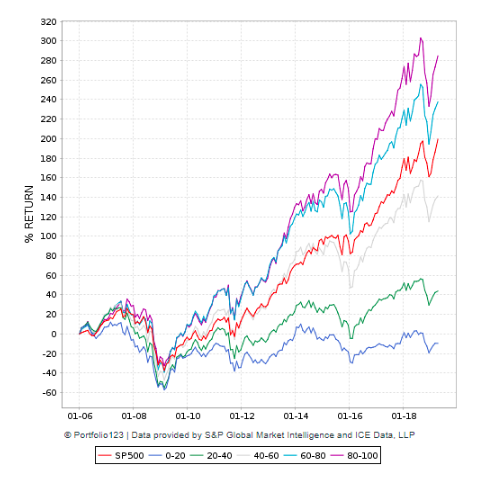
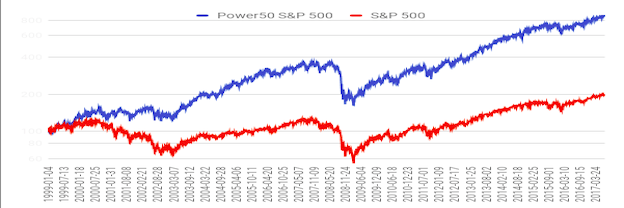
The PowerFactors system is a quantitative investing system available to members in "The Data Driven Investor." This system basically ranks companies in a particular universe according to quantitative return drivers such as financial quality, valuation, fundamental momentum, and relative strength.
Data from S&P Global via Portfolio123
Amazon is the top segment, with a PowerFactors ranking of 88.7. According to the backtesting data, this should mean that Amazon is well positioned for attractive returns from a numerical perspective.
The numbers alone don't tell the whole story, of course. The quantitative system shows that a group of companies with strong numerical attributes tend to outperform the market over the long term. However, this does not really tell us much about what kind of performance a particular company will deliver in a specific year.
However, the main point is that Amazon stock is not overvalued at all when the valuation ratios are analyzed in combination with other quantitative metrics.
The Regulatory Risk
Amazon has received plenty of criticism from politicians on all sides of the political spectrum, ranging from Bernie Sanders to Donald Trump. In fact, Elizabeth Warren has recently released an aggressive plan to break up Amazon and other big tech players such as Google (GOOG) (GOOGL) and Facebook (FB). Regulatory risk is arguably one of the main risk factors affecting Amazon, and it will probably keep weighing on the stock as the political debate heats up in the coming months.
However, there is one big difference to consider in terms of comparing Amazon versus the old monopolies in areas such as oil production. As opposed to leveraging on its market dominance to increase prices and profitability, Amazon is aggressively benefitting consumers by using its competitive strength to cut prices.
In fact, one of the first things that Amazon did after buying Whole Foods is cutting prices, and the company has recently announced its third round of price cuts since buying Whole Foods in August of 2017. Amazon's dominance is actually benefitting consumers as opposed to hurting them, and this makes all the difference in the world from a regulatory perspective.
Amazon has produced considerable damage to brick-and-mortar retailers in different categories over the years. But the company has also allowed third-party sellers to thrive on its platform. Bezos highlighted in the most recent letter to investors how third-party sales have increased from 3% of total revenue in 2009 to 58% in the most recent quarter.
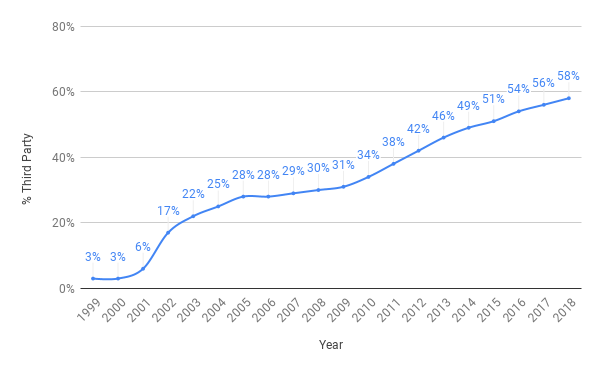
Data Source: Amazon Letter To Investors 2018
In Bezos' own words:
Third-party sales have grown from 3% of the total to 58%. To put it bluntly: Third-party sellers are kicking our first party butt. Badly.
And it's a high bar too because our first-party business has grown dramatically over that period, from $1.6 billion in 1999 to $117 billion this past year. The compound annual growth rate for our first-party business in that time period is 25%. But in that same time, third-party sales have grown from $0.1 billion to $160 billion - a compound annual growth rate of 52%.
Amazon's market leadership is clearly benefitting consumers. The company is hurting some competitors, but it is also allowing other small companies to grow and thrive on its platform. At the end of the day, this is what competitive capitalism is all about.
All things considered, Amazon has some strong points on its side when it comes to fending off regulatory pressure.
What Is Your Edge When It Comes To Amazon?
When it comes to such a widely followed company, investors need to ask themselves what kind of edge they could have in terms of evaluating the stock.
In theory, if the stock is being closely watched by the press and by Wall Street research firms, we should expect all of the relevant information to be already incorporated in the stock price, so there should be no edge available in Amazon stock right now.
However, this theory does not translate very well into real life since big and massively watched stocks have many times delivered exceptional returns over the years. In fact, Amazon itself has produced market-beating returns in the past decade while also being one of the most followed stocks in the market.
Everyone is watching Amazon, but not everyone is focused on the same drivers. Looking at the same business but seeing different things and managing the position with a longer time horizon can make all the difference in the world in terms of performance.
The main edge for investors in Amazon is behavioral: As opposed to trying to figure out if the company will deliver earnings numbers above or below expectations in the next quarter, focusing on the big picture and the whole investment thesis over 5 years or more.
As long as the main thesis remains intact, holding on to Amazon stock for the long term and capitalizing on any opportunities to buy at discounted prices could be a simple and effective strategy to consider.
Statistical research has proven that stocks and ETFs showing certain quantitative attributes tend to outperform the market over the long term. A subscription to The Data Driven Investor provides you access to profitable screeners and live portfolios based on these effective and time-proven return drivers. Forget about opinions and speculation, investing decisions based on cold hard quantitative data can provide you superior returns with lower risk.



Comments
Log in or sign up to join the conversation.