A simple model of retail assumes that more customer traffic equals more revenue. Home Depot’s second quarter shows why that model can break down. Comparable customer transactions fell 1.0%, but the average ticket rose 2.8% and total sales still increased 5.7%. The important catch is that homeowners are not rushing into massive renovations. Management said demand was broad based because customers continued to engage in smaller projects, while high mortgage rates and weak housing turnover are still holding back the large discretionary jobs. Home Depot is finding enough repair, maintenance and professional demand to keep growing, but the report does not prove that the locked in homeowner is spending freely.
|
The Locked In Homeowner Trade |
|
 |
Verdict: The core home improvement trade is intact, but the reason is different than the headline ticket growth suggests. Customers are completing fewer transactions, while repair, maintenance and smaller project demand remains broad enough to lift comparable sales. The professional market is adding another layer of growth, but high mortgage rates are still delaying the large renovations that would signal a full housing recovery.
|
The Home Depot reported second quarter revenue of $47.86 billion, beating estimates as sales increased 5.7% year over year. Comparable sales rose 1.7%, including a 1.3% increase in the US, while adjusted earnings per share of $4.92 also beat expectations. Comparable average ticket size rose 2.8% to $92.50, but management said the broad based demand came as customers continued to engage in smaller projects rather than a return of massive renovations.
|
Comparable customer transactions fell 1.0% for the quarter, but comparable sales still rose 1.7%. The difference between total sales growth and comparable sales growth shows that acquisitions and newer locations are contributing to the top line, while the existing base is still growing modestly. Home Depot is leaning further into the professional contractor market through SRS and its GMS business, but the quarter was not simply an acquisition driven rescue of collapsing retail demand. |
|
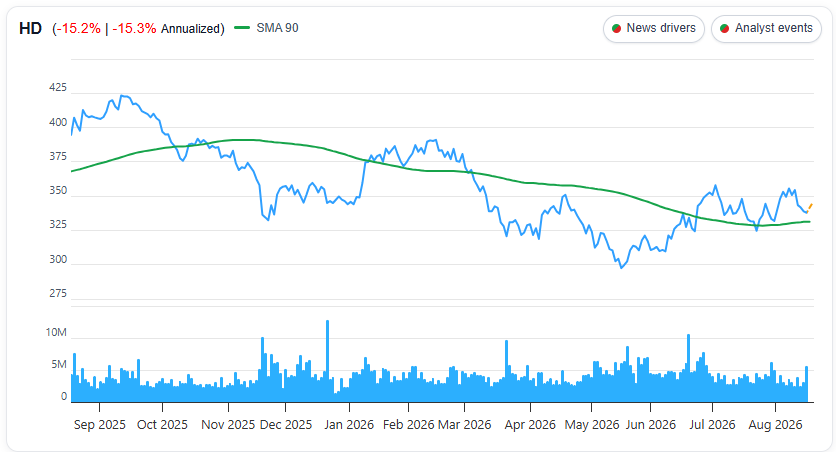 |
Home Depot (HD) 1 Year Chart
|
Retail growth usually benefits from healthy transaction volumes, but a retailer can still grow when ticket size, pricing, project mix and acquired businesses offset weaker transactions. Home Depot is doing that through positive comparable sales, a broader professional platform and steady smaller project demand. The concern is not that management is manufacturing growth from nothing. It is that the quality of growth is harder to judge when core transactions are falling and acquisitions are lifting the top line.
|
What changed in the thesis
|
The professional contractor pivot is becoming more important, but it is not the only engine keeping the thesis alive. Home Depot still reported positive comparable sales, and management described demand as broad based. The Pro platform gives the company another route to grow and cross sell trade credit, delivery and a wider product assortment, but the real test is whether those acquisitions can create organic growth without permanently weakening margins.
|
What the market may be missing
|
The cost of this inorganic growth is changing the financial profile, but the balance sheet is not moving in only one direction. Operating margin edged down to 14.3% from 14.5%, while adjusted operating margin slipped to 14.7% from 14.8%. At the same time, Home Depot repaid $3.0 billion of long term debt during the first half and kept share repurchases paused, a policy that has been in place since March 2024, as it works to reduce outstanding debt. That is a real trade off for shareholders, but it is better described as deliberate deleveraging than a balance sheet being overwhelmed.
|
Valuation and expectations
|
With buybacks still paused, earnings per share growth has to come from the business rather than a shrinking share count. At the recent share price, the stock trades at roughly 22 to 23 times management’s fiscal 2026 adjusted earnings guidance. That valuation assumes Home Depot can protect margins, integrate the Pro acquisitions and eventually benefit from a healthier housing market. The risk is that acquired growth masks a core retail recovery that remains slower than investors expect. |
|
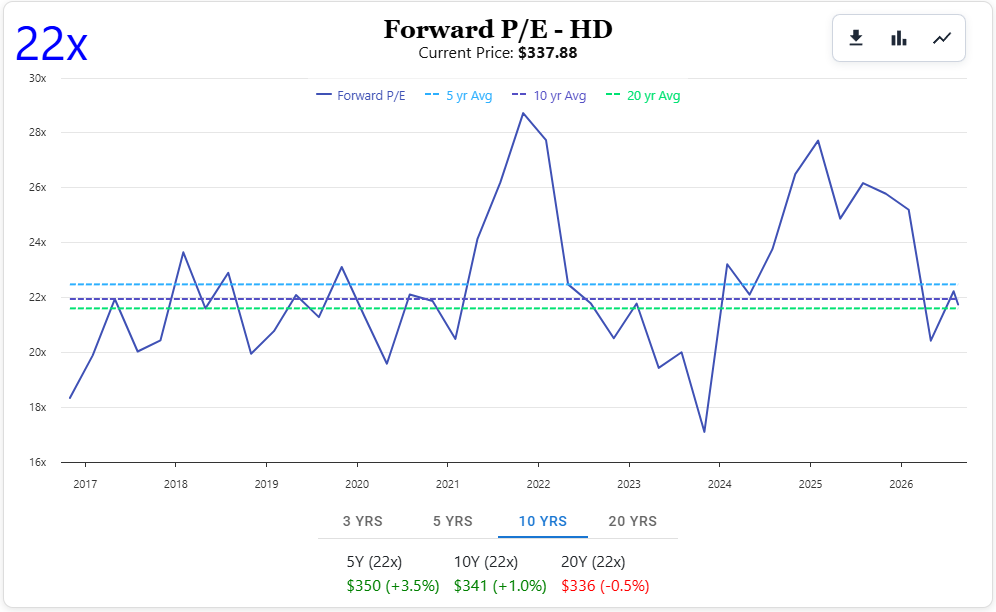 |
Home Depot (HD) Forward PE Ratio
|
The strategy makes sense because the professional market gives Home Depot another route to grow while housing turnover remains weak. But the company is not turning into a wholesale distributor overnight, and the quarter does not show homeowners rushing into massive renovations. It shows a retailer benefiting from steady repair and maintenance demand, modest ticket growth and a broader Pro distribution platform. For long term investors, the real question is whether those pieces can produce durable organic growth without giving up too much margin or keeping buybacks paused longer than expected.
|
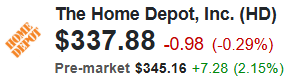
The average US 30 year fixed mortgage rate was 6.67% in Freddie Mac’s latest weekly survey. That remains high enough to discourage home moves and keep housing turnover subdued, but the current Home Depot report points more clearly to repair and maintenance demand than a wave of heavy renovations. Shares of Home Depot traded near a premium multiple of roughly 23 times forward earnings leading into the morning report.
Why it matters this morning
|
The lock in effect of high borrowing costs creates a strange dynamic for the retail sector. It keeps many homeowners in place and supports steady repair and maintenance demand, but it also delays the large discretionary projects that usually follow a home purchase or a more confident consumer. That gives Home Depot a floor under smaller project spending, not an automatic boom in major renovations.
|
The direct competitor reports second quarter earnings on August 19. Because Lowe's recently spent billions acquiring wholesale interior suppliers like Foundation Building Materials, its results will show whether the entire sector is relying on these inorganic professional acquisitions to offset shrinking casual retail traffic.
|
Tractor Supply Company (TSCO)
|
The rural lifestyle retailer recently cut its full year sales growth guidance to a range of 2.5% to 3.5% and now expects comparable store sales to range from down 1% to flat. Second quarter net sales still rose 2.3% because of new store openings, while comparable transactions fell 1.7% and comparable sales declined 1.5%. That makes Tractor Supply a useful warning about weak discretionary demand, but not a clean example of a retailer that relies entirely on foot traffic.
|
Customer transactions remain soft across several retailers, but the pressure is not identical across the board. Home Depot is getting support from smaller projects and its Pro platform, while Tractor Supply is leaning on new stores and needs based categories as discretionary demand weakens. The broader lesson is that reported sales growth can look healthier than customer transaction trends, so investors need to separate organic demand from acquisitions and store expansion.
|
Lowe's earnings results on August 19 to see if casual retail transaction volumes are deteriorating faster than expected. Home Depot third quarter comparable average ticket size, as any drop from the current $92.50 level would signal the renovation cycle is cracking. The pace of corporate debt paydown, tracking progress toward the target leverage ratio that will allow share buybacks to resume.
The ultimate test is whether homeowners can keep funding repair and maintenance projects if the labor market weakens. Until then, high mortgage rates are keeping housing turnover subdued and supporting some stay in place spending, but they are also delaying the large renovations that would normally drive a stronger recovery. Home Depot has a durable business, but mortgage rates are a mixed force, not an iron clad moat. |
|





Comments
Log in or sign up to join the conversation.