TSMC: Strong Earnings, Costly Growth

TSMC reported a 41.2% Q3 revenue jump, but shares slipped as expansion costs for 2nm chips squeezed margins.

Source: DepositPhotos

A lower gross margin still met management's forecast

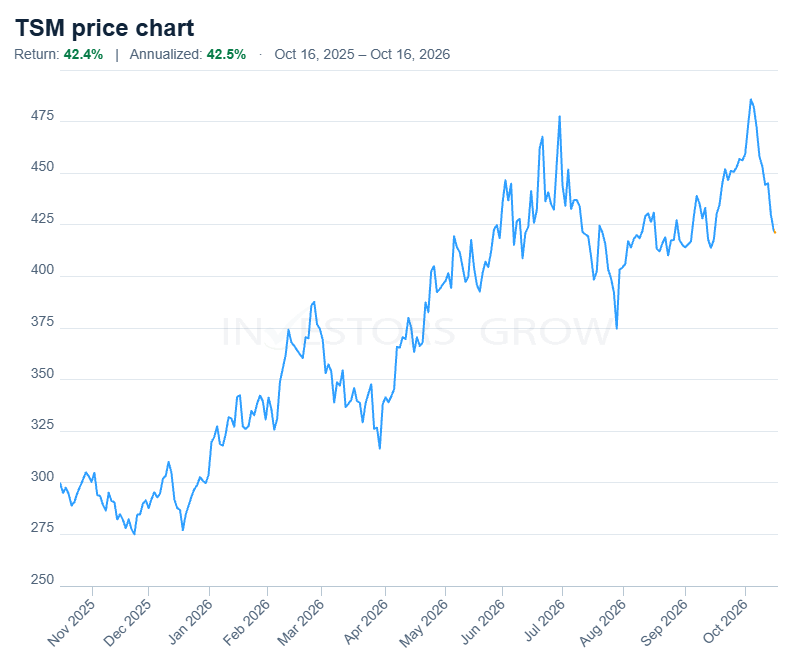
Taiwan Semiconductor Manufacturing Company, better known as TSMC, reported third quarter revenue of $46.72 billion on Thursday, up 41.2% from a year earlier in U.S. dollar terms. Revenue exceeded management's forecast, yet its U.S. listed shares (TSM) closed down 1.80% at $422.25.

A strong quarter doesn't settle what future growth will earn. TSMC is expanding advanced chip production, which brings startup costs and more expensive overseas factories. The question is whether the profits and cash from that expansion will justify the bill.

The PHLX Semiconductor Index also fell Thursday, down 0.88%. TSM's decline came alongside broader semiconductor weakness, but the available evidence does not establish how much of the move reflected industry conditions versus concerns specific to TSMC.

TSM is the company's NYSE listed American depositary share, representing ownership in the Taiwanese company. All share and index moves here refer to Thursday's completed U.S. regular session. Dollar figures are in U.S. dollars unless otherwise noted.

TSMC (TSM) one-year price chart, October 16, 2025 to October 16, 2026, with a blue price line and a short orange endpoint.

A lower margin is different from a missed target

Gross margin is the share of revenue left after production costs. TSMC's gross margin fell to 66.4% from 67.7% in the preceding quarter. Its results and guidance comparison shows that the result was still inside management's forecast range of 65% to 67%.

Revenue exceeded the $44.6 billion to $45.8 billion forecast range. Operating margin, which also accounts for expenses such as research and administration, reached 58.7%, above the projected 56% to 58%. These are comparisons with management's guidance, not analyst consensus.

A company can also keep a smaller percentage of sales and earn more profit if sales grow enough. That happened here. Operating profit increased 14.3% from the preceding quarter, measured in New Taiwan dollars, even as operating margin declined.

TSMC delivered more sales and profit while absorbing pressure on its profit rate. Investors can question where margins go from here, but calling this a miss against management's gross margin guidance would confuse a decline from the previous quarter with a failure to meet the forecast.

New chip technology comes with a learning curve

TSMC is a foundry: customers bring chip designs, and TSMC manufactures them. Its factories, called fabs, make chips on wafers, discs on which many chips are produced together. Demand for more powerful computing reaches TSMC through customers' manufacturing orders.

Management attributed the decline in gross margin from the preceding quarter primarily to the initial expansion of N2, its 2 nanometer manufacturing technology. N2 accounted for 8% of wafer revenue in the third quarter, up from 3% in the second quarter.

Getting a new process into production is only part of the job. Yield measures the proportion of manufactured chips that work, while utilization measures how fully factory capacity is being used. Better yields and fuller factories can spread costs across more usable output. A new technology can strengthen TSMC's competitive position before it produces its best margins.

Overseas factories add a separate cost pressure. Management says their costs remain higher and expects them, along with the N2 expansion, to weigh on fourth quarter margins. Productivity improvements and adjustments to how capacity is used are expected to offset part of that pressure.

That leaves two different questions: how much will costs improve as N2 production matures, and how much will remain higher because of where TSMC manufactures? Sales growth alone cannot answer either one.

The factories have to earn back their cost

Management reiterated its 2026 capital spending budget of $60 billion to $64 billion. It also expects spending over 2026 through 2028 to be significantly higher than over the preceding three years, without giving precise budgets for the later years.

Capital spending pays for assets such as factories and equipment. Our July discussion of TSMC's factory spending explains the timing gap: cash goes out before the full cost appears in earnings, where much of it is spread over time through depreciation. That helps explain why rising profits can still leave a business with a heavy demand for cash.

If customers need the additional chips and TSMC can manufacture them efficiently, the new factories could generate attractive returns. The risk is committing the money before demand is secure enough to support those returns.

An analyst explored that risk on the call, asking about power availability, financing and other components needed for AI infrastructure. Management said its planning includes checks on data center construction and power supply. Delays in those areas could postpone customer deployments and eventually affect chip orders.

TSMC's manufacturing capacity is one part of a larger system. Customers also need the funding, power and equipment to put those chips to work.

What would show the spending is paying off?

TSMC's fourth quarter outlook calls for revenue of $52.3 billion to $54.3 billion and gross margin of 65% to 67%. Management expects another expansion in sales while allowing for continued costs from the manufacturing buildout.

Results within those ranges would be one useful checkpoint. More efficient N2 production and stronger cash generation after capital spending would provide further evidence that the investment is paying off. Sales falling short of guidance or persistent production inefficiencies would weaken that case.

For someone considering the shares, the question goes beyond how many chips TSMC can sell. It is how much cash the business can generate after paying for growth, and whether that return justifies the price paid for the stock.

STOCKS IN THIS ARTICLE

Comments