

Business Investment “depends on the prospective yield of capital, and not merely on its current yield” - John Maynard Keynes
One of the many puzzles of the recovery since the 2008 crisis has been the corporate sector’s reluctance to add to a nation’s capital stock. Investment in new plant and equipment along with the construction of new productive facilities has lagged behind the experience of previous recoveries. Throughout the industrialized world, the rate of growth in fixed capital investment has been dismissal, resulting in below average rates of growth in national income. Hence, the general malaise we experience today.
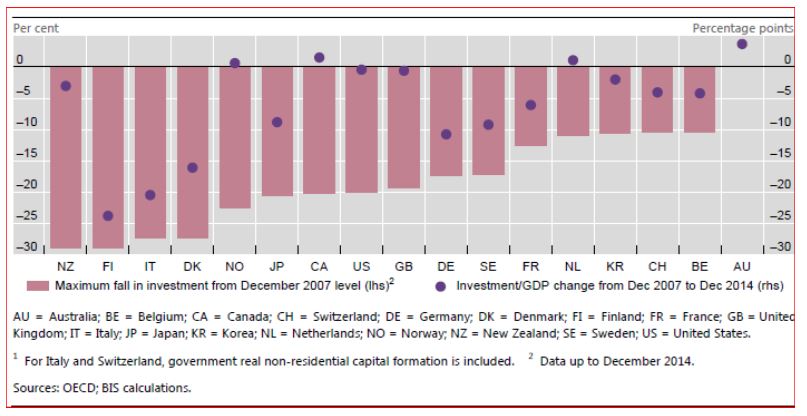
The accompanying Chart 1 measures the maximum fall in investment activity since 2007 as well as the decline in ratio of investment to growth in GDP in the industrialized world. The fall off in investment has been quite dramatic, especially in Japan, the US, and in Western Europe.
Chart 1 The Decline of Business Investment, Selected Countries , since 2007
(Click on image to enlarge)
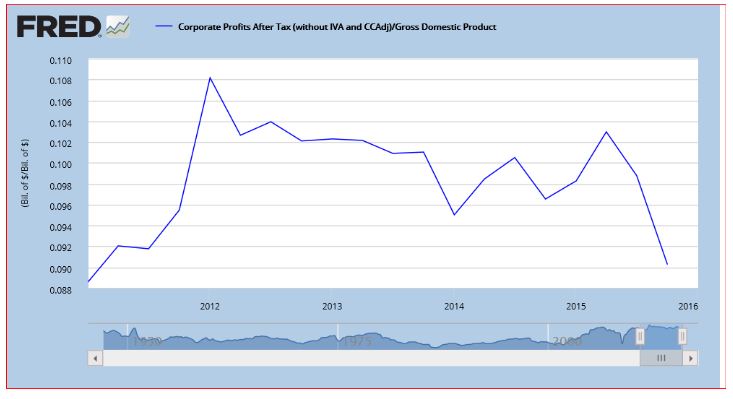
Now, we are entering a period in which profit growth has not only slowed, but appears to be on the decline. As Chart 2 reveals US corporate profitability as a percent of GDP has slumped from 11% to 9% in less than five years. Forecasts for the 2016-17 anticipate a weak profit performance in response to the worldwide slowdown. To the extent that profits motivate corporations to expand their facilities, the absence of this important ingredient only adds to our concern for the future.
Chart 2 The Decline of Profits as a Percent of GDP, United States
(Click on image to enlarge)
Why Are We Puzzled?
This dramatic weakness in capital formation is worrisome given all the factors that one would expect would generate a flourish of new investment such as:
-
Unprecedented monetary stimuli in the form of zero interest rates and central banks’ purchases of domestic bonds( QEs);
-
A narrowing of corporate bond spreads, providing cheap credit for expansion;
-
Record levels of retained earnings and dividends ; both items provide businesses with the wherewithal to self-finance expansion;
-
Record levels of profit margins, again providing the corporate sector with ample encouragement to expand facilities and reach for new markets domestically and internationally.
-
Access to alternative, non- traditional bank lending sources (e.g. private equity) at competitive rates.
Is This Dilemma New?
In the 1930s, John Maynard Keynes challenged the conventional thinking that interest rate changes influenced the entrepreneurs to investment. He argued that investment decisions are relatively unresponsive to interest rate movements, particularly at the extreme end of the business cycle. Not unlike today, he maintained that when there is excess productive capacity and when inflation is very subdued that business leaders are likely to be pessimistic about the future outlook. And, by the same token, when business activity is operating at a high level, rising interest rates do not dampen enthusiasm towards economic expansion. Under either conditions, monetary policy is limited .
Keynes emphasized the importance of prospective yields which are based upon expectations of future profits. Using his jargon, the “marginal efficiency of capital” (return on investment) has more to do with what the corporation expects to earn in return for taking risks . The current yields-- i.e. interest rates ---are quite secondary in importance. To be fair to today’s central bankers they have done just about they can do with regard to improving the prospective yields by instituting zero interest rates and other stimulus measures----yet investment remains too low to provide support for economic growth.
Theories on Why Investment Has Fallen
One explanation for the lack of investment lies in the camp that believes that the industrialized world is experiencing “secular stagnation”. Larry Summers, former US Secretary of Treasury, puts several reasons in support of secular stagnation, such as:
-
A worldwide savings glut , i.e. insufficient consumption ;
-
Too much savings pulls down real interest rates, resulting in a financial bubble and a misallocation of resources ( e.g. the pre-2008 housing bubble in the US);
-
Demographic shifts reducing the labour force growth; and,
-
Government austerity policies that have a negative impact on growth.
A second explanation is advanced by Paul Krugman who argues that there exists a Keynesian `liquidity trap` in today`s financial markets . Simply, borrowers are not interested in expanding, regardless of how low rates fall, even when real interest rates are negative as is the case in many countries today. And, finally, a third explanation for the lack of investment is that proposed by Kenneth Rogoff who argues that debt levels at the corporate and national levels are at such high ratios-to-GDP that there is no appetite ( by lenders or borrowers ) to assume further debt in the interest of expansion.
A recent report by McKinsey Global Institute makes a very bold assertion when it “projects that the global corporate-profit pool, which currently stands at almost 10 percent of world GDP, could shrink to less than 8 percent by 2025---undoing in a single decade nearly all of the corporate gains achieved relative to the world economy during the past 30 years”(1)
Summing up, as these theories suggest there are large forces operating to holdback investment growth. Some of which can be addressed by policy changes (e.g. step up government spending) and others that are immune to conventional policy changes ( e.g. demographic shifts). In the meantime why waiting for shifts in macroeconomic policy to take hold, we can expect continued weakness in capital formation and hence in overall economic growth.
-
McKinsey Global Institute, Playing to win: The new global competition for corporate profits, 2015.


Comments
Log in or sign up to join the conversation.