

Chinese growth rebounded in the second quarter exceeding our expectations considerably but we still think it is unstainable. Even though exports have improved, there are still challenges from geopolitics and the floods. Nonetheless, we have revised our growth forecasts upwards for 2H20 and the full year 2020.

Big questions on GDP growth with slow stimulus progress
China is recovering from damages of Covid-19, but the details below show that GDP growth of 3.2% year on year in 2Q20 may not be sustainable despite the improvements in foreign demand and infrastructure investments. However, we expect better growth numbers than our previous forecasts.
GDP growth at 3.2% YoY in 2Q20 after a -6.8% YoY contraction in 1Q20 looks very good - and this is a lot better than our expectations of -3.1% YoY.
But we doubt that the main sources of growth were just inventories and net exports - which were brought lower because of slow import growth, and this is unsustainable as we expect imports to grow faster in 3Q with improving domestic demand. We don't have the breakdown of GDP growth by components, so our guess is that some industrial production output which had not been used by infrastructure projects has been placed into the inventories category.
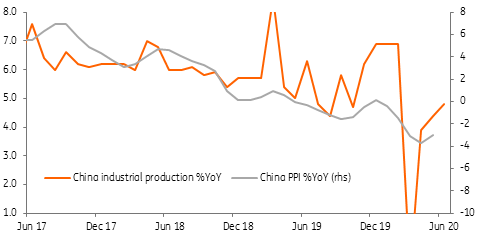
Industrial production grew 4.4% YoY in 2Q20, and most of the growth came from raw materials, technology components, and energy production. Some of these were used for exports. But we expect that some raw materials also went to inventories as infrastructure projects have progressed slowly in 2Q20 in general. This matches the negative year on year growth of the producer price index. If manufacturing was doing well in 2Q20, PPI should be rising.
Net export growth was faster at 8.8% in 2Q20 than a year ago due to the smaller growth in exports and imports. Foreign demand seems to have rebounded as shown in the June data, and hopefully, this would form a recovery path for 2H20. This could help not only exporters but also manufacturers producing export goods, and therefore migrant workers’ unemployment rate should come down. We previously estimate a 10% overall unemployment rate from April to May, including migrant workers, which has now come down to 8% in June due to more export orders for factories.
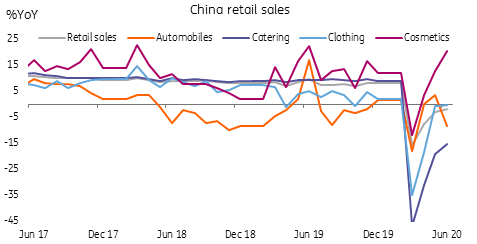
Retail sales contracted by 3.9% YoY in 2Q20. Consumption has not picked up on a yearly basis despite the relaxation of social distancing measures. This shows how cautious consumers and this continues to impact the hospitality sector. Spending on automobiles dropped on a yearly basis, which could be a result that the one-off demand for cars to avoid taking public transports has been fulfilled after a few months’ pick up in automobile sales.
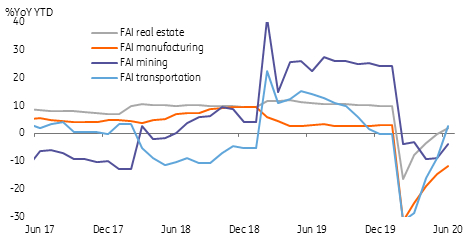
Fixed asset investments contracted by 3.1% YoY YTD in June, which was a smaller contraction in June compared to May. Fiscal and monetary stimulus' impact on investments was small in 2Q20 due to the slow kick-off of transportation infrastructure projects but investments in R&D in advanced technology have started. The faster growth of investments from May to June could be due to more infrastructure projects being kicked off after the Two Session meetings held in May.
Chinese industrial production rebounds but PPI continues to be negative
Source: National Bureau of Statistics of PRC, ING
China retail sales were dismal but should improve with exports
Source: National Bureau of Statistics of PRC, ING
China infrastructure investments speed up in June
Source: National Bureau of Statistics of PRC, ING
The three main challenges ahead
Even though the economy is recovering, there are more challenges for China in the second half of 2020.
- The biggest risk is the technology war, not just with the US but also with the rest of the world. China has started to put a lot of money on R&D in advanced technology to achieve self-reliance on the most advanced semiconductor chips but that will take time to yield results.
- The most imminent risk domestically comes from the widespread floods. So far the government has been able to reduce death tolls through early warnings to local communities. But food prices have increased, but that will not change the People's Bank of China’s stance on monetary policy as this is a one-off event. The floods are so wide-spread that some infrastructure projects will be delayed as most of the projects are related to construction activities. As such, investments in July and even August will be affected by the floods.
- The chance of another round of trade war could be on the rise, as the US uses Hong Kong to punish Mainland China. Though China continues to import agricultural products from the US, the growth of imports from Brazil was 34% MoM, higher than the 11% MoM imports from the US, which signals China continues to diversify sources of agricultural imports in case political tension with the US increases.
GDP forecast for 2H20 revised upwards
For 3Q20, we revise our GDP forecast to +0.5% YoY and 5.0% YoY in 4Q20 from our previous forecasts of -0.5% YoY and +4.5% YoY, respectively. Our full-year 2020 forecast is revised upwards to 0.48% and the revision comes from:
- Better foreign demand from countries coming out of Covid-19 lockdowns
- Faster implementation of infrastructure investment projects
- Better job market situation in the manufacturing sector when foreign demand improves
The risk of this forecast is that it relies on improvements in major economies, but if that doesn't happen, then China's GDP growth will also be undermined.



Comments
Log in or sign up to join the conversation.