

For those of us in London, the turmoil in France's bond market feels uncomfortably familiar. It's a reminder of Britain's own experience almost exactly four years ago, when the 2022 mini-budget crisis illustrated what can happen when fiscal missteps collide with an already febrile global bond market.
The comparison is compelling, if not complete. Then, as now, central banks were tightening into an energy crisis. Fed Chair Kevin Warsh's hawkish bombardment at Jackson Hole last month was not so different from the speech delivered by Jerome Powell in 2022 – both adding even more pressure to bond markets. And crucially, back then, the Bank of England was forced to step in and buy gilts. Similar questions are now being asked of the ECB and its Transmission Protection Instrument.
The only comfort is that global financial conditions are less tight, and France isn’t facing the equivalent of the LDI pension crisis that amplified Britain’s problems in 2022.
Is this France's 'UK mini budget' moment?
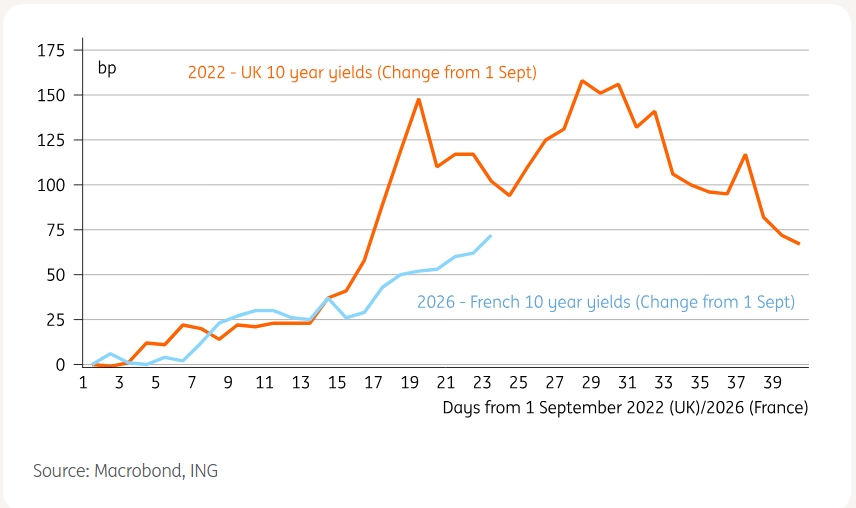
Britain’s plight back then is a cautionary tale; our bond experts think the situation could easily get worse. As my colleague Charlotte puts it: “Markets need a reason to turn more positive on France, and for now there is none."
What’s striking about that is that the same can’t currently be said of the UK.
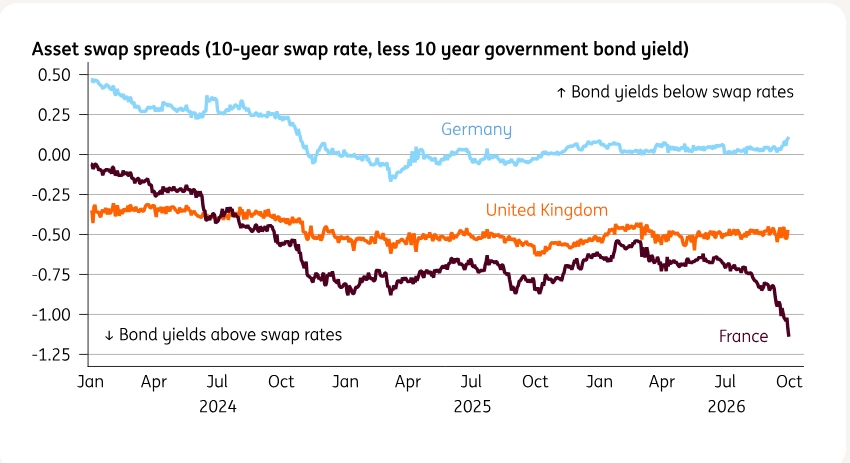
Yes, UK yields are higher than France’s. Thirty-year borrowing costs briefly hit 6% this week, making Britain the first G7 economy to reach that level since the euro crisis. But look instead at the spread between the 10-year gilt yield and the equivalent swap rate. That shows the portion of borrowing costs that cannot be explained by central bank expectations. And on this measure, the UK has been remarkably well-behaved this year despite considerable political upheaval. French bonds have not.
The gap between 10-year yields and swap rates has dramatically widened in France
Paris has no good options. Spending cuts are politically unpalatable and the tax burden is already among Europe's highest. In a fragmented parliament, consensus for tough decisions is lacking. So far, higher debt interest costs do not appear to be changing that calculation.
On each of those points, Britain currently looks different.
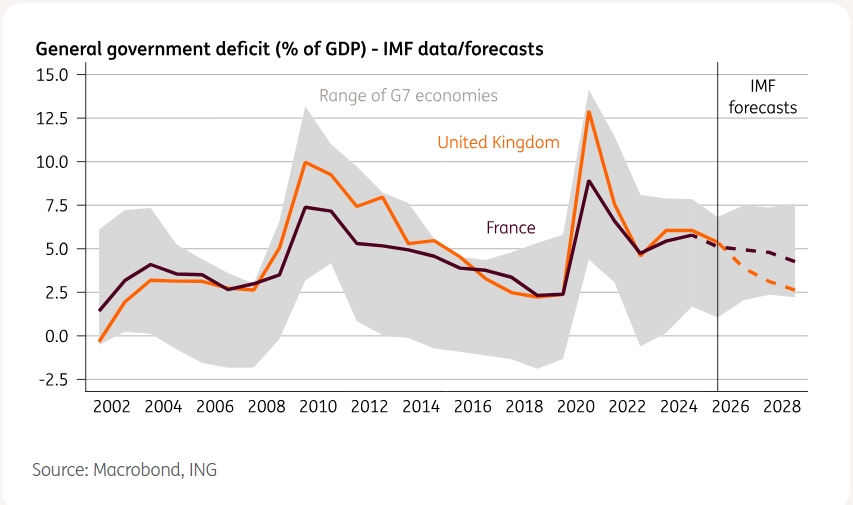
France is battling to stop its deficit exceeding 6% of GDP next year, up from a projected 5.4% this year. The UK deficit, by contrast, is set to fall to around 4% this year despite the Iran war and bond-market pressure. It is the only G7 economy undertaking genuine fiscal tightening right now. The ongoing freeze in tax thresholds is pushing tax-to-GDP higher.
That will not be enough given mounting pressure on the public purse. But unlike France, the UK has options, even if they aren't particularly appealing. Comparable OECD data shows tax-to-GDP stood at 43.5% in France in 2024, compared with 34.4% in Britain. And whisper it, but UK workers on an average salary enjoy among Europe's lowest tax rates, once employer social security is included.
Having options is one thing. Having the political will to use them is another. Yet unlike France, Britain's ruling Labour Party enjoys a huge parliamentary majority. And crucially, Burnham appears willing to risk a fight.
The most consequential moment at this week's party conference was his pledge to water down the infamous pensions triple lock. Without getting bogged down in details, it’s a move that’s neither popular nor particularly cash-generating, which makes it all the more eye-catching. In time, will this boldness extend to thorny issues like welfare spending or personal taxation? That's the question investors are now asking.
The UK's deficit is edging lower, faster than France
That all said, the bond selloff is still a major headache for the UK. Yes, it has a longer weighted-average debt maturity than most, slowing the pass-through of higher yields to interest costs. But it also has an embarrassingly large pile of inflation-linked debt. In this environment, that is no good thing.
Still, Britain has two things that France appears to lack. The first is a fiscal rule that effectively mandates spending cuts or tax rises when higher debt interest threatens to breach it. The second is a political class still deeply scarred by the crisis four years ago. Nobody wants the same fate as Liz Truss – and that’s why, despite his bold policy platform, Burnham appears reluctant to rewrite the fiscal rulebook.
The mortgage market reinforces that discipline. British homeowners typically fix for two to five years, while French borrowers often fix for well over a decade. UK households therefore feel higher rates much faster – and Truss took much of the blame for higher mortgage rates in 2022. The Conservatives paid the price at the election two years later.
That will have an important bearing on the October budget. At a time when the government has little control over what’s driving yields higher, the chancellor looks reticent to add fuel to the fire – not least with the Bank of England edging closer towards a November rate hike.
The final difference is elections. France goes to the polls next spring to choose its next president, with parliamentary elections possibly set to follow. Britain, by contrast, does not vote until 2029. Or does it?
After Burnham's speech this week, it is getting harder to see how he doesn’t go to the polls well before then – and quite possibly next year. A gamble? No doubt. But otherwise it is hard to square his bold ambition on everything from social care to the water industry with a very restrained October Budget.
I doubt an election would be received well by markets – not least because, with a fresh mandate for significant change, higher borrowing and looser fiscal rules would only get more tempting. And after all, Britain faces many of the same challenges as France and the rest of Europe – defence, ageing and populism to name just three.
It reinforces a point I’ve been making for some time: short-term, the UK’s public finance story is genuinely looking comparatively better. But longer-term, there are plenty of reasons for investors to be cautious.
After all, France is a painful reminder of what happens when markets start to seriously question if governments can make difficult choices.
James Smith
THINK Ahead in developed markets
United States (James Knightley)
ISM Services PMI/Consumer Confidence (Mon/Fri): Interest rate hike expectations for the October FOMC meeting have fluctuated wildly over the past week in response to jobs and inflation data and some dovish-leaning comments from senior Fed officials. Right now, the market believes the most likely outcome is a pause at the October FOMC meeting, followed by a December hike, and we share that view. Market pricing should be somewhat rangebound over the coming week, given the economic release schedule, with the ISM services index and the University of Michigan consumer confidence index as the highlights. These two surveys are polar opposites. Consumer sentiment is at all-time lows while the ISM index suggests the service sector is booming, and this makes policymaking very challenging. Slow and steady is likely to be the Fed's mantra.
Canada (James Knightley)
Jobs Report (Fri): The Canadian jobs report should show a partial rebound which will probably keep markets anticipating a December rate hike. The Bank of Canada policy rate is relatively low at 2.25%, and Canada has not suffered the same sort of surge in government borrowing costs that other economies have faced, while the Canadian dollar has weakened throughout September. As such, there is scope for modest policy tightening in the coming months.
Key events in developed markets
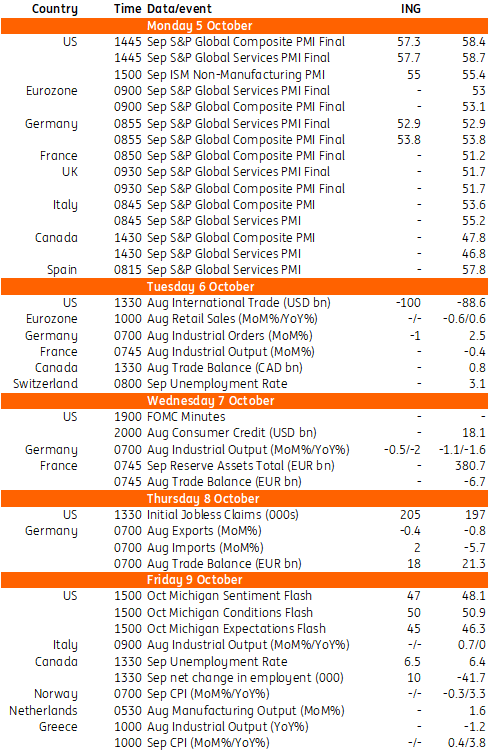
Source: Refinitiv, ING


Comments
Log in or sign up to join the conversation.