

Let us face it: central bankers are not reliable economic forecasters. Prior to the global financial crisis, central bankers tended to underestimate growth and have overestimated growth since 2008. Cynics often refer to the latter case as “serial disappointment``, since these forecasts repeatedly call for a strengthening of the global economy and higher inflation rates. The Federal Reserve bases its monetary guidance on the so-called “dot plot” which shows where each member thinks the fed funds rate are head for the next few years. These dots reflect the optimism that monetary policy is on the right path and the economy will return to “normal “.
A recent research paper by the staff of the Bank of Canada examines the reasons behind the failure of central banks to capture the essence of economic growth[1]. To begin with, the report notes that:
“Persistently negative forecast errors over the one-year-ahead horizon can be tied in part to the effects of a succession of one-sided negative shocks, some of which proved over time to be larger and more structural in nature than initially expected. At the same time, the financial crisis has had longer-lasting effects than anticipated.”
Globally, a slowdown in growth and in international trade has weighed heavily on business investment. Austerity policies held growth in check throughout the G20 countries in the early stages of recovery. The euro-area crisis of 2011-13 combined with unexpected monetary policy tightening resulted in large negative forecast errors for the euro area. Growth expectations failed to materialize in some of more important emerging markets, e.g. Brazil (political upheaval). The combined effect of these negative shocks was a reduction in the rate of growth in potential and actual output that continues to persist to this day.
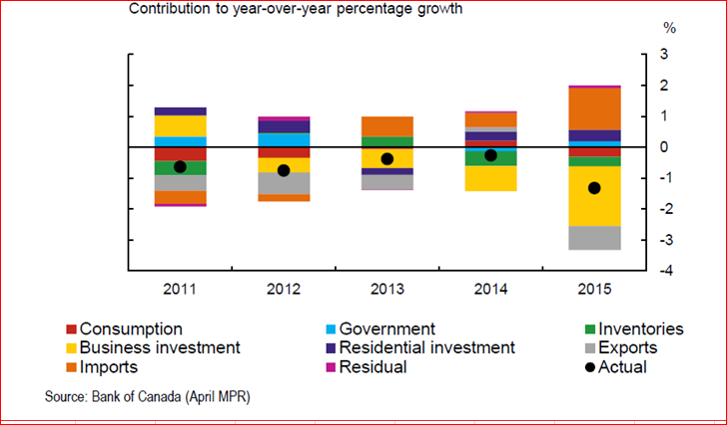
Along with other central banks, the Bank of Canada’s forecasts for Canada have consistently been too optimistic. The two outstanding disappointments were business investment and export growth, especially to the United States (see accompanying chart). The only forecast error on the positive side was the strong growth in housing. The Bank of Canada’s assessment of foreign demand for Canadian exports has been continuously revised down with each new forecast such that average forecast errors for Canadian GDP growth are negative over this period.
Canada growth forecast errors, by component, one year ahead
Notwithstanding its past track record, the Bank of Canada continues to forecast improved economic performance assuming that:
- Labour productivity growth is expected to pick up; weak growth has been a dominate feature for all developed economies;
- Global trade and investment will strengthen; although protectionist sentiment is growing, especially under a Trump administration;
- Non-commodity exports will pick up the slack created by the fall off in oil/gas exports; non-energy exports have beenenduring disappointment; and
- Business investment is expected to improve, although a Bank`s recent survey of investment intentions does not offer much encouragement in this sector.
Canada`s outlook will continue to be fashioned by business investment and export growth. The Trump economic team is rattling its sabres and has targeted NAFTA. Canadians should expect a period of negative surprises in foreign and domestic output growth, making the job of forecasting enough more difficult than heretofore.
[1]“ Justin-Damien Guénette, Nicholas Labelle St-Pierre, Martin Leduc and Lori Rennison, “The Case of Serial Disappointment “ 2016



Comments
Log in or sign up to join the conversation.