

“Flation” remains one of the key debates of the day.
Some expect huge inflation. Others expect stagflation (a rediscovered buzzword) and still others hyperinflation (yes, some still hang their hats on that one), or even deflation.
Meanwhile, the Fed and other economists have a spotlight on inflation expectations (as if they matter, but they really don’t).
Let’s take a look at “flation”, where it shows up, and where it doesn’t.
Perfect Storm?
Gad Levanon, vice president, The Conference Board, emailed me yesterday stating “some of my blogs will be posted on the CNBC website.”
His new blog is “The US Faces a Perfect Economic Storm”
Levanon invited questions.
I had questions. I usually do. First let’s see what the “perfect storm” is all about.
In Search of Supply Constraints
“The main story in the U.S. economy right now is that it is gradually running into supply constraints” said Levanon.
Do these charts represent supply constraint?
Merchant Wholesalers: Inventories to Sales Ratio

Total Business Sales Percent Change From Year Ago

Total Business Sales Detail

Harper Petersen Shipping Index

Supply Constraint or Oversupplied?
Somehow it seems we are massively oversupplied.
Retail sales were dismal (see Retail Sales -0.3%; Autos Down 4th Month, Plunge -2.1%)
Also note that Used Car Inventory Hits Record Level.
For more charts and commentary, please see Inventories and Sales: How Bad Are They? Study in Pictures
Questions and Comments for Levanon
- What about stock market and junk bond market bubbles? I seriously cannot understand the Fed and other economists never taking asset bubbles into consideration.
- Then what happens when those bubbles pop? Recession?
- And what about GDPNow at 0.1% and Auto sales dropping?
- Retail spending looks weak. Manufacturing is in a recession.
- Yep – oil prices going up – so will import prices.
- Exports? In a weakening global economy?
- It will not take much to tip this economy into a recession (assuming we are not already in recession – and I think we are).
- Fed prepared to hike with GDP at 0.1% and falling like a rock?
- Then again – these guys have never seen a recession in advance, and likely never will.
Those were my unanswered comments and questions to Levanon.
Perhaps those questions and comments hint at a “perfect storm” but for different reasons than inflation.
Regardless, there are few if any supply constraints.
Yield Curve

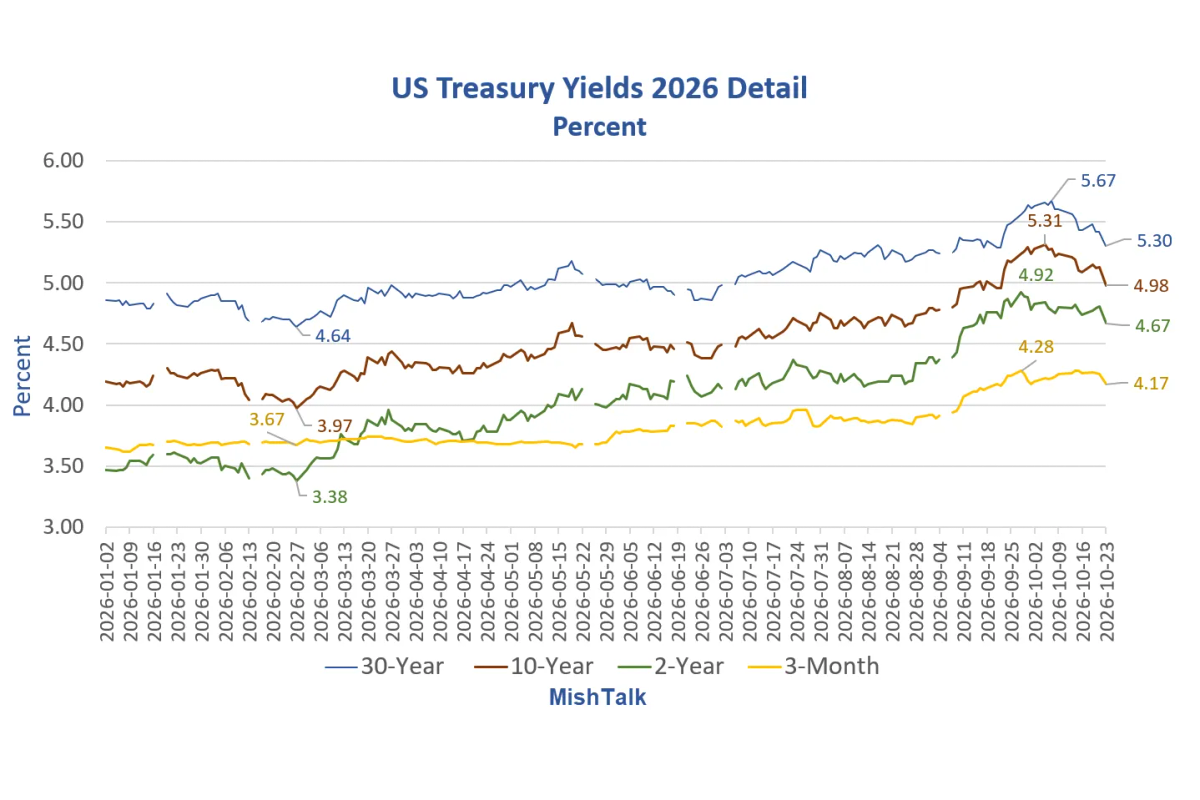
The 30-year long bond is a mere 33 basis points from a record low. The 10-year note is under 30 basis points away from a new low. Meanwhile, the short end of the curve has been rising since 2013 or 1014.
Had rates been higher, an inversion would have been likely.
The US treasury yield curve looks and acts like the concern is recession or deflation, not inflation. Why?
Three Possibilities
- Recession is here or on the horizon
- Central bank manipulations and negative yields make US treasuries attractive at what would otherwise be unattractive rates
- Both of the above
I sympathize with reasons one and three, but not two in isolation.
Price Inflation
For sure, there is decent-sized price inflation in healthcare, education, gasoline since the low earlier this year, housing, and rent.
We also see significant wage inflation in a number of states.
If wages and prices do rise, and the Fed hikes into recession, we have the dreaded stagflation scenario, albeit at much lower levels of concern.
Many promoting a stock market crash believe in hyperinflation.
We can sort this all out in a moment. First, I have a musical tribute.
Whole Lotta Flation Going On
Asset Bubble Inflation/Deflation
The key to where this is all headed depends on the answer to the question “Did the Fed sponsor more asset bubbles?”
If the answer is yes (and I believe it is), then another asset bust is coming up.
Asset bubble busts lead to asset level deflation, falling profits, rising unemployment, and likely falling prices.
Mike “Mish” Shedlock

Comments
Log in or sign up to join the conversation.