

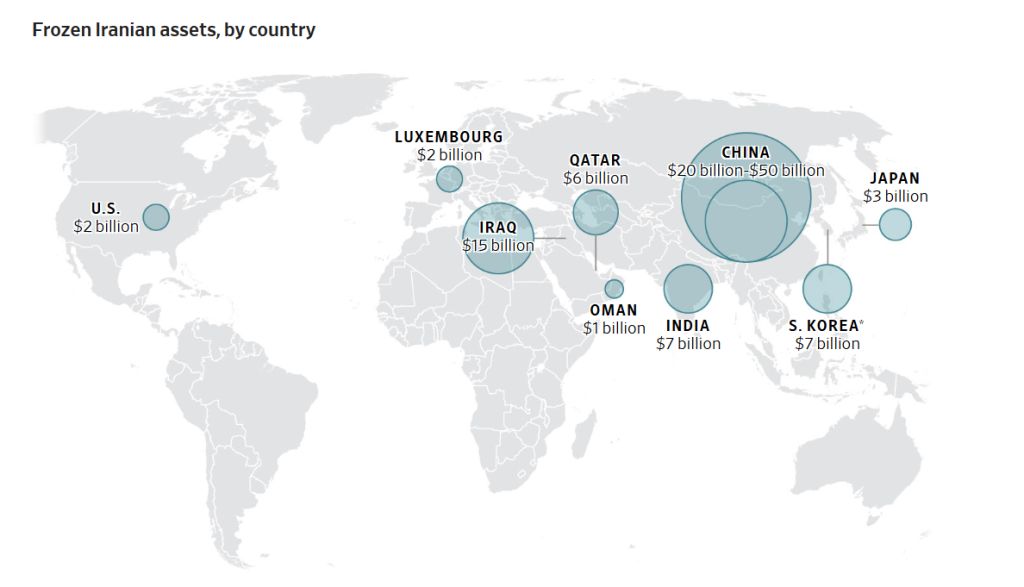
Estimates vary but the biggest chunk is locked up in China.
Frozen Assets
The U.S. blocked several countries from paying for oil purchases, money that Tehran now wants back to permanently end the war.
The Wall Street Journal discusses Where Iran’s Billions of Dollars in Frozen Assets Are Held
Iran is entering negotiations with the Trump administration with an eye on a big prize: tens of billions of dollars locked abroad that could help revive its crisis-hit economy.
Some of the assets have been frozen for nearly as long as the Islamic Republic, which dates to the 1979 revolution, has existed. But the blocked assets are mostly more recent payments for Iran’s oil sales to China, India, South Korea and Japan—money got stuck when President Trump withdrew from the Obama administration’s nuclear accord and reinstated sanctions on Iran in 2018.
Estimates of how much Iranian assets abroad are worth vary, with Tehran saying it is at least $100 billion. Other experts put it much lower. Tehran’s priority is to unblock an initial $24 billion in phases.
Estimates by Country
China: China has long been the biggest buyer of Iranian oil, and estimates of Tehran’s frozen assets there range from $20 billion to $50 billion.
IRAQ: $15 billion. Iraq is a major buyer of electricity and natural gas from Iran, its neighbor, but U.S. restrictions have long prevented Baghdad from paying for the services.
INDIA: $7 billion. Before Trump pulled out of the Obama-era nuclear deal, India was Iran’s second-largest oil buyer. The Trump administration’s sanctions forced Indian banks to withhold payments for the purchases of Iranian crude.
SOUTH KOREA: $7 billion. Like India and China, South Korea was a major oil customer of Iran’s before the first Trump administration imposed sanctions. Much of the $7 billion frozen there was later transferred to Qatar as part of a prisoner exchange with the U.S.
QATAR: $6 billion. The U.S. reversed course after the Oct. 7, 2023, attacks on Israel by Iran-backed Hamas, a U.S.-designated terrorist organization. Washington still hasn’t allowed Qatar to transfer the funds, which were meant to be used only for humanitarian purposes. Current negotiations focus heavily on granting Iran access to these funds.
OTHERS: $8 billion. Iranian assets are also held in Japan, Luxembourg, Oman and even the U.S.
What the Journal Gets Wrong
The U.S. is able to stop countries from paying Iran for oil because almost all global oil deals are transacted in dollars.
That’s complete silliness. Nothing stops Iran from conducting transactions in other currencies.
The article even noted “Iran has been able to tap some of these funds to purchase Chinese machinery and auto spare parts, among other things.”
Iran buying items from China accounts for the wide range of frozen assets in China from $20 billion to $50 billion.
Other than using yuan, it’s difficult for Iran to avoid dollar payment systems. That accounts for frozen assets, not oil priced in dollars.
It’s US sanction threats on other countries that has kept all countries in line except for China.
Vance Tries to Explain $300 Billion to Iran
Understanding the Terminology
Neither Obama nor Trump did/will give US taxpayer money to Iran.
Trump will free up hundred of billions more than Obama counting restoration funds and unfreezing of assets.
Obama vs Trump Numbers
CBS correspondent Ed O’Keefe asked Vance point-blank whether Iran would have access to a $300 BILLION reconstruction fund. Vance’s answer? Essentially yes — “funded by the Gulf Coast coalition so long as they honor their end of the obligation.”
So let’s do the math that the Trump administration desperately doesn’t want you to do. Let’s compare Trump’s Iran deal to the one Republicans spent a DECADE calling the worst deal in American history — Barack Obama’s.
OBAMA’S IRAN DEAL:
$1.7 billion in unfrozen Iranian assets
In exchange for a 98% reduction in Iran’s uranium stockpile
And strict limits capping enrichment at 3.7%
TRUMP’S IRAN DEAL:
$24 BILLION in unfrozen assets and cash
A $300 BILLION reconstruction fund
Lifted sanctions
In exchange for an “opened Strait” under Iran and Oman’s control
Read those numbers again. Trump is handing Iran roughly FOURTEEN TIMES the unfrozen cash Obama did — plus a $300 billion reconstruction windfall — after starting a war that nobody wanted, spiking gas prices, and killing the existing ceasefire because he found negotiations “boring.” AND the deal just kicks what happens with Iran’s uranium stockpile to future negotiations!
Republicans screamed for YEARS that Obama “gave Iran billions” and “appeased the mullahs.” They called his deal treasonous. They tore it up. And now their guy is giving Iran an order of magnitude MORE money for a far weaker arrangement.
But here’s the part Vance accidentally revealed. He warned that Iranian hardliners would “over-emphasize the benefits that Iran gets while under-emphasizing all the things they have to concede.”
That’s PROJECTION. Because it’s the TRUMP administration that’s been over-emphasizing the “wins” while burying the $24 billion, the $300 billion fund, the lifted sanctions, and the fact that the strategic Strait would fall under Iranian and Omani control. Vance is accusing Iran of doing EXACTLY what his own administration is doing — hiding the real terms of the deal from the public.
The man who promised to be tougher than Obama on Iran just handed Tehran the biggest payday in its history — after dragging America into a war first.
$1.7 billion versus $324 billion. That’s the difference between Obama’s “terrible” deal and Trump’s “great” one.
Was This a Good Deal?
Compared to what is the correct question. It’s horrible compared to the deal Obama negotiated.
It’s poor compared to the deal Iran agreed to before Trump stupidly started the war.
The warmongers will disagree, but compared to dragging things on endlessly with oil reserves at strategically low levels, Trump made the correct call to wave the white flag of surrender.
Trump had little choice and looks like a fool because of it. But surrender was the best he could do given where he was at.
The speculation will as soon as the deal is signed, hopefully Friday. Then we will know for sure what’s been agreed to.

Comments
Log in or sign up to join the conversation.